Ministerial Meeting on the Revised Trade Union Act
"Institutionalizing Mutually Beneficial Negotiations within the Principal-Subcontractor Structure"
With six days remaining until the enforcement of the revised Trade Union Act, commonly known as the "Yellow Envelope Act," the government has initiated a final, pan-governmental review. Having consistently emphasized the need to institutionalize responsible dialogue within the principal-subcontractor structure, the government’s intent is to launch a comprehensive response system to ensure the new law takes root on the ground.
The Ministry of Employment and Labor announced on March 4 that it reviewed the implementation status and response measures for the revised Trade Union Act during a related ministerial meeting held at the Government Complex Seoul. The meeting, presided over by Deputy Prime Minister and Minister of Economy and Finance Koo Yooncheol, was attended by the heads and vice-ministers of 11 ministries, including the Ministry of Employment and Labor, Ministry of Health and Welfare, Ministry of Land, Infrastructure and Transport, Ministry of Planning and Budget, and the Financial Services Commission.
Minister of Employment and Labor Kim Younghoon stated regarding the legislative intent, "Today’s meeting is to conduct a final review of the government’s readiness and the inter-ministerial joint response system so that the revised law can be implemented stably in the field," adding, "The aim is to institutionalize dialogue to enable mutually beneficial negotiations on working conditions that are actually determined within the principal-subcontractor structure."
There have been ongoing concerns that principal contractors have a substantial influence on working conditions but have evaded bargaining responsibilities. Therefore, with the enforcement of the Yellow Envelope Act, the government intends to ensure responsible negotiations take place within an institutional framework.
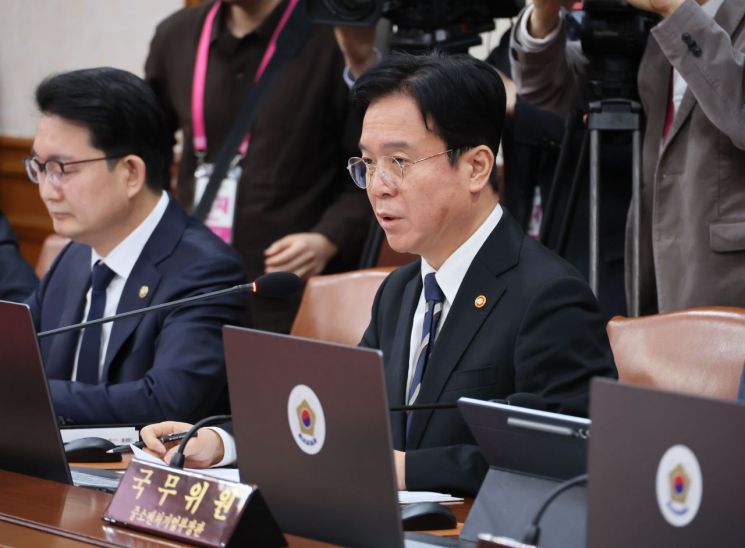 Kim Younghoon, Minister of Employment and Labor, is reporting at the Cabinet meeting held at the Government Seoul Building in Jongno-gu, Seoul on the 3rd. Photo by Yonhap News.
Prior to the enforcement of the law, the government has operated on-site support teams to gather opinions from labor and management organizations, revised enforcement decrees, and prepared interpretation guidelines and negotiation procedure manuals. Minister Kim said, "We have prepared thoroughly so that the intent of the law can be fully realized on the ground," and added, "Based on this, we will establish consistent principles to enhance predictability at the workplace."
However, he also acknowledged, "This is an uncharted path for us," expressing the possibility of confusion in the field. Differences in the interpretation of negotiation procedures and scope could lead to conflicts between labor and management.
Minister Kim noted, "On one hand, there are concerns that the bargaining power of subcontractor unions may be weakened. On the other hand, there are worries that excessive negotiations could increase disputes," emphasizing, "The government will take these concerns into consideration and will not spare support to enhance predictability in the workplace with consistent principles and support, and to help foster trust in labor-management relations."
In particular, the government has clarified its leading role in the public sector. Minister Kim stated, "The public sector is an area where the government must play a substantive role," and pledged, "We will responsibly support stable labor-management relations by carefully identifying the needs at the field level."
The government plans to rapidly disseminate negotiation procedures and interpretation guidelines for principal-subcontractor relationships through dedicated local support teams, and to strengthen on-site guidance so that negotiations proceed smoothly when user status is recognized by the Labor Relations Commission.
Additionally, the government aims to support the implementation of the law by providing expert advisory-based assistance in collective bargaining judgments and developing mutually beneficial bargaining models. The government will take a proactive role by meeting with labor and management regularly to listen to voices from the field, creating best-practice models, and working with relevant ministries to encourage their adoption across the private sector.
Minister Kim emphasized, "As the saying goes, 'There is no standing without trust,' there is no area where the asset of trust is more important than in labor-management relations," and called on both labor and management to prioritize dialogue and negotiation for mutual benefit, rather than fostering mistrust and confrontation.
© The Asia Business Daily(www.asiae.co.kr). All rights reserved.