Limited Amendments to Articles of Incorporation by Four Major Financial Holding Companies Despite Regulatory Pressure
"(The financial company governance reform plan) will have a signaling effect in and of itself, regardless of when it is implemented." (January 28, Lee Eokwon, Chairman of the Financial Services Commission)
"If it is deemed a good thing, there is no reason to delay." (February 12, Lee Chanjin, Governor of the Financial Supervisory Service)
As the regular general shareholders' meetings scheduled for the end of this month approach, the heads of the financial authorities have publicly and repeatedly urged financial holding companies to proactively restructure their governance. However, it has been found that not a single financial holding company has strengthened its CEO reappointment requirements, which is the core demand of the authorities. Since President Lee Jaemyung criticized the financial holding companies as a "corrupt inner circle," the financial authorities have been indirectly pressuring for governance reform, even at the risk of being accused of meddling in private business, but have ultimately fallen short of their goals.
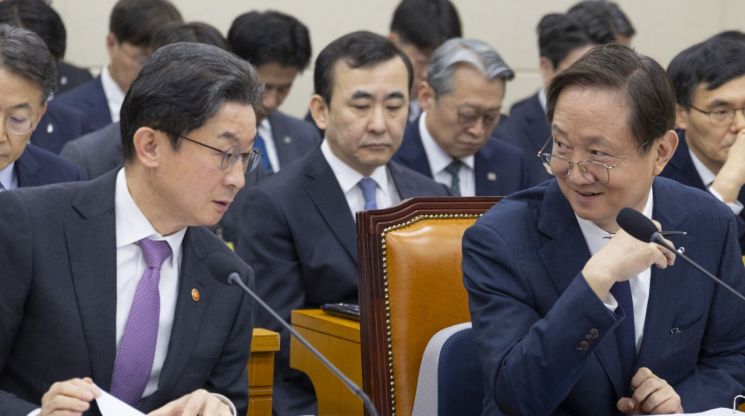 Lee Eokwon, Chairman of the Financial Services Commission (left), and Lee Chanjin, Governor of the Financial Supervisory Service, are seen attending the full meeting of the Political Affairs Committee held at the National Assembly on the 5th of last month and engaging in conversation. Photo by Yonhap News
According to the financial industry on the 4th, as of the previous day, the board meeting schedules of the four major financial holding companies-KB, Hana, Woori, and Shinhan-have all been concluded, with Shinhan Financial Group being the last.
With the general shareholders' meetings at the end of the month approaching, the key point of interest for each board meeting was whether the articles of association would be amended to require a special resolution by the shareholders' meeting for chairman reappointment. However, none of the companies revised their articles of association to include this clause. Only Woori Financial Group partially amended its articles of association to apply a special resolution for the reappointment of a CEO for a third consecutive term.
This falls short of the governance reform plan currently under review by the financial authorities. The authorities are pursuing financial company governance improvement measures focusing on: the introduction of a special shareholders’ resolution for CEO reappointment; and the adoption of single, three-year terms for outside directors. In particular, their plan is to significantly raise the threshold for CEO reappointment by changing it from a general resolution (approval by a majority of attending shareholders) to a special resolution (approval by at least two-thirds of attending shareholders).
Major financial holding companies have also not introduced the plan to change the maximum term of outside directors, which is currently up to six years, to a single three-year term. The scale of director replacements was also more limited than expected. Of the 32 outside directors at the four major financial holding companies, 23 are due to complete their terms this year, but in reality, only six were replaced, with just one or two changes at each company.
This is at odds with the position of the financial authorities, who have maintained that financial companies should voluntarily move forward with governance reform even before the announcement of guidelines or legal amendments. The authorities believe that the chairmen of financial holding companies have assembled boards of directors with individuals favorable to themselves, effectively building a "trench," and have maintained a structure of "self-reappointment" based on this foundation. After President Lee criticized the system by saying, "Leaving finance to administrative control has resulted in the formation of a corrupt inner circle, allowing a small group to rotate control," the financial authorities have moved more swiftly. Nevertheless, in order to avoid controversy over government intervention, the authorities initially intended to release guidelines after the shareholders' meetings, expecting that the financial holding companies would proactively amend their articles of association to reflect the authorities’ plan, but this expectation turned out to be misplaced.
The financial sector is reluctant, stating that it is difficult to be the first to adopt the authorities' plan in the absence of finalized detailed standards. One industry insider commented, "The governance reform guidelines themselves are quite burdensome for financial companies," and added, "It is not easy to implement them preemptively without the detailed standards in place."
Some also argue that it is difficult to declare any single governance model as ideal and question whether it is appropriate to raise governance issues at a time when financial holding companies are recording all-time high performance. Another financial industry insider said, "Global proxy advisory firms may issue opposition recommendations on shareholders’ meeting agendas based on uniform standards that do not sufficiently reflect the unique characteristics of Korea’s financial industry. If minority shareholders join in, management stability could be undermined," adding, "The more stringent the reappointment requirements become, the greater the influence of proxy advisory firms, and this is also a concern."
Meanwhile, as financial holding companies have not voluntarily undertaken preemptive governance reform, the financial authorities are reportedly considering moving up the announcement of governance inspection results and guidelines, which were originally scheduled for after the shareholders' meetings. This is seen as a move to raise the pressure on the financial holding companies. However, given that the shareholders' meetings are imminent, it is unlikely that the holding companies will be able to reflect these changes in this round of meeting agendas, and even if the authorities release guidelines before the meetings, there are concerns that it may be seen as "coming too late."
© The Asia Business Daily(www.asiae.co.kr). All rights reserved.