A Moderate, Pro-American Figure Likely Considered as Next Leader
Contradicts Statement Urging Iranians to Seize Power
Directly Refutes Reports of U.S. Missile Shortages
Stresses Oil Price Increases Will Be Temporary
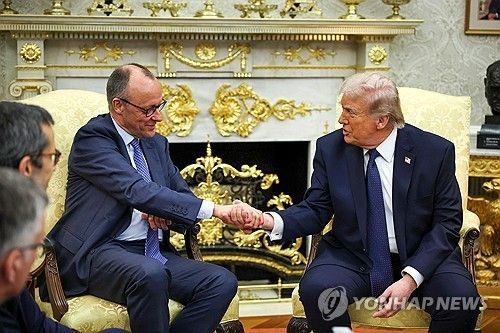
On March 3 (local time), President Donald Trump of the United States stated that the worst-case scenario regarding the power vacuum in Iran's Supreme Leadership would be if someone as bad as the late Khamenei were to seize power. This remark is interpreted as implying that Trump has in mind a successor to Iran's leadership who is cooperative with the United States and more moderate.
During a bilateral meeting with German Chancellor Friedrich Merz at the White House that day, President Trump mentioned military operations against Iran and said, "The worst case is that after we do this, someone as bad as the previous figure takes power."
He continued, "That could happen. We do not want that to happen," adding, "We want someone in power who will set Iran right for the people."
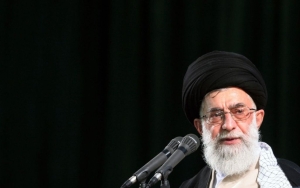
Ayatollah Seyyed Ali Khamenei, Iran's Supreme Leader, died on February 28 due to military operations by the United States and Israel.
President Trump also said, "The Iranian people have been given an opportunity, and we have urged them not to do it just yet. If they want to go out and protest, we have told them not to do it yet," adding, "It is extremely dangerous outside right now, with many bombs being dropped."
When asked whether Reza Pahlavi, the last crown prince of Iran who is currently in exile in the United States, could be an alternative for the next Iranian regime, Trump replied, "I haven't thought deeply about that issue," but added, "I think someone from inside (Iran) might be more suitable, if there is someone currently in Iran who is popular. We also have more moderate figures."
This is interpreted as an expression of expectation for a new leadership that is more moderate and cooperative with the United States, in contrast to the previous leadership that continued anti-government protests crackdowns and an anti-American stance.
Additionally, President Trump mentioned the situation in Venezuela following the operation to arrest President Nicolas Maduro in early January, saying, "Venezuela was truly remarkable in that we attacked and yet the government remained intact," and noted that relations between the United States and Venezuela are in excellent condition.
In the case of Venezuela, after the operation to arrest Maduro, power was transferred to Delcy Rodriguez, who was the vice president. This was a method of changing the leader while minimizing personnel changes in the regime.
President Trump's reference to the Venezuelan model is interpreted as a judgment that, for Iran as well, it would be advantageous for someone within the existing regime who is cooperative with the United States to take power, rather than a sudden or radical change. However, this contradicts President Trump's own statement urging the Iranian people to take control of the government after the end of U.S. military operations.
Along with this, President Trump commented on the ongoing U.S. military operations against Iran, now in their fourth day, saying, "We have militarily subdued them," and claimed that the United States is maintaining its advantage.
President Trump stated that Iran's navy and air force have been neutralized and that Iran's missile stockpiles are rapidly decreasing. This counters a report by the Wall Street Journal the previous day, which said, "The United States is currently facing shortages of Patriot and THAAD (Terminal High Altitude Area Defense) missile ammunition."
President Trump further stated, "We were negotiating with these madmen, but I thought they would strike first. They were about to attack. If we hadn't acted, they would have attacked first."
This is a claim that, even as Iran continued nuclear negotiations with the United States, it was contemplating a preemptive strike against America, and it is interpreted as an attempt to justify the U.S. and Israeli military operation against Iran on February 28.
This remark is seen as a response to the domestic debate in the United States over the reality of the "imminent threat" from Iran that Trump cited as the justification for the attack on Iran.
President Trump also said, "Perhaps I might have forced Israel's hand. But Israel was ready, and so were we."
This was a rebuttal to the popular analysis that the military operation resulted from the persistent persuasion of President Trump by Israeli Prime Minister Benjamin Netanyahu. It appears to be an attempt to emphasize that the United States, not Israel, made the decisive decision and led the operation.
Regarding concerns that the military conflict between the United States, Israel, and Iran would impact international oil prices, President Trump said, "Oil prices may be a little high for a while, but I believe that as soon as this is over, oil prices will go down, and may even be lower than before."
© The Asia Business Daily(www.asiae.co.kr). All rights reserved.