Highest Among All City-Level Local Governments
2,848 Prime Working-Age Individuals Added Over Four Years
As the nation continues to experience a natural population decline due to low birth rates and an aging population, Gwangyang City is drawing attention by demonstrating clear indicators of demographic vitality, such as a rising total fertility rate and a shift to natural population growth.
■ Total fertility rate far exceeds the national average...Highest among city-level local governments
According to the "2025 Birth and Death Statistics (Provisional)" released by the National Data Office on February 26, the total fertility rate in Gwangyang City for 2025 was recorded at 1.32. This figure significantly surpasses not only the national average of 0.8 but also Jeonnam's 1.1, making it the highest among all city-level basic local governments in Korea.
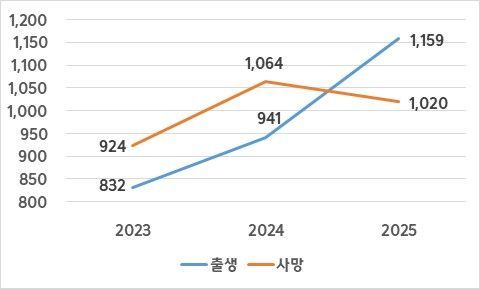
Natural population growth was also observed in the structure of births and deaths. Last year, Gwangyang City recorded 1,159 births and 1,020 deaths, resulting in a natural increase of 139 people. This trend is in contrast to the ongoing natural decline seen in most regions nationwide.
This outcome is attributed not only to a positive shift in social perceptions regarding marriage and childbirth but also to Gwangyang City's years of policy efforts to create a "child-friendly environment." The recent statistics numerically demonstrate the changes in these population indicators.
■ A city where young people come and settle...Population vitality centered on employment
Alongside policies supporting pregnancy and childbirth, Gwangyang City identifies the influx and settlement of young people as a key foundation supporting the birth rate. The city has pointed to the availability of quality jobs as one of the most significant factors enabling young generations to settle, and has focused on implementing related policies.
As a result, the population in the prime working age group (27-34 years old) has grown over the past four years, strengthening the foundation for demographic vitality.
■ Housing stability as a foundation for childbirth...Support for housing loan interest for 1,417 households
Housing stability for young people is also analyzed as a major factor driving the birth rate. To reduce the housing cost burden for the younger generation, Gwangyang City has implemented a program supporting interest on housing loans (for purchase or rental) since 2018, and has supported the diverse housing needs of young people through the supply of new multi-family housing, among other initiatives.
The city plans to continuously strengthen related policies so that the combination of employment and housing stabilizes the lives of young people, creating a structure that leads to marriage and childbirth.
An official from Gwangyang City stated, "Even as the nation faces severe challenges of low birth rates and an aging population, Gwangyang City's efforts to create a child-friendly environment are coming to fruition. We will continue to strengthen comprehensive policies on childcare, education, housing, and employment to sustain demographic vitality."
Meanwhile, the population of Gwangyang City at the end of 2025 is projected to reach 155,259, making it the only region in Gwangju and Jeonnam to record four consecutive years of population growth.
© The Asia Business Daily(www.asiae.co.kr). All rights reserved.