Major Iranian Media Outlets Inaccessible Due to DDoS Attacks
Rapid Increase in Iranian Cyberattacks Targeting Israel’s Defense Systems
The United States and Iran have simultaneously launched large-scale cyber warfare operations. As the reality of a "cyber war" unfolds, concerns are being raised that South Korea, a key U.S. ally, is no longer in a safe zone.
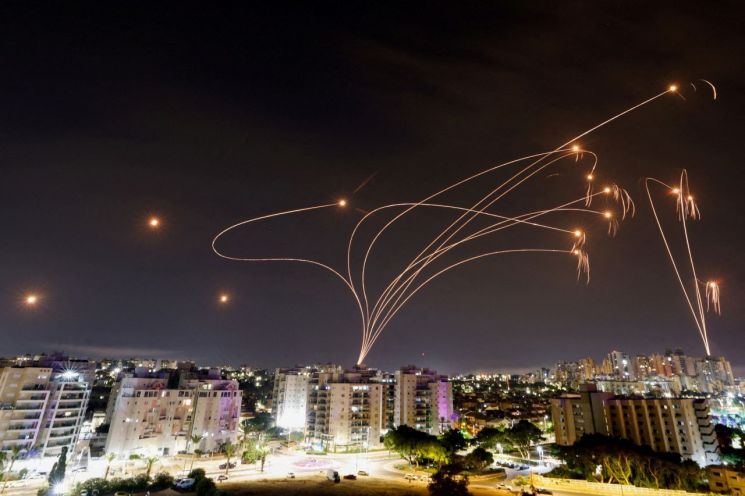 The Iron Dome air defense system in Ashkelon, Israel, is intercepting rockets fired from the Gaza Strip. Yonhap News Agency
According to foreign media reports on March 3, immediately after the United States and Israel carried out large-scale airstrikes on Iran, they also launched concurrent cyberattacks. Major media outlets linked to the Islamic Revolutionary Guard Corps, such as Fars News Agency, Tasnim News, and INA, experienced temporary access disruptions. The internet monitoring group NetBlocks stated that "Iran's national internet connectivity dropped to about 4%," indicating a near-total digital paralysis across the country.
Key government agencies and media websites were reportedly rendered inaccessible due to DDoS attacks. Some international media outlets described this operation as a hybrid warfare campaign that combined physical airstrikes with large-scale cyberattacks.
The reason the United States and Israel are conducting cyberattacks in parallel is that they can paralyze the administrative and economic functions of the target nation without deploying troops. It is difficult to identify the perpetrators of the attack. The political burden is relatively low. The cost-effectiveness is high. Essential social infrastructure-such as power, finance, telecommunications, transportation, and media-relies on networks. Even before Russia invaded Ukraine in 2022, massive hacking attacks targeting government agencies and communications networks occurred first. The 2010 Stuxnet attack against Iran’s nuclear facilities demonstrated that industrial equipment could be disabled without bombing.
Iran’s retaliatory cyber operations have also been formidable. They targeted Israeli air defense weapons systems. The Islamic Revolutionary Guard Corps claimed on X, "We used a new attack method that caused Israel's (air defense) systems to target each other," and added, "Despite Israel's latest defense technology, we succeeded in hitting ground targets with missiles as much as possible." This suggests that Iran employed tactics to disrupt Israel’s air defense infrastructure.
Some have raised the theory that the reason Israel’s multi-layered air defense system could not fully intercept Iran’s missiles is due to the so-called "Iron Dome hacking theory." Iran previously claimed during Israel's "Operation Standing Lion" in June 2023 that it used hypersonic missiles against Israel. In reality, there were incidents where Israel’s Iron Dome air defense system was partially penetrated.
At the time, Iran did not disclose the exact name or specifications of the missile but is believed to have used the "Fattah-1," which was successfully test-fired in 2023. This missile has a range of 1,400 kilometers and a flight speed of Mach 15 (Mach 1 equals the speed of sound). Hypersonic missiles maneuver in and out of the atmosphere and can freely alter their trajectory during the strike phase, making interception extremely difficult.
Iran also appears to be conducting disinformation operations targeting Israeli civilians. IRNA reported that, the previous day, text messages were sent to Israeli citizens in the name of the Israeli military, falsely instructing them to "take shelter in air raid shelters." This is believed to be part of Iran’s cyberattack campaign. Israeli civilians have also recently received false text messages stating that "fuel supplies will be suspended for 24 hours starting at midnight tonight."
© The Asia Business Daily(www.asiae.co.kr). All rights reserved.