The government will activate a pan-government, all-out response system for one month to preemptively respond to high concentrations of ultra-fine dust in spring.
The Ministry of Climate, Energy and Environment announced on the 25th that from March 1 to 31 it will strengthen reduction measures across workplaces, construction sites, and everyday living spaces in cooperation with relevant ministries.
The new measures will be implemented in four key directions: intensive management of major pollution sources, expanded emission reductions in the public sector, protection of public health in everyday living spaces, and enhanced information provision and public awareness. The government explained that although the average concentration of fine dust in winter and spring has fallen by about 40%, from 33 ㎍/㎥ (micrograms per cubic meter) in the early phase of the seasonal fine dust management system to 20 ㎍/㎥, additional action is needed because March is the month with the highest annual concentration and the largest number of days classified as "bad."
First, the government will conduct special joint inspections by the public and private sectors on workplaces with a risk of illegal emissions, using drones and mobile monitoring vehicles, and will expand AI and big-data-based smart monitoring nationwide. It will also strengthen crackdowns on exhaust emissions and idling from vehicles, and increase intensive collection of agricultural waste to three times a week to prevent illegal open burning.
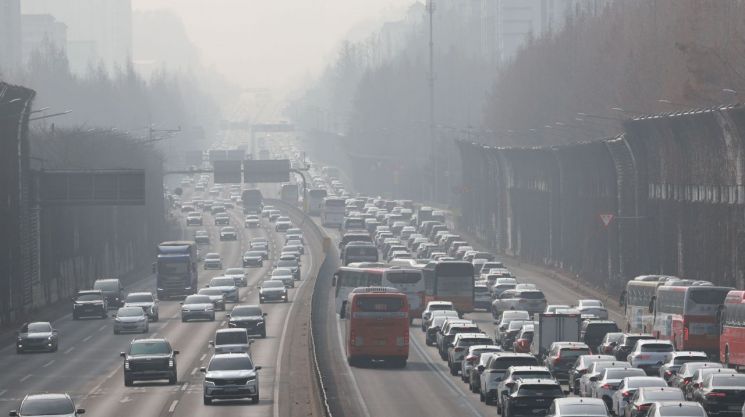 On the second day of the Lunar New Year holiday, the 15th, the area near the Seoul Jamwon Interchange on the Gyeongbu Expressway was crowded with southbound vehicles (right-hand side) leaving Seoul. Yonhap News
The public sector will take the lead in reducing emissions. The number of public coal-fired power units to be suspended will be increased from 17 in winter to 29 in spring, and the response level of emergency reduction measures will be raised when high concentrations occur. The applicable regions will also be expanded from the current 3 metropolitan and provincial governments to 7.
Measures to protect public health will also be strengthened. The government will inspect the status of air quality management at facilities used by vulnerable groups, such as daycare centers and schools, and conduct special inspections of ventilation and air purification systems at multi-use facilities such as underground stations and airport terminals. On-site inspections will be carried out to protect outdoor workers, and flexible working arrangements will be recommended if high concentrations persist.
Minister of Climate, Energy and Environment Kim Sunghwan said, "Clean air is a basic right for all citizens," adding, "We will work closely with relevant ministries to ensure there are no gaps in our response to fine dust in spring."
© The Asia Business Daily(www.asiae.co.kr). All rights reserved.
![Clutching a Stolen Dior Bag, Saying "I Hate Being Poor but Real"... The Grotesque Con of a "Human Knockoff" [Slate]](https://cwcontent.asiae.co.kr/asiaresize/183/2026021902243444107_1771435474.jpg)















