Lisa Cook Points to the Limits of Demand-Focused Monetary Policy
AI-Driven Productivity Gains Could Push Unemployment Higher
Economy May Stay Robust Even as Jobless Rate Rises
Hard to Cut Rates Based Solely on Labor Market Data
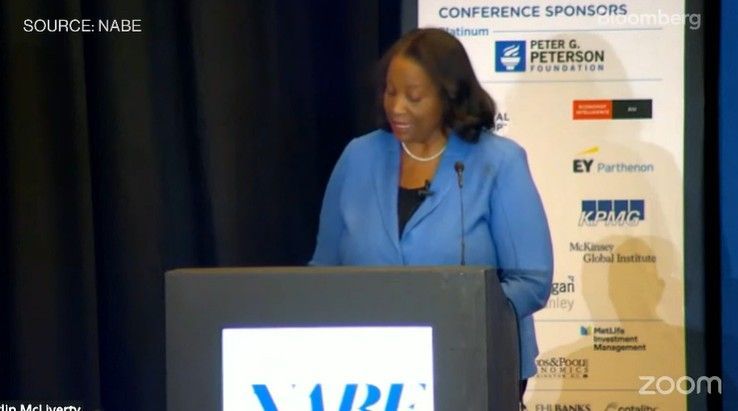
Federal Reserve Governor Lisa Cook pointed out that the adoption of artificial intelligence (AI) could create a monetary-policy trap in which the Fed is unable to cut interest rates even if the unemployment rate rises. She explained that if productivity increases due to AI, the economy could remain solid even as unemployment goes up, which would expose the limits of conventional demand-side monetary policy.
According to Bloomberg on the 24th (local time), Cook said in a speech at the National Association for Business Economics (NABE) annual meeting held in Washington, D.C., that "if AI continues to boost productivity, economic growth could remain strong even if the unemployment rate rises due to changes in the labor market."
Cook noted, "In such periods of productivity booms, a higher unemployment rate may not necessarily mean an increase in economic slack," adding, "It may be difficult, with standard demand-side monetary policy, to ease AI-induced unemployment spells without fueling inflationary pressures."
Typically, when the unemployment rate rises, people’s incomes decline and overall demand falls. In such cases, central banks have responded by cutting policy rates to stimulate demand and support employment. However, if productivity improves because of AI, unemployment may increase while overall economic conditions remain strong, meaning that cutting interest rates in that environment could be akin to pouring oil on the fire and might further intensify inflation.
Cook went on to say, "As investment contributes to robust aggregate demand, the current neutral rate of interest may be higher than it was before the Covid-19 pandemic." Under the same conditions, if the neutral rate rises, the current policy rate becomes relatively more accommodative, implying that additional tightening could be required.
However, she also said that if AI adoption deepens economic polarization, the neutral rate could decline over the longer term. Cook explained, "This could reverse if the productivity gains from AI are fully realized, or if the transition in the labor market leads to greater income inequality and a larger share of income accruing to wealthier consumers," adding, "All else equal, that could lower the neutral rate of interest."
The Fed kept its policy rate unchanged at its January 2026 meeting, following three consecutive rate cuts that concluded in 2025, while citing signs of stabilization in the labor market. According to the futures market, investors currently do not expect any additional rate cuts at least until the middle of this year.
Cook did not comment on the near-term outlook for monetary policy, but she pointed to employment data released after the January FOMC meeting and expressed the view that conditions are stabilizing.
Cook said, "In recent years, the unemployment rate among recent college graduates has risen as some employers have begun deploying AI to perform tasks that used to be carried out by entry-level workers," adding, "Nonetheless, the overall unemployment rate remains low at 4.3%, and recent layoff figures are still subdued."
Cook projected that it could take five to ten years for the impact of AI to show up clearly in economy-wide productivity statistics. She added that the Fed is already incorporating AI into its forecasting models, citing its potential effects on the neutral rate and the impact of data center investment on economic growth.
© The Asia Business Daily(www.asiae.co.kr). All rights reserved.
![Clutching a Stolen Dior Bag, Saying "I Hate Being Poor but Real"... The Grotesque Con of a "Human Knockoff" [Slate]](https://cwcontent.asiae.co.kr/asiaresize/183/2026021902243444107_1771435474.jpg)















