Researchers from Tohoku University and Hokkaido University announce findings
"Possibility of an ultra-large earthquake after 400 years"
A study has found that there is a possibility that an ultra-large earthquake and tsunami similar to those of the 17th century could recur off the Pacific coast of Hokkaido, Japan. Based on observations of crustal deformation on the seafloor, the researchers analyzed that an amount of energy comparable to that of past giant earthquakes has already accumulated.
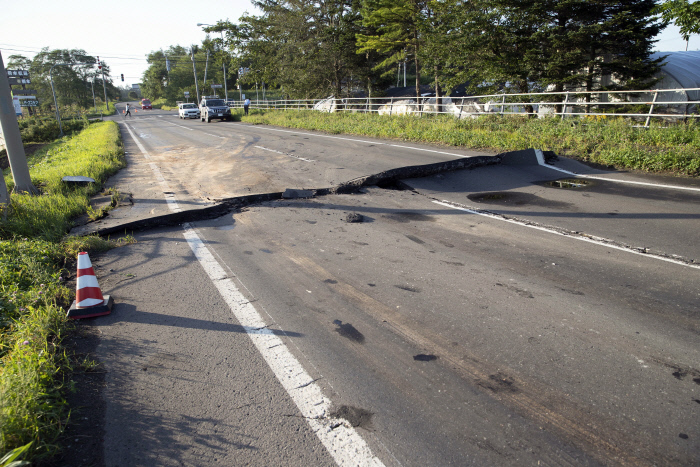 A road is split in Abira, Hokkaido, Japan, where a magnitude-6.7 earthquake struck on September 6, 2018. EPA/Yonhap News
According to the Mainichi Shimbun on the 23rd, a joint research team from Tohoku University, Hokkaido University, and the Japan Agency for Marine-Earth Science and Technology (JAMSTEC) published these findings recently in the international journal "Communications Earth & Environment".
The researchers identified the Kuril Trench (Chishima Trench) area east of Hokkaido as a strong candidate region for the next giant earthquake. The Kuril Trench is a zone where the Pacific Plate rapidly subducts beneath the Okhotsk Plate, and historically it has repeatedly generated magnitude 8 to 9 class major earthquakes and large tsunamis.
Energy buildup similar to a magnitude 8.8 earthquake in the 17th century
The Tohoku University team estimated that ultra-large earthquakes have repeatedly occurred off the Pacific coast of Hokkaido in roughly 400-year cycles. The last major earthquake is believed to have been a magnitude 8.8 class event that occurred between 1611 and 1637, and the resulting tsunami is reported to have flooded areas extending up to 1 to 4 kilometers inland from the coast.
From 2019 to 2024, the researchers installed three observation devices on the seafloor in the Nemuro offshore area to precisely measure crustal deformation. The measurements showed that both the Pacific Plate and the landward plate near the trench are moving approximately 8 centimeters per year toward the west-northwest.
If this deformation has continued to accumulate since the 17th century, the total displacement of the Pacific Plate is estimated to reach 20.5 to 30 meters. Given that the plate boundary is thought to have shifted by about 25 meters during the giant earthquake in the 17th century, the researchers suggest that stress sufficient to trigger an earthquake of comparable magnitude may already have accumulated.
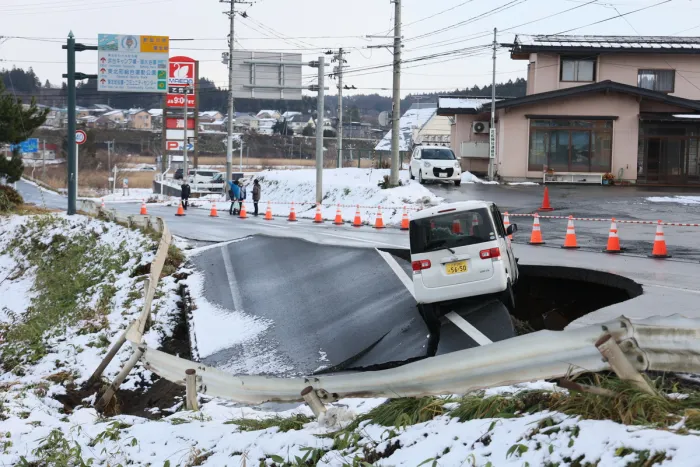 On December 9 last year in Aomori Prefecture, Japan, a vehicle lies in a roadway that had subsided due to an earthquake. EPA/Yonhap News
Similar to the 'seismic gap' before the Great East Japan Earthquake
The Mainichi Shimbun pointed out that, prior to the 2011 Great East Japan Earthquake, there was also a "seismic gap" off Miyagi Prefecture near the Japan Trench where no major earthquakes had occurred. The magnitude 9.0 earthquake at that time caused a massive tsunami as the fault slipped on a large scale. The area targeted in the latest study is likewise a segment where no large ruptures have occurred for a long period, and analysts warn that if the fault fails all at once in the future, a large-scale tsunami could follow.
Fumiaki Tomita, an associate professor at Tohoku University, told the Mainichi, "Along the Hokkaido coast, we expect a very large tsunami of up to about 20 meters," and urged, "I hope people will go about their lives with an awareness of the risk that a giant earthquake will inevitably occur in the future."
Japanese government raises probability of major Nemuro offshore quake to 90%
The Japanese government’s Earthquake Research Committee recently revised upward the probability that a magnitude 7.8 to 8.5 class major earthquake will occur within the next 30 years off the eastern coast of Hokkaido near Nemuro, from the previous "around 80%" to "around 90%." This reflects the fact that large earthquakes in that sea area have occurred at average intervals of about 65 years, and that more than 50 years have already passed since the last major event. Off Aomori Prefecture, which faces Hokkaido, a magnitude 7.5 earthquake also struck in December last year, indicating that seismic activity continues in the offshore region of northeastern Japan.
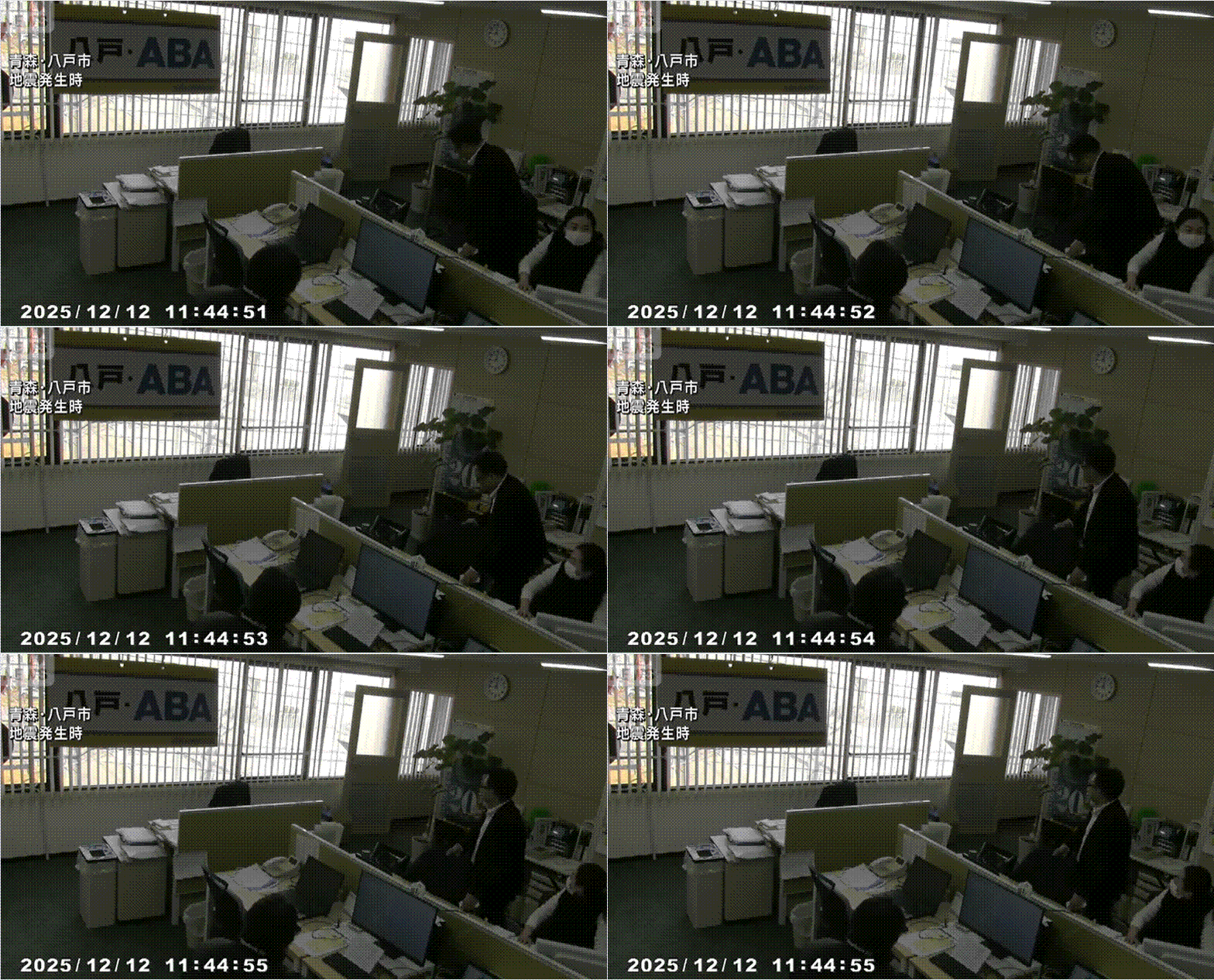 The interior of a building in Hachinohe, Aomori Prefecture, is shaking due to an earthquake that occurred off the coast of Aomori Prefecture on December 12 of last year. QAB
The previously published outlook for the probability that a Nankai Trough megathrust earthquake will occur within the next 30 years, in the offshore area stretching from off Shizuoka Prefecture west of the Tokyo metropolitan area to southern Shikoku and eastern Kyushu, remains unchanged at "60% to over 90%" or "20% to 50%," depending on the segment. Historically, magnitude 8 to 9 class earthquakes have repeatedly occurred along the Nankai Trough at intervals of 100 to 200 years. Experts noted that both the Kuril Trench and the Nankai Trough are zones of long-term stress accumulation, and emphasized the need for disaster-prevention measures and strengthened early warning systems that take their structural characteristics into account.
© The Asia Business Daily(www.asiae.co.kr). All rights reserved.
![Clutching a Stolen Dior Bag, Saying "I Hate Being Poor but Real"... The Grotesque Con of a "Human Knockoff" [Slate]](https://cwcontent.asiae.co.kr/asiaresize/183/2026021902243444107_1771435474.jpg)

















