Lower flour, sugar, and starch sugar prices
Cost reduction factors of 1% to 5% for processed foods
Over 80% of sales going to costs
Heavier burden on low-margin companies

As flour, sugar, and starch sugar prices have been successively lowered following the government's collusion investigation, attention is focusing on whether processed food prices will also come down. With even search-and-seizure operations recently carried out on starch sugar manufacturers, there is now clear downward pressure in the raw materials market. The government is signaling that the cuts in raw material unit prices should be reflected in consumer prices. However, as prices of secondary raw materials such as palm oil continue to rise, analysts view the room for lowering processed food prices as limited.
According to the food industry on the 25th, instant noodle manufacturers such as Nongshim, Ottogi, and Samyang Foods, beverage companies such as Lotte Chilsung Beverage, and confectionery companies such as Orion and Lotte Wellfood use flour, sugar, and starch sugar as core raw materials. Recently, CJ CheilJedang, Daehan Flour Mills, and Sajo DongA One lowered flour and sugar prices by 4% to 6%, and Daesang, CJ CheilJedang, and Sajo CPK also cut starch sugar prices by 3% to 5%. As price reductions on the supply side materialize, the processed food industry now stands at a crossroads.
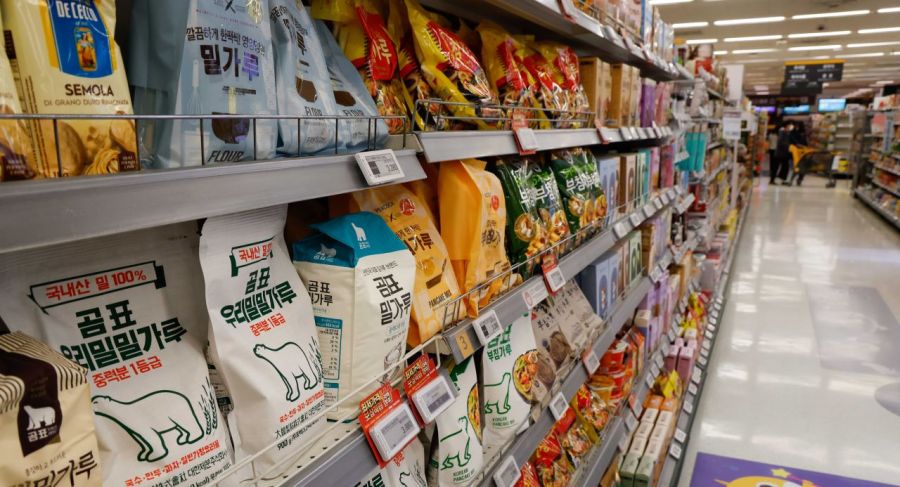
Wheat, sugar, and starch sugar price cuts...Factors for reducing product costs
For instant noodle manufacturers such as Nongshim, Ottogi, and Samyang Foods, wheat flour and palm oil are the main raw materials. Nongshim's cost-of-sales ratio is about 71%, meaning 7 won out of every 10 won in sales is spent on manufacturing costs. Among this, raw materials such as wheat flour and palm oil account for 59.1% of total raw material purchases. A simple calculation suggests that if wheat prices fall by 10%, this generates a cost-saving factor of around 4% to 5% in product manufacturing costs.
International wheat prices have also been on a downward trend over the past one to two years. The average unit price per ton of wheat futures on the Chicago Board of Trade (CBOT) fell from 236 dollars in 2023 to 192 dollars in the third quarter of last year. According to the Food and Agriculture Organization of the United Nations (FAO), last month the grain price index stood at 107.5 points, down 3.9% from the same period a year earlier. This underpins the analysis that falling flour prices can to some extent help ease cost burdens.
However, rising palm oil prices remain a variable. The average unit price per ton of palm oil futures on the Kuala Lumpur exchange in Malaysia rose 20.9%, from 876 dollars in 2023 to 1,059 dollars in the third quarter of last year. The recent trend is also upward. Last month the vegetable oil price index was 168.6, up 10.2% year-on-year. In particular, palm oil prices have risen for two consecutive months as global import demand has remained strong.
The situation is similar in the bakery industry. SPC Samlip's cost-of-sales ratio is about 85%, meaning most of its sales are consumed by manufacturing costs. Looking at the share of major raw materials, wheat (flour) accounts for 39.5%, eggs 17.2%, fats and oils 3.1%, and sugars 2.2%. The structure is such that a drop in flour prices can directly translate into a certain level of cost savings. However, rising egg and pork prices are a burden. According to the Korea Institute for Animal Products Quality Evaluation, as of the 24th, the wholesale price of eggs (large, 30-count) was 5,421 won, up 12.3% from 4,829 won a year earlier. Pork (neck, per kilogram) prices also rose 6% to 14,386 won.
The confectionery and beverage industries are highly dependent on sugars such as sugar and starch sugar. Starch sugar refers to sweeteners such as starch syrup and glucose produced by processing corn starch. Lotte Chilsung Beverage's cost-of-sales ratio is around 66%. In the cost structure of its beverage division, raw materials account for 49.5% and packaging materials for 50.5%. Among raw materials, sugars and additives make up 18% of the total. If sugar unit prices fall by 5%, this structure generates a cost-saving factor of around 1% in total manufacturing costs. However, the average unit price of beverage containers rose from 103.7 won in 2023 to 115.1 won this year.
Lotte Wellfood and Orion have cost-of-sales ratios of 72% and 63%, respectively. For snacks, sugars such as sugar and starch sugar and fats and oils are the main cost items. It is estimated that if sugar unit prices fall by around 5%, product manufacturing costs see a cost-saving effect of about 1% to 2%. However, fluctuations in prices of fats and oils and cocoa are additional variables.
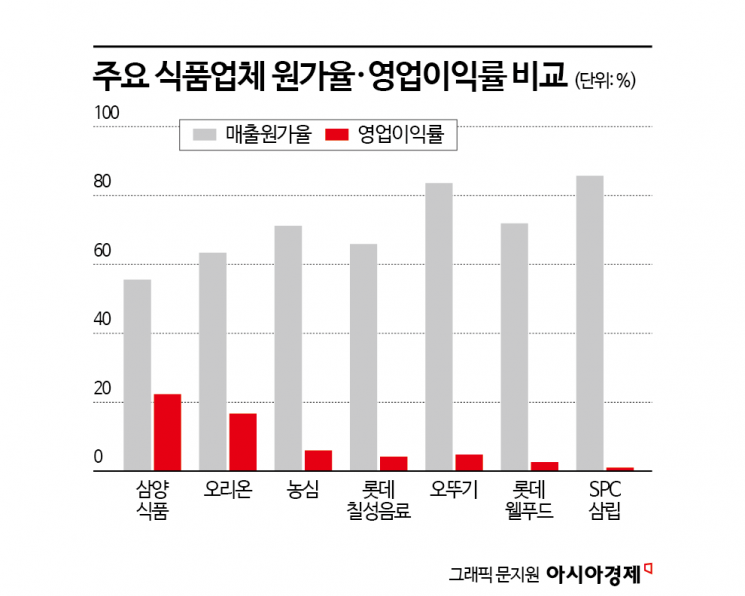
Gap in operating margins makes price adjustments burdensome
Looking only at raw material unit prices, it is true that some product categories now have room for price adjustments. The issue is the companies' profit structures. In terms of last year's operating margin, Samyang Foods and Orion posted double-digit profitability at 22.3% and 16.7%, respectively. In contrast, Lotte Wellfood at 2.6%, SPC Samlip at 1%, Lotte Chilsung Beverage at 4.2%, Ottogi at 4.8%, and Nongshim at 6% (based on the third quarter) remained in the single digits.
Companies with a high share of overseas sales have relatively greater capacity to absorb cost fluctuations, backed by exchange rate effects and improved profitability. In contrast, domestically focused companies face significant burdens in cutting prices solely on the back of partial declines in raw material costs. For companies where more than 80% of sales are consumed by costs and operating margins remain at only 1% to 5%, they must also factor in rising labor, logistics, and energy costs.
Observers point out that the current phase of raw material price cuts is not simply about adjusting prices, but about "who has the capacity to endure." A food industry official said, "It is true that some raw material unit prices have fallen, but the burden of rising labor, logistics, and energy costs remains," adding, "Depending on each company's profit structure, the scale and timing of price adjustments will inevitably differ."
© The Asia Business Daily(www.asiae.co.kr). All rights reserved.
![Clutching a Stolen Dior Bag, Saying "I Hate Being Poor but Real"... The Grotesque Con of a "Human Knockoff" [Slate]](https://cwcontent.asiae.co.kr/asiaresize/183/2026021902243444107_1771435474.jpg)

















