Securities and Futures Commission to Table Hong Kong ELS Fine Agenda on the 25th
FSS Cuts Fines from 2 Trillion Won to 1.4 Trillion Won...Further Reductions Possible
Will Banks' Voluntary Compensation Efforts and the Push for Productive and Inclusiv
The size of the fines to be imposed on banks in connection with the misselling of Hong Kong H-Share Index (Hang Seng China Enterprises Index, HSCEI) equity-linked securities (ELS) will be effectively finalized on the 25th. With the Financial Supervisory Service having lowered the fines from the original 2 trillion won to around 1.4 trillion won at its Sanctions Review Committee, attention is focused on whether the Financial Services Commission will move to reduce them further.
According to the Financial Services Commission on the 25th, the Securities and Futures Commission is scheduled to table and review the agenda item on sanctions related to the misselling of Hong Kong H-Share Index ELS by banks at its meeting that afternoon. As agenda items that pass the Securities and Futures Commission are normally finalized at the regular meeting of the Financial Services Commission, the outcome of this review is expected to represent the de facto final decision by the financial authorities. The final resolution is expected to be made as early as the regular meeting of the Financial Services Commission on March 4.
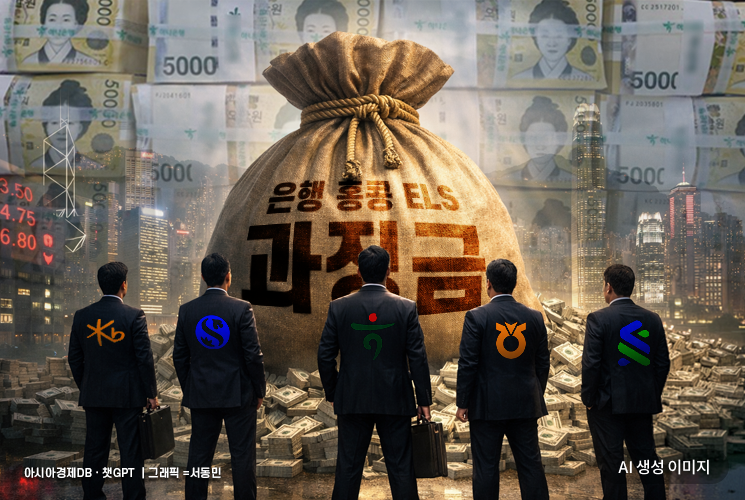
Commercial banks are pinning their hopes on the possibility that the fines will be further reduced during the Securities and Futures Commission’s review. In November last year, the Financial Supervisory Service gave prior notice of fines totaling 2 trillion won to five banks: KB Kookmin Bank, Shinhan Bank, Hana Bank, NH Nonghyup Bank, and Standard Chartered Bank Korea. Subsequently, at the third sanctions review held on the 12th of this month, the amount was reduced to around 1.4 trillion won in consideration of the banks’ active efforts to remedy the situation after the fact.
The banks maintain that even the reduced fines set by the Financial Supervisory Service are still excessive. In practice, KB Kookmin Bank set aside 260 billion won in provisions in anticipation of fines related to Hong Kong H-Share Index ELS, but the fine ultimately imposed by the Financial Supervisory Service amounts to about 800 billion won. Shinhan Bank and Hana Bank also booked 150 billion won and 90 billion won, respectively, as related provisions, yet the fines imposed on them are around 230 billion won and 240 billion won, respectively, exceeding those amounts.
The financial sector is paying close attention to a decision made by the Securities and Futures Commission in December last year. At that time, the proposed administrative fine sanctions submitted by the Financial Supervisory Service were significantly eased during the Securities and Futures Commission’s review. The Securities and Futures Commission adjusted the Financial Supervisory Service’s original plan, markedly reducing the level of administrative fines, with the result that the fine for KB Kookmin Bank was cut to about one-fifth of the initial proposal, and the fines for Shinhan Bank and Hana Bank were each reduced to roughly half. Since the first round of sanctions serves as a preliminary step leading to the second round of sanctions, which are directly linked to fines, some analysts believe there is room once again for the Securities and Futures Commission to adjust the fines.
The fact that recent cases in which the Securities and Futures Commission has increased fines relative to the Financial Supervisory Service’s sanctions review outcomes are rare, while there have been numerous precedents of reductions, also lends weight to the possibility of additional fine cuts. The Financial Supervisory Service faces certain regulatory limits on the extent to which it can reduce fines, but the Financial Services Commission has the authority of discretionary reduction, which allows it to lower fines within its discretion without separate restrictions.
The key issue is how much weight the Securities and Futures Commission will give to the banks’ voluntary post-incident compensation efforts. Under the Financial Supervisory Service’s dispute mediation plan, banks have already completed voluntary compensation totaling 1.3 trillion won for more than 90% of all victims. According to the revised Financial Consumer Protection Act, which took effect in November last year, if post-incident recovery efforts are recognized, fines can in principle be reduced by up to 50%, and if additional conditions such as preventive efforts are met, the reduction can be as much as 75%.
In addition, there is speculation that the Securities and Futures Commission’s decision on reductions could be influenced by the fact that the financial authorities are pushing policy initiatives to expand both "productive finance" and "inclusive finance," and that the banking sector is supporting these efforts with large-scale capital commitments.
A financial industry official said, "Given that the banks have already carried out voluntary compensation on a considerable scale, we expect this to be taken into account," adding, "Since the Financial Supervisory Service has imposed both fines and administrative penalties, we believe there is still room for additional reductions."
© The Asia Business Daily(www.asiae.co.kr). All rights reserved.
![Clutching a Stolen Dior Bag, Saying "I Hate Being Poor but Real"... The Grotesque Con of a "Human Knockoff" [Slate]](https://cwcontent.asiae.co.kr/asiaresize/183/2026021902243444107_1771435474.jpg)
















