60th-anniversary roundtable
Expanding K-discourse and strengthening IP business as a publishing content strategy
Having endured censorship and forced closure under the military regime, as well as the cancellation of its publishing license, the magazine has made its way back through revival and democratization. And in 2026, the quarterly magazine Changjakgwa Bipyeong (Creation & Criticism) marks the 60th anniversary of its first issue.
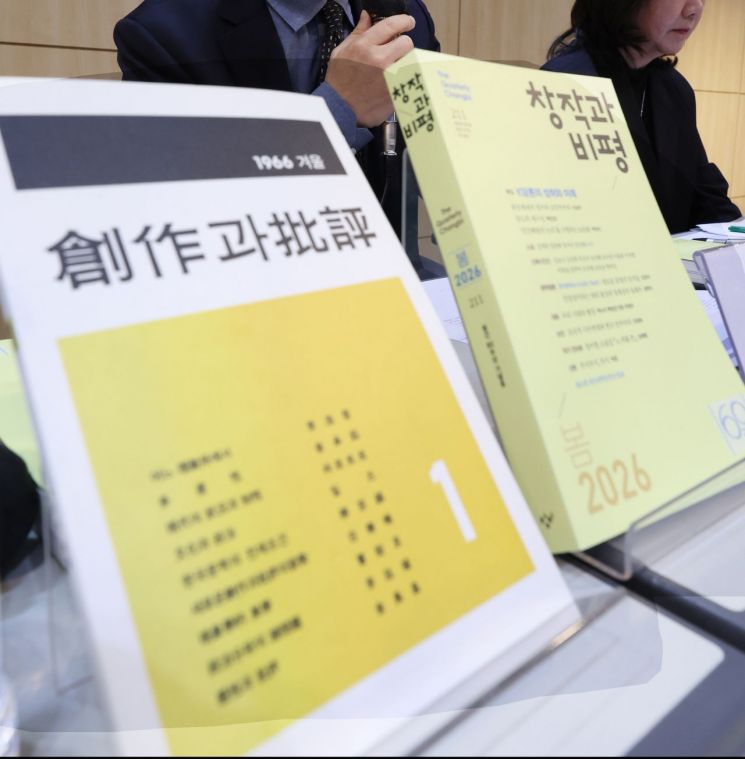 Press conference commemorating Changbi's 60th anniversary held on the 24th at the 50th Anniversary Hall of the Changbi Seogyo Building in Mapo-gu, Seoul. Yonhap News
The press conference held on the morning of the 24th at the 50th Anniversary Hall of the Changbi Seogyo Building in Seogyo-dong, Seoul, became a place where questions came before commemoration. The questions were how a literary magazine managed not to disappear, and with what it will endure the time ahead.
In attendance at the event were Lee Namju, Editor-in-Chief of Changjakgwa Bipyeong (Creation & Criticism); Hwang Jeonga and Paek Jiyeon, editorial deputy chiefs; and Yeom Jongsun, CEO of Changbi. The remarks from the podium were closer to explanations than congratulations, and they leaned more toward setting out standards than simply looking back.
Accumulation of generations, enduring through structure
Asked about the driving force that has sustained the magazine for 60 years, CEO Yeom first pointed to structure rather than individuals. Editorial board members, working-level editors, and staff in sales and production have been succeeded generation by generation, and this accumulated organizational strength, he explained, has been the condition for long-term continuity. Although people have changed, the approach of not separating editing from publishing has been maintained.
Honorary editor Baek Nakcheong was mentioned as the symbol of this structure. He is no longer involved in official day-to-day operations. However, CEO Yeom explained that he continues his relationship with the magazine by attending the review meetings held after each issue is published, sharing his views there, and having the editorial team consider and reflect them as appropriate.
Yeom went on to define the basic attitude of Changjakgwa Bipyeong (Creation & Criticism) as "a way of adapting to the times while breathing with them, and at the same time overcoming them." He explained that the magazine has consistently been driven by this dual task: not turning away from reality, yet not remaining confined within it.
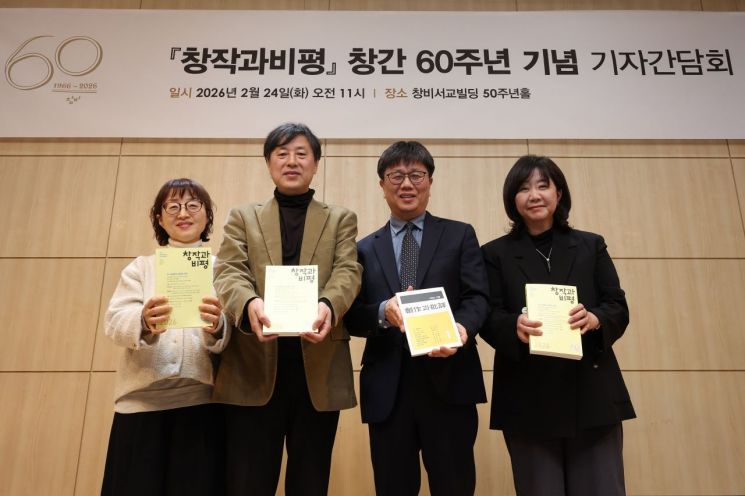 Participants pose at the Changbi 60th anniversary press conference held on the 24th at the 50th Anniversary Hall of the Changbi Seogyo Building in Mapo-gu, Seoul. From left: Hwang Jeonga, senior editor; Lee Namju, editor; Yeom Jongseon, CEO of Changbi; Paek Jiyeon, senior editor. Photo by Yonhap News
A literary magazine and an opinion journal... From K-discourse in literature to K-thought
Regarding the choice to pursue both a literary magazine and an opinion journal at the same time, Editor-in-Chief Lee said, "It has not been an easy path." Placing literature and social criticism side by side in the same pages has always involved tension, and managing that tension has been the core task of editing, he explained.
He cited "a scholar’s sense of critical questioning and a practical sense of reality" as key editorial criteria. He said that the very attempt to combine these two stances - neither remaining in the realm of ideals nor settling for reality - constitutes the critical perspective of Changjakgwa Bipyeong (Creation & Criticism). He added that the power behind its orientation toward serious public discourse has come from literature, and that literature has functioned as a source of creative thought.
This editorial direction carries over into the magazine’s 60th-anniversary projects. Since 2024, Changjakgwa Bipyeong (Creation & Criticism) has been running a series titled "In Search of K-Discourse," which it will continue in its Spring 2026 issue. The project aims to organize Korean democracy, centrist thought, and the experiences of modern Korean history as resources for global intellectual discourse.
At the same time, the magazine will launch a new series titled "The Possibilities of Korean Literature and K-Thought." Starting from figures such as Yeom Sangseop and Na Hye-sok, the project seeks to reread Korean literature as a resource for civilizational critique and reflection. In the fall, the magazine plans to hold a "K-Thought Symposium" to share the achievements of completing the 30-volume series "Selections of Korean Thought."
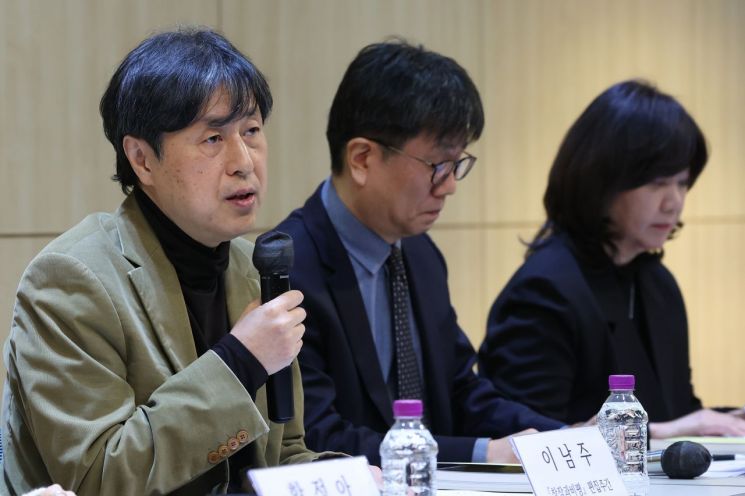 Lee Namju, editor-in-chief of Creation and Criticism, is answering questions at a press conference commemorating Changbi's 60th anniversary held on the 24th at the 50th Anniversary Hall of the Changbi Seogyo Building in Mapo-gu, Seoul. Yonhap News
Shifting readership, the video era, and ways of reading
The current readership landscape was also presented. As of the Spring 2026 issue, Changjakgwa Bipyeong (Creation & Criticism) has a total of 10,000 subscribers across print and digital formats: 7,500 for print and 2,500 for digital. Readers in their 20s and 30s account for 40%. The second cohort of the book club "Club Changbi" has more than 2,700 participants, 56% of whom are in their 20s and 30s.
Editorial deputy chief Hwang said that "a significant number of subscribers joined because the magazine engages with both literature and serious public discourse." She explained that the very format of combining literature with social debate has served as an entry point for attracting readers.
Questions were also raised about changes in the media environment. There was a shared awareness that the trend of people making judgments through video rather than text poses a clear challenge to magazines. While noting that the size of the readership has remained relatively stable over the past 10 years, Editor-in-Chief Lee said the magazine cannot afford to be complacent.
Book-club activities that involve reading and discussing the magazine’s pieces together, and expanding serial content through the online platform "Magazine Changbi," were presented as key responses. Lee said, "What matters is not whether a piece is difficult or easy to read, but whether it has a clear sense of critical questioning." He added that the editorial team also takes into account young readers’ fatigue with purely formal footnotes and meaningless theoretical citations.
Editorial deputy chief Paek explained that the magazine is experimenting online with serialized fiction and anthology-style content to compensate for the limitations of print in terms of speed. She stressed that this is not about replacing print, but about combining it with digital.
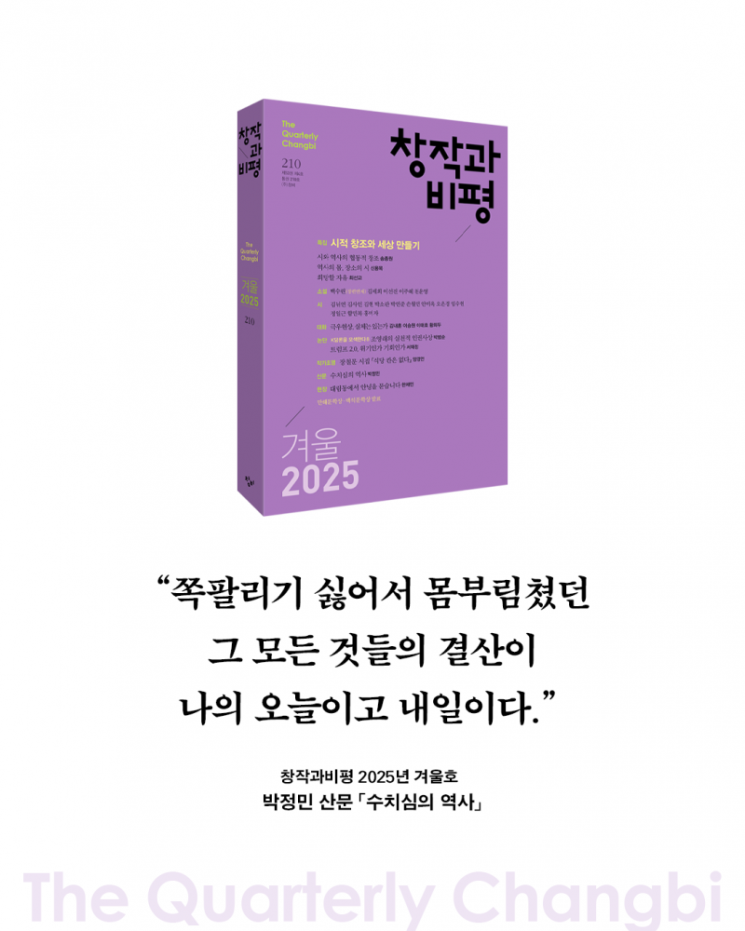 Changbi's Winter 2025 issue featured an essay by actor Park Jungmin, which propelled the magazine onto bestseller lists and made headlines. Photo by Changbi
The power of works, and the tasks ahead
A question was also raised about the impact of celebrity recommendations on the publishing market. Referring to the short story collection "Honmono," which drew attention after being recommended by actor Park Jungmin, Editor-in-Chief Lee said, "Publicity can have an impact, but what ultimately creates sustained results is the power of the work itself." Paek likewise commented, "If it is not a good novel, it is difficult for it to develop into a broader phenomenon."
On the broader crisis facing the publishing environment, CEO Yeom assessed that the foundations for reading and discussion have not completely disappeared. He also pointed to the export of publishing rights, including translation and overseas distribution, and the expansion of IP businesses as major tasks. The children’s book series "Goyangi Hae-gyeolsa Kkamnyang" (Cat Problem-Solver Kkamnyang) is currently exploring secondary creations, including screen adaptations.
Riding the wave of global interest in K-literature, Changbi plans to expand its export of publishing rights and IP business. CEO Yeom stated, "As overseas interest in K-literature has grown, we will further strengthen translation and overseas expansion."
© The Asia Business Daily(www.asiae.co.kr). All rights reserved.
![Clutching a Stolen Dior Bag, Saying "I Hate Being Poor but Real"... The Grotesque Con of a "Human Knockoff" [Slate]](https://cwcontent.asiae.co.kr/asiaresize/183/2026021902243444107_1771435474.jpg)

















