During this year's Lunar New Year holiday period, businesses were caught falsely labeling Canadian pork belly as domestic and selling pears from other regions as if they were Naju pears.
The National Agricultural Products Quality Management Service announced on the 24th that it conducted a 19-day intensive inspection of country-of-origin labeling from January 26 to February 13, focusing on popular gift and ritual food items for the Lunar New Year, and uncovered 470 violating businesses (522 cases by item).
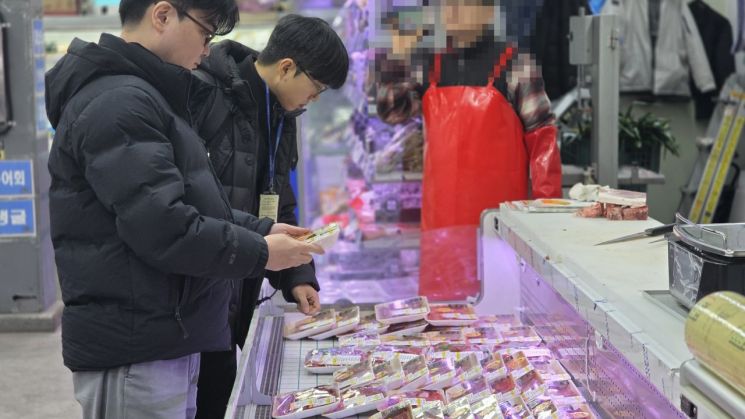 Officials from the National Agricultural Products Quality Management Service are conducting origin inspections. National Agricultural Products Quality Management Service
During this intensive inspection period, the National Agricultural Products Quality Management Service deployed special judicial police officers and honorary inspectors to 11,680 locations, including manufacturers and processors of gift and ritual food items, online retailers, and agricultural and livestock product wholesalers and retailers. The inspection focused on acts such as disguising imported products as domestically produced or falsely selling them as specialty products from well-known domestic regions.
As a result, a restaurant located in Daejeon was caught cooking and selling Canadian pork belly while falsely labeling the pork’s country of origin as domestic. A wholesale business in Gwangju was also caught purchasing and selling pears from other regions while labeling their origin as Naju pears.
Among the businesses caught, 256 that engaged in false labeling will face criminal charges (imprisonment of up to seven years or a fine of up to 100 million won) and will be investigated by the agency itself before being referred to the prosecution. For 214 businesses caught for failing to provide labeling, administrative fines totaling 54.76 million won were imposed.
During this enforcement period, joint crackdowns were conducted in cooperation with the Korea Forest Service, the Korea Customs Service, and local governments. At traditional markets nationwide, where ritual food items are heavily sold, campaigns promoting country-of-origin labeling were also carried out together with consumer organizations and market merchant associations.
Kim Cheol, head of the National Agricultural Products Quality Management Service, said, "In the upcoming month of March, we plan to strengthen inspections of online sales channels, including delivery apps, in order to firmly establish country-of-origin labeling," and requested, "We ask consumers to report any cases where country-of-origin labeling is missing or suspected to be false, either by phone or through the National Agricultural Products Quality Management Service website."
© The Asia Business Daily(www.asiae.co.kr). All rights reserved.
![Clutching a Stolen Dior Bag, Saying "I Hate Being Poor but Real"... The Grotesque Con of a "Human Knockoff" [Slate]](https://cwcontent.asiae.co.kr/asiaresize/183/2026021902243444107_1771435474.jpg)















