Focusing on three pillars: eco-friendly technologies, AI, and small and medium-sized shipyards
Announcement of 34 new R&D projects
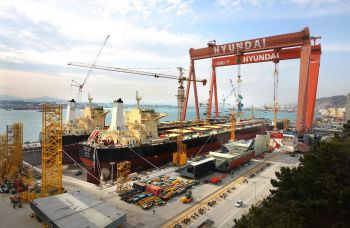
The government will invest 320 billion won this year to secure cutting-edge technologies for K-shipbuilding. It plans to concentrate its capabilities on three key areas: eco-friendly ships, artificial intelligence (AI)-based smart shipyards, and specialized technologies for small and medium-sized shipyards, in order to respond to intensifying global competition.
The Ministry of Trade, Industry and Energy announced on February 24 that it will invest 320 billion won this year in the shipbuilding and offshore sector to strengthen technological competitiveness, an increase of about 23% from the previous year. Along with this, it also announced 34 new research and development (R&D) projects worth a total of 42.7 billion won starting the same day.
Last year, K-shipbuilding recorded exports of 31.8 billion dollars, the highest level in eight years, contributing to the nation’s total exports surpassing 700 billion dollars. Its global order share reached 20.2%, up 6.2 percentage points from the previous year, and it regained the world’s No. 1 position in high value-added vessel types such as large liquefied natural gas (LNG) carriers.
By year, export figures were 21.3 billion dollars in 2018, 19.7 billion dollars in 2020, 18.2 billion dollars in 2022, 25.6 billion dollars in 2024, and 31.8 billion dollars in 2025, showing an upward trend.
However, the ministry pointed to several challenges: the pursuit by competing countries, the tightening of global eco-friendly regulations, structural issues in the workforce, an order structure concentrated in certain ship types, and weak competitiveness among small and medium-sized shipyards and equipment suppliers. Accordingly, it decided to expand technology investment with three pillars: eco-friendly technologies, AI, and support for small and medium-sized shipyards.
First, in the field of eco-friendly ships, the government will work to secure core technologies such as zero-carbon fuel propulsion technologies including ammonia turbines and hydrogen engines, systems that capture and store carbon dioxide from ship engine exhaust gases, and electric propulsion system equipment for medium- and large-sized vessels. The strategy is to preemptively respond to the strengthening of international environmental regulations and secure leadership in future markets.
The spread of AI technologies will also be fully accelerated. Given the labor-intensive nature of shipbuilding processes, AI will be applied across production processes and autonomous ships. Through technologies such as automation of assembly for medium- and large-sized ship blocks weighing tens of tons, and logistics management for transporting components, blocks, and equipment using mobile unmanned robots, the government aims to achieve both automation of high-difficulty processes and improved safety.
In the field of autonomous ships, the government will launch large-scale demonstration projects to advance AI models. It plans to secure operational data from around 30 vessels operating in Korea to lay the groundwork for commercialization.
Support will also be provided in parallel to strengthen the competitiveness of small and medium-sized shipyards and equipment suppliers. The government will promote the localization of icebreaker design technologies and equipment, which currently rely heavily on foreign sources; support the development of electric propulsion systems for offshore wind power support vessels; back the development of tugboats incorporating autonomous navigation and eco-friendly technologies; and help establish collaborative robot operation systems for on-site use.
An official from the ministry said, "Although the shipbuilding industry has recently been delivering strong results, challenges such as workforce structural issues, concentration of orders, and strengthening the competitiveness of small and medium-sized shipyards remain," adding, "Securing overwhelming technological competitiveness is the best strategy, and we will continue to promote the spread of AI across the shipbuilding industry and the development of future eco-friendly ship technologies through the largest-ever level of support."
Detailed information on the new projects and application forms can be found on the Integrated Research Information System (IRIS) for pan-ministerial R&D support, and applications will be accepted from February 24 through March 25.
© The Asia Business Daily(www.asiae.co.kr). All rights reserved.
![Clutching a Stolen Dior Bag, Saying "I Hate Being Poor but Real"... The Grotesque Con of a "Human Knockoff" [Slate]](https://cwcontent.asiae.co.kr/asiaresize/183/2026021902243444107_1771435474.jpg)















