People Power Party holds business breakfast meeting on Special Act on Investment in the United States on the 24th
Hyundai Motor: "Concern over growing pressure to raise item-specific tariffs on the U.S."
Automobile association: "Automobile industry ecosystem facing weakened competitiveness"
Lawmaker Park Sooyoung: "Uncertainty has grown despite ruling that reciprocal tariffs are unlawful"
Sung Kim, President and Head of Strategy and Planning at Hyundai Motor Group, said on the 24th, "Now that the reciprocal tariffs based on the International Emergency Economic Powers Act (IEEPA) have been nullified, there could be growing pressure to raise tariffs on individual items," adding, "If a 25% tariff rate on automobiles becomes a reality, Korea's competitiveness in the global automobile market could be weakened, including in areas such as the transition to electric vehicles and the acceleration of autonomous driving."
President Kim attended a business breakfast meeting on the same day with members of the People Power Party's special committee for handling the Special Act on Investment in the United States, held at the National Assembly in Yeouido, Seoul, and said, "Last year alone we paid 720 billion won in tariffs, and if the tariff rate is raised from the current 15% to 25%, we will face an even larger tariff burden this year."
Kim said, "The automobile industry plays a pivotal role in the national economy in various aspects such as production, taxation, and exports, but it has been facing a major crisis due to tariff issues that have continued since last year," and added, "Although the IEEPA has been ruled unconstitutional, I believe there is a high possibility that tariffs imposed on automobiles and steel will remain in place due to Section 232 of the Trade Expansion Act."
Kim also said, "Since it is unclear when the United States will move to raise tariff rates, I hope that a thorough review of the bill to break through this situation will proceed swiftly," adding, "As much as the National Assembly has worked hard, Hyundai Motor will also do its utmost for the development of the national economy."
Kang Namhoon, Chairman of the Korea Automobile & Mobility Industry Association, likewise expressed concern, saying, "If a 25% tariff becomes a reality, the domestic automobile industry will have to shoulder an astronomical additional tariff burden," and, "It is a situation in which the survival of the entire ecosystem, including not only finished vehicle manufacturers but also partner companies, is under threat."
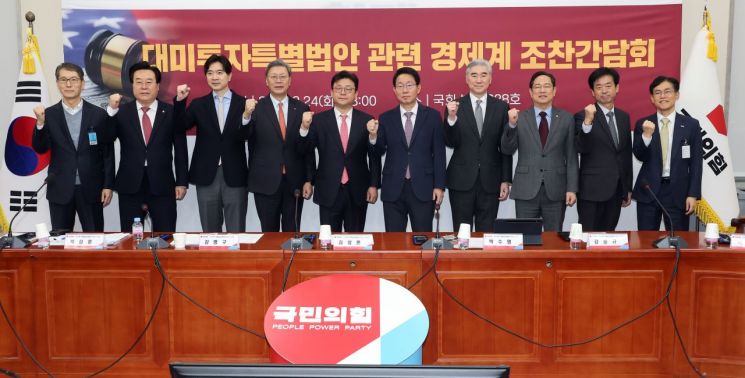 Participants pose for a commemorative photo at a breakfast meeting of business leaders on the People Power Party's special bill on investment in the U.S., held at the National Assembly on the 24th. Photo by Yonhap News
Participants at the meeting agreed that, despite the U.S. Supreme Court's ruling that reciprocal tariffs are unlawful, uncertainty for industry has only grown. Kim Changbeom, Executive Vice Chairman of the Federation of Korean Industries, said, "The U.S. position is changing by the day, and it is putting forward various legal bases," adding, "From a corporate standpoint, the greatest difficulty is uncertainty and the inability to forecast, and it feels like we are in a fog."
He continued, "At times like this, it is important to scrutinize the legislative process, deal with the parts that can be pushed forward quickly, and send a swift signal," adding, "From the perspective of expanding strategic supply chains, I also believe that full-fledged discussions on investment in the United States are necessary."
Park Sooyoung, a lawmaker from the opposition party who serves as the secretary of the Special Committee on the Special Act on Investment in the United States, also said, "The law that was found unlawful by this ruling is one of five tools related to reciprocal measures that former President Trump had at his disposal," and assessed, "Since authority can still be exercised under the remaining four laws, uncertainty has in fact increased for our companies."
The breakfast meeting was organized by the People Power Party to hear the views of industry on the Special Act on Investment in the United States. Attendees included Kim Sanghoon, Chairman of the National Assembly's Special Committee on the Special Act on Investment in the United States, and lawmakers Park Sooyoung, Kang Myunggoo, Park Sanghoon, and Park Sangyong. From the business community, participants included President Sung Kim of Hyundai Motor, Executive Vice President Lee Hangsoo, Executive Vice Chairman Jang Changbeom of the Federation of Korean Industries, Jang Sangsik, Head of the International Trade & Commerce Research Institute at the Korea International Trade Association, and Kang Namhoon, Chairman of the Korea Automobile & Mobility Industry Association.
© The Asia Business Daily(www.asiae.co.kr). All rights reserved.
![Clutching a Stolen Dior Bag, Saying "I Hate Being Poor but Real"... The Grotesque Con of a "Human Knockoff" [Slate]](https://cwcontent.asiae.co.kr/asiaresize/183/2026021902243444107_1771435474.jpg)















