A 6th-Century Plow Carved from Sawtooth Oak
Revived with Advanced Drying Techniques to Prevent Deformation
Cross-Verification of Goguryeo’s Occupation of Baekje
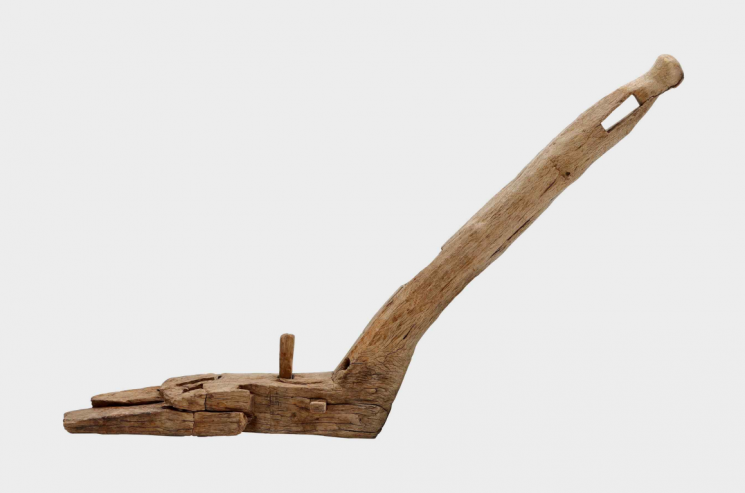
A wooden plow used 1,500 years ago by a Goguryeo person in the heart of Hanseong Baekje has been revealed in its complete form.
The Cultural Heritage Conservation Science Center of the National Research Institute of Cultural Heritage under the National Heritage Administration announced on the 24th that it has completed conservation treatment of a Three Kingdoms period plow excavated from Mongchontoseong in Seoul.
The artifact was recovered in June 2023 from a water collection facility (jipsuji), which stored drinking water and water for daily use in the fortress. It is in the form of a so-called Nupjaenggi, a type mainly used in the northern part of the Korean Peninsula, in which the body (sul) that continues from the blade that cuts into the ground runs parallel to the surface of the earth.
Scientific analysis showed that the plow was carved from hard oak (a species of sawtooth oak). It was finely shaped using woodworking tools such as an adze, a chopping and hewing tool, and a small knife called a doja, which is used to smooth the surface.
Radiocarbon dating indicates that it was produced sometime between 534 and 640. This matches precisely the period when Goguryeo occupied Baekje's Mongchontoseong, constructed the jipsuji, and ruled the area for a time.
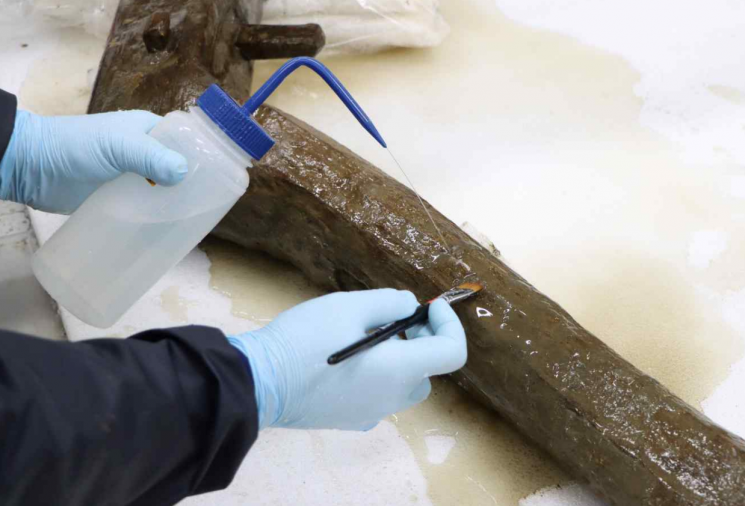
To restore the severely decayed and warped wood that had been buried for a long period, the Cultural Heritage Conservation Science Center employed advanced techniques. In particular, they reinforced the weakened structure by impregnating it with polyethylene glycol (PEG), a water-soluble compound. This substance replaces the moisture inside the wood and fills the internal spaces, firmly supporting the weakened tissues of the artifact.
The research team also applied a vacuum freeze-drying method. By sublimating the moisture directly from solid to gas at low temperatures below minus 40 degrees Celsius, they fundamentally prevented any deformation of the shape. The blade portion, which was too badly damaged to be physically rejoined, was virtually restored using three-dimensional (3D) scanning technology.
The plow, which has regained its original appearance, will be transferred to its repository, the Hanseong Baekje Museum. It will subsequently be used for research on the history of agricultural technology and as material for general exhibitions.
© The Asia Business Daily(www.asiae.co.kr). All rights reserved.
![Clutching a Stolen Dior Bag, Saying "I Hate Being Poor but Real"... The Grotesque Con of a "Human Knockoff" [Slate]](https://cwcontent.asiae.co.kr/asiaresize/183/2026021902243444107_1771435474.jpg)
















