Producer Price Index for January Up 0.6% Month-on-Month
Basic Metal Products and Financial and Insurance Services Rise Sharply
Prices Driven Mainly by Intermediate Goods, While Domestic Supply Prices of Consumer Goods Fall
Both Upside and Downside Factors for Consumer Prices, Outlook Remains Uncertain
The producer price index increased for the fifth consecutive month, with the pace of growth accelerating from the previous month. The sharp rises in basic metal products and financial and insurance services drove the producer price increase this month.
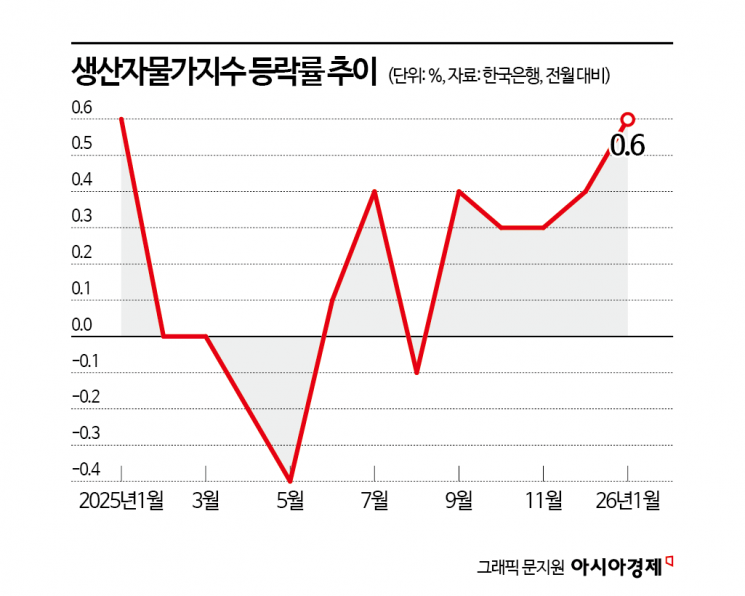
According to the provisional "Producer Price Index for January 2026" released by the Bank of Korea on the 24th, last month's producer price index stood at 122.50 (2020=100), up 0.6% from the previous month. Basic metal products and financial and insurance services rose, expanding the increase from the previous month (0.4%) and marking the fifth straight month of gains. Compared with the same period a year earlier, the index rose 1.9%, maintaining the previous month's year-on-year pace.
Although the increase in agricultural, forestry and marine products narrowed from the previous month, the sharp rises in basic metal products and financial and insurance services produced this result. Agricultural, forestry and marine products climbed 0.7% from the previous month, as agricultural products (1.4%) and livestock products (0.9%) went up. This extended their gains for a second month, but the increase was smaller than in the previous month (3.4%). Among manufactured goods, basic metal products (3.0%) rose mainly on nonferrous metal products, while computers, electronic and optical equipment including semiconductors (1.8%) also increased, pushing manufactured goods up 0.6% month-on-month. In services (0.7%), financial and insurance services (4.7%) jumped sharply, mainly due to higher brokerage commissions following stock price gains. Transportation services (0.7%) also increased. In electricity, gas, water and waste, industrial city gas (2.6%) rose, but waste collection, transport and treatment (-3.2%) fell, leaving the index flat from the previous month.
Officials explained that the trend this month still needs to be monitored. Factors that mainly affect producer prices include international crude oil and other raw material prices, exchange rates, and domestic and overseas economic conditions. Lee Moonhee, Head of the Price Statistics Team at the Economic Statistics Department 1 of the Bank of Korea, said, "Looking at the main conditions, the price of Dubai crude in February to date has risen by about 9% compared with the average of the previous month, while the won-dollar exchange rate has fallen slightly," adding, "Since the main drivers are moving in different directions, we need to wait and see the results of the February price survey."
The five-month streak of producer price increases has raised concerns that it could feed into higher consumer prices. On this point, Lee said, "The recent producer price trend could act as an upside factor for consumer prices going forward, but considering the characteristics of the items leading the increase and the fact that domestic supply prices of consumer goods have fallen, the impact is also expected to be limited." He explained that, because the rise in producer prices is mainly due to higher prices of intermediate goods such as basic metal products and semiconductors, there will be a time lag before it affects consumer prices. He added that, in the domestic supply price index, consumer goods turned to a decline for the first time in eight months since May 2025, and this will act as a downward pressure factor on consumer prices.
Last month, the domestic supply price index rose 0.3% from the previous month, as import prices fell but domestic shipment prices increased. By stage of production, raw materials fell 0.8%, but intermediate goods rose 0.6%. For final goods, capital goods and consumer goods declined, but services increased, leaving the index flat compared with the previous month. Year-on-year, it was up 1.0%. The domestic supply price index measures price changes of goods and services supplied to the domestic market (domestic shipments and imports) in order to capture how price fluctuations spread through the economy.
The total output price index, which measures price changes of goods and services on a total output basis by including exports in addition to domestic shipments in order to capture overall price movements of domestically produced goods, rose 1.3% from the previous month as both domestic shipments and exports increased. Manufactured goods and services climbed 1.8% and 0.7%, respectively. Year-on-year, the index jumped 1.3%.
© The Asia Business Daily(www.asiae.co.kr). All rights reserved.
![Clutching a Stolen Dior Bag, Saying "I Hate Being Poor but Real"... The Grotesque Con of a "Human Knockoff" [Slate]](https://cwcontent.asiae.co.kr/asiaresize/183/2026021902243444107_1771435474.jpg)
















