Koo Yuncheol, Deputy Prime Minister for Economy and Minister of Strategy and Finance, said on the 23rd that, in relation to the possibility of a U.S. airstrike on Iran amid difficulties in nuclear negotiations, "We are preparing a contingency plan to minimize the impact on the Korean economy."
At a briefing on government work for the National Assembly's Planning and Finance Committee that day, Deputy Prime Minister Koo gave this answer when asked what response strategy the government has in the event of a military clash, given that international oil prices are fluctuating due to the possibility of war between the United States and Iran.
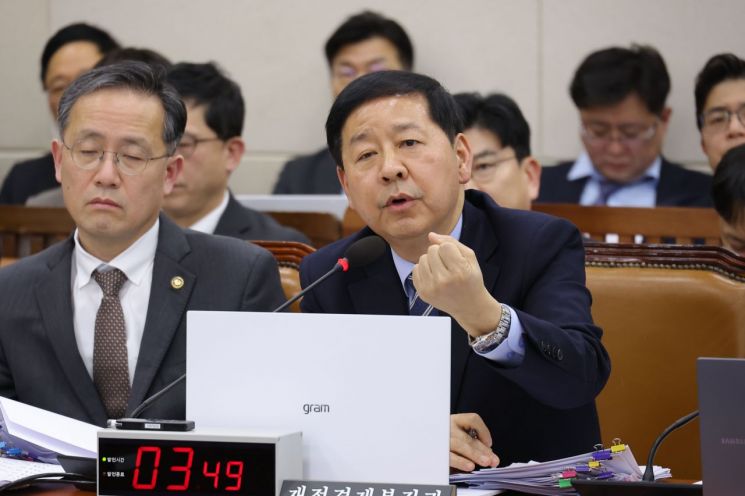 Koo Yooncheol, Deputy Prime Minister for Economy and Minister of Economy and Finance, is attending the plenary meeting of the Financial and Economic Planning Committee at the National Assembly on the 23rd and answering lawmakers' questions. Yonhap News
Regarding concerns over a disruption in crude oil supplies in the event that the Strait of Hormuz is blocked, he said, "We are stockpiling a certain amount of oil, and we are preparing contingency plans such as securing alternative imports from other countries."
On whether there will be tax reforms such as an increase in property holding taxes, he replied, "We are listening to a variety of opinions." On the strengthening of leverage management for non-owner-occupied real estate, he said, "It is true that a lot of real estate investment has taken place through excessive leverage," and added, "I believe that leverage for real estate that is not one’s own residence needs to be normalized."
He continued, "We will consult with the Financial Services Commission on other tasks such as the supply of rental housing," and said, "As for the part where finance flows into (is injected into) real estate, we will try to normalize it as much as possible."
When asked whether there had been any exchange of views with the U.S. government following the U.S. Supreme Court ruling invalidating reciprocal tariffs, he said, "Since it is a matter of a court ruling, we have not discussed it with the U.S. government."
He said, "It is true that uncertainty has increased (due to the ruling that reciprocal tariffs are unlawful)," but added, "If (under Section 122 of the Trade Act) new global tariffs are raised to 15%, the same level as the reciprocal tariffs, I believe there is a non-negligible possibility that things may change compared with last time."
In response to a question on whether the Korea-U.S. agreement concluded in April last year is still valid, he answered, "It is valid." Regarding the Special Act on Investment in the United States, which is pending in the National Assembly, he said, "It consists of two elements: creating a platform fund for implementing the (trade) agreement, and establishing an operating entity to manage that fund," and added, "From the government’s standpoint, it is desirable to continue proceeding with that part according to the established procedures."
When asked what problems might arise if setbacks occur with the Special Act on Investment in the United States amid tariff uncertainty, he said, "There is room for misunderstanding that we are not implementing the (Korea-U.S. strategic investment) memorandum of understanding (MOU), so it would be difficult for it to have a positive effect."
© The Asia Business Daily(www.asiae.co.kr). All rights reserved.
![Clutching a Stolen Dior Bag, Saying "I Hate Being Poor but Real"... The Grotesque Con of a "Human Knockoff" [Slate]](https://cwcontent.asiae.co.kr/asiaresize/183/2026021902243444107_1771435474.jpg)















