Korea Exchange union warns: "Excessive competition will erode market quality"
Ruling party: "Competitive structure will free KOSDAQ from being KOSPI's second division"
To revitalize the relatively sluggish KOSDAQ market compared to the KOSPI, which is on its way toward 6,000 points, the government and the ruling party are pushing to separate KOSDAQ by converting Korea Exchange (KRX) into a holding company structure. The plan is to make KOSDAQ independent so that it can pursue faster decision-making and the delisting of underperforming companies.
However, the Korea Exchange labor union and some experts counter that simply separating KOSDAQ will not automatically energize the market, and argue that the issue requires sufficient discussion and a cautious approach.
Korea Exchange union: "Even Nasdaq operates multiple markets in an integrated way"
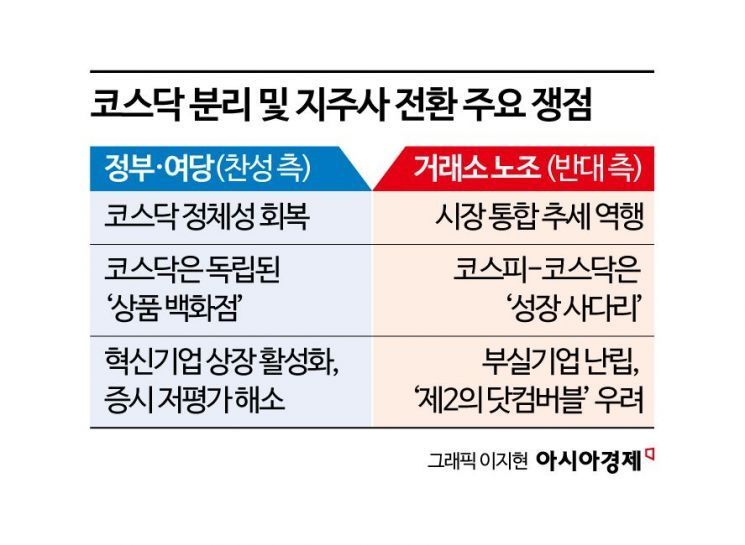
According to industry sources on the 24th, the Korea Exchange branch of the National Office and Financial Service Workers' Union plans to hold a general meeting of about 300 members in front of the presidential office on March 4. They intend to strongly express their opposition, saying that "(Separating KOSDAQ) is an absurd idea stemming from ignorance of market structure." They also plan to distribute policy proposal materials to members of the National Assembly's National Policy Committee.
The Korea Exchange union directly refuted the argument for "turning KOSDAQ into a Nasdaq-style market." A union official said, "KOSDAQ is a single market, whereas Nasdaq is an exchange that operates multiple markets, so it is wrong from the outset to compare the two on the same line," and criticized, "This is no different from comparing a neighborhood-level district with an entire metropolitan city, or trying to make a middle school student compete with a university student."
The official continued, "Major global exchanges such as Nasdaq in the United States and JPX in Japan are instead moving toward integrating multiple markets within a single exchange," adding, "Maintaining a growth-ladder system in which companies move from lower-tier markets to upper-tier markets in line with their growth stage is the global standard."
The union warned that if KOSDAQ is separated as an independent subsidiary and forced into competition with KOSPI, it will lead to a deterioration in market quality. They argued that if competition becomes excessively focused on profit, a large number of underprepared, underperforming companies will flood into the market, potentially leading to a replay of the "dot-com bubble" experienced in 1999, with the losses ultimately being borne entirely by retail investors.
Government and ruling party: "Essential for structural improvement"
The core rationale of the government and ruling party, which are pushing for KOSDAQ separation, is the "restoration of KOSDAQ's market identity." By breaking away from a KOSPI-centered unified operating structure and granting independence to each market, they aim to resolve the chronic undervaluation of the domestic stock market and maximize market dynamism.
At a National Assembly interpellation session on February 9, Prime Minister Kim Minseok said, "KOSDAQ also needs changes and institutional improvements, just like KOSPI," and added, "Including the proposal (on KOSDAQ separation) by Representative Kim Taenyeon of the Democratic Party of Korea, it would be desirable to make a comprehensive judgment, prepare countermeasures, and bring about changes through legislation."
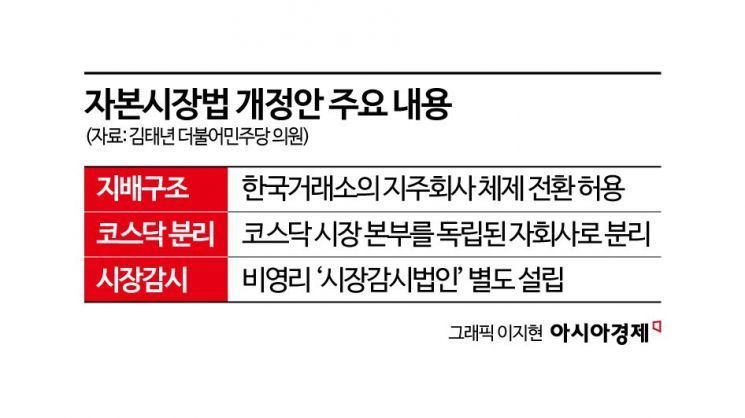
According to the National Assembly’s Bill Information System, Representative Kim sponsored an amendment to the Financial Investment Services and Capital Markets Act on February 6. The bill grants independent operating authority to the KOSDAQ market, which has been run within a framework similar to KOSPI and has consequently been criticized for having a blurred identity.
In particular, if KOSDAQ is separated as an independent subsidiary under a holding company, it is expected that flexible listing and delisting criteria tailored to the characteristics of the market can be designed. In particular, the amendment establishes a basis for allowing the exchange itself to set special listing provisions for innovative companies and swift delisting standards for underperforming companies. The strategy is to lower entry barriers for promising venture firms and startups, while quickly filtering out substandard companies, thereby enhancing the credibility of the market.
Representative Kim explained, "Because KOSDAQ has effectively been treated like a second division of KOSPI, a market structure focused on short-term trading has become entrenched, and there is a structural limitation in that long-term investment rarely takes place," adding, "A reform of the Korea Exchange governance structure is needed to overcome this."
This amendment is in line with the direction of capital market reform emphasized by the presidential office. Previously, Presidential Policy Chief Kim Yongbeom stated that President Lee Jaemyung had ordered the preparation of comprehensive institutional reform measures, including exchange reform. President Lee has defined the exchange as a "department store of products" that swiftly supplies high-quality companies and has consistently stressed the need to strengthen its market function.
Experts also divided over the proposal
Opinions among stock market experts are split. Kang Sohyun, head of the Capital Market Division at the Korea Capital Market Institute, urged caution, saying, "The core of the proposal to separate KOSDAQ is competition, but there seems to be no clear explanation of what exactly that diversification of competition entails," and, "The real issue for KOSDAQ is how to deal with marginal firms, and what is needed first is a concrete discussion on differentiated systems that can fundamentally resolve this."
Lee Namwoo, chairman of the Korea Corporate Governance Forum and visiting professor at Yonsei University Graduate School of International Studies, said, "The key to KOSDAQ separation is to activate competition, and because Korea Exchange has not engaged in competition so far, problems such as the stagnation of the KOSDAQ market have arisen," and evaluated, "The government's proposal is directionally correct in terms of revitalizing KOSDAQ."
© The Asia Business Daily(www.asiae.co.kr). All rights reserved.
![Clutching a Stolen Dior Bag, Saying "I Hate Being Poor but Real"... The Grotesque Con of a "Human Knockoff" [Slate]](https://cwcontent.asiae.co.kr/asiaresize/183/2026021902243444107_1771435474.jpg)

















