Presenting Urban Regeneration Solutions for Buk-gu
Proposing a Resident-Centered Urban Reset
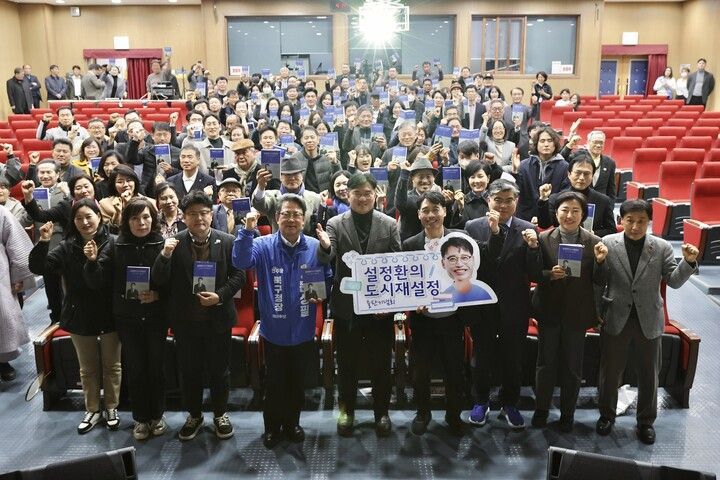 Seol Jeonghwan, Representative of Jaeseoljeong Urban Research Institute, held a book launch on the 21st at the Gwangju Buk-gu Youth Center with about 1,000 local figures and citizens in attendance. Provided by Seol Jeonghwan, Jaeseoljeong Urban Research Institute.
Seol Jeonghwan, head of the Jaeseoljeong Urban Research Institute, who has tirelessly explored the alleyways of Buk-gu in Gwangju in search of solutions for community self-governance and urban regeneration, has published a new book titled "Seol Jeonghwan's Urban Reset," which encapsulates his accumulated experience and vision.
On February 21, Seol held a book launch at the Youth Center in Buk-gu, Gwangju, with about 1,000 local figures and citizens in attendance, where he presented a new urban model for the future of Buk-gu, Gwangju. The event went beyond the mere publication of a book and served as a meaningful forum for public policy discussion to explore the future direction of Gwangju.
Through the book, Seol points out the structural limitations facing today's local communities. He said, "The complex problems of everyday life and long-standing issues can no longer be solved with familiar approaches alone," stressing that "cities must be redesigned not through flashy master plans or grand slogans, but starting from the everyday spaces where citizens live their lives."
The book fully reflects the vivid on-the-ground experience he accumulated while serving as a National Assembly aide, policy chief of the Gwangju Metropolitan City chapter of the Democratic Party of Korea, environmental activist, and director of a cultural city center. In particular, it has drawn significant attention for boldly discarding theory-centered discourse and instead presenting immediately actionable "field-ready strategies," including neighborhood-level everyday-life policies, resident-participation governance, and methods for utilizing idle public assets.
At the book launch, Seol argued, "The dignity of a city depends not on the administrative capacity to manage it, but on how well it solves the problems found in the daily lives of residents walking its streets," adding, "It is time to reset from administration-centered to resident-centered, and from a 'city of management' to a 'city of solutions.'"
On the day of the event, National Assembly member Jeong Junho, Gwangju Metropolitan Council Chairperson Shin Sujeong, and Chonnam National University Professor Kang Singyeom, among many other leading figures from politics, academia, and the cultural sector, attended to offer their congratulations. Senior Democratic Party of Korea official Park Jie-won and Deputy Floor Leader Lee Jeongheon from the party's central leadership also sent video messages of support.
Participants recalled Seol's achievements during his tenure as head of the Gochang Cultural City Center, when he secured a total project budget of 16 billion won and led the effort to have the area designated as a statutory cultural city. They spoke with one voice in saying that his strong drive and planning capabilities will play a key role in enhancing the urban competitiveness of Buk-gu, Gwangju going forward.
With Seol Jeonghwan recently appointed as a member of the Presidential Committee for the Promotion of the Asian Culture Hub City, there is growing attention in the local community on how his vigorous activities and "everyday life-oriented urban strategies" will translate into concrete changes in local administration.
© The Asia Business Daily(www.asiae.co.kr). All rights reserved.
![Clutching a Stolen Dior Bag, Saying "I Hate Being Poor but Real"... The Grotesque Con of a "Human Knockoff" [Slate]](https://cwcontent.asiae.co.kr/asiaresize/183/2026021902243444107_1771435474.jpg)















