"Independent Directors" and Combined 3% Rule in July
Mandatory Cumulative Voting in September
Nongshim and Ottogi Embrace Cumulative Voting
Samyang to Increase Audit Committee Headcount
Nongshim Appoints Third-Generation Owner as Inside Direct
The domestic instant noodle industry's "Big 3" have all moved to overhaul their governance structures. By submitting articles-of-association amendment proposals such as the introduction of electronic general meetings of shareholders, the adoption of cumulative voting, and the expansion of separate election of audit committee members to this year's regular general meetings, they are preparing for institutional changes. With this effectively being the last regular shareholders' meetings before the amended Commercial Act comes into force in July and September, the industry is paying close attention to their moves.
According to the food industry on the 24th, Nongshim, Ottogi, and Samyang Foods will deal with agenda items related to governance changes to their articles of association at their regular general meetings in March. The first and second amendments to the Commercial Act, which passed the National Assembly last year, will be implemented in stages. From July, the title "outside director" will be changed to "independent director," and the so?called "combined 3% rule" will take effect, which limits the voting rights of the largest shareholder and related parties to 3% when appointing audit committee members. From September, the minimum number of audit committee members to be elected separately will be increased from one to two, and cumulative voting will become mandatory.
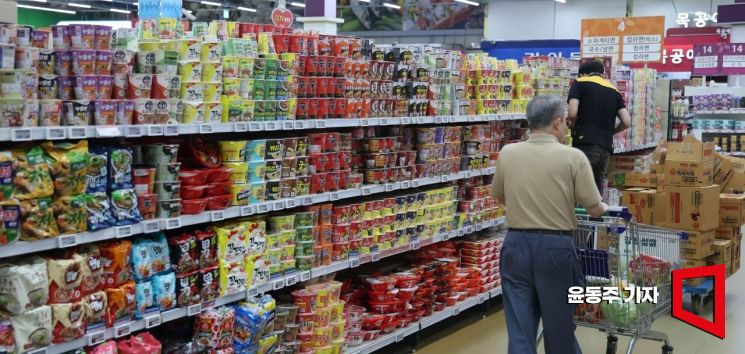
All three companies have specified in their articles of association the legal basis for introducing electronic general meetings of shareholders. The intention is to lower the barrier to shareholder participation by allowing meetings to be held online or in a hybrid format. This is being evaluated as a mechanism that can enhance access for minority shareholders and increase the rate of exercising voting rights.
Revisions to the articles relating to cumulative voting also stand out. Nongshim has submitted an agenda item to switch from the current "exclusion" of cumulative voting to its "adoption." Ottogi has also deleted the clause excluding cumulative voting, thereby establishing a basis for its application. Cumulative voting is a system under which, when appointing two or more directors, shareholders are granted as many voting rights per share as the number of directors to be appointed, allowing them to concentrate their votes on specific candidates. It is designed to enable minority shareholders to exert a certain degree of influence over the composition of the board of directors and is regarded as a means of strengthening checks on controlling shareholders. With mandatory implementation scheduled for September, the companies are effectively preemptively updating their articles of association.
Nongshim has also put forward an agenda item to newly appoint two inside directors. Among them, Executive Vice President Shin Sang-Yeol is the eldest son of Chairman Shin Dong-Won, who rose to executive vice president after serving as head of the Future Business Office and senior executive director. Analysts say that while maintaining a professional management system, the broader involvement of the third-generation owner family in management is being reflected in the composition of the board. In contrast, Ottogi has submitted an agenda item to reappoint Chairman Ham Young-Joon as an inside director, signaling a strategy of responding to institutional changes while maintaining the existing management structure.
Samyang Foods will increase the number of audit committee members to be elected separately and revise provisions related to their appointment and dismissal. This is seen as a measure taken in view of the expansion of the minimum number of audit committee members to be separately elected starting in September.
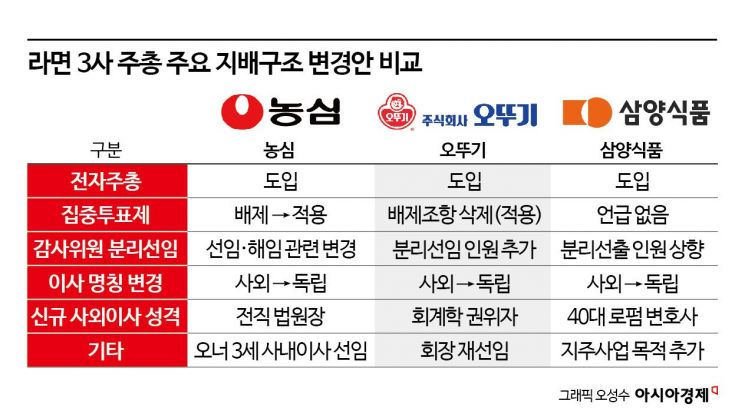
All three companies have also included an agenda item to change the title "outside director" to "independent director." The intention is to clarify standards for board independence by adopting terminology commonly used in global capital markets.
The direction of each company was also evident in the appointment of new independent directors. Samyang Foods appointed attorney Mok Seung-Ho of Kim & Chang, a graduate of Seoul National University School of Law, as an audit committee member, strengthening its capabilities in managing legal risks associated with global business expansion. Nongshim brought in attorney Lee Sung-Ho, former chief judge of the Seoul Central District Court, to reinforce its compliance and control functions, while Ottogi appointed Ahn Tae-Sik, emeritus professor at Seoul National University Business School and former president of the Korean Accounting Association, as an audit committee member, focusing on enhancing financial transparency.
Samyang Foods has also submitted an agenda item to add holding company business and shared services center (SSC) support for subsidiaries to its business purposes. The company has reflected in its articles of association the basis for acquiring and holding stakes in subsidiaries to guide and manage their operations, and for centrally providing common functions such as human resources, accounting, and IT from headquarters. This effectively establishes a structure under which the company can operate its business around subsidiaries or centralize support functions.
An official in the food industry said, "This round of amendments to the articles of association is an institutional overhaul aimed at enhancing mid- to long-term corporate value rather than short-term performance," adding, "It is a step taken in line with structural changes arising from the enforcement of the amended Commercial Act."
© The Asia Business Daily(www.asiae.co.kr). All rights reserved.
![Clutching a Stolen Dior Bag, Saying "I Hate Being Poor but Real"... The Grotesque Con of a "Human Knockoff" [Slate]](https://cwcontent.asiae.co.kr/asiaresize/183/2026021902243444107_1771435474.jpg)

















