"2026 Oxfam Doughnut Report" released
Income inequality deepens... wage gaps continue to widen
Public social spending remains at 72% of the OECD average
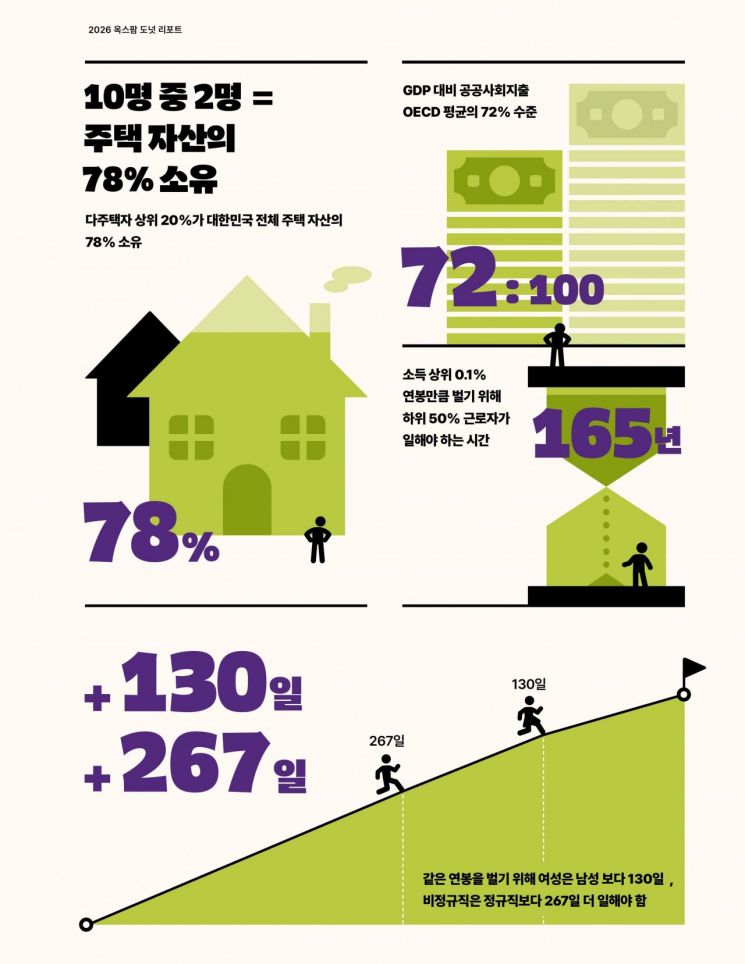
The top 20% of multi-homeowners in Korea were found to own 78% of all residential property assets in the country. It was also found that economic inequality is deepening, with the top 10% by income accounting for 4.1 times more income than the bottom 40%.
On the 23rd, Oxfam Korea, an international relief and development organization, released these findings through its "2026 Oxfam Doughnut Report," which illustrates the state of inequality in Korean society.
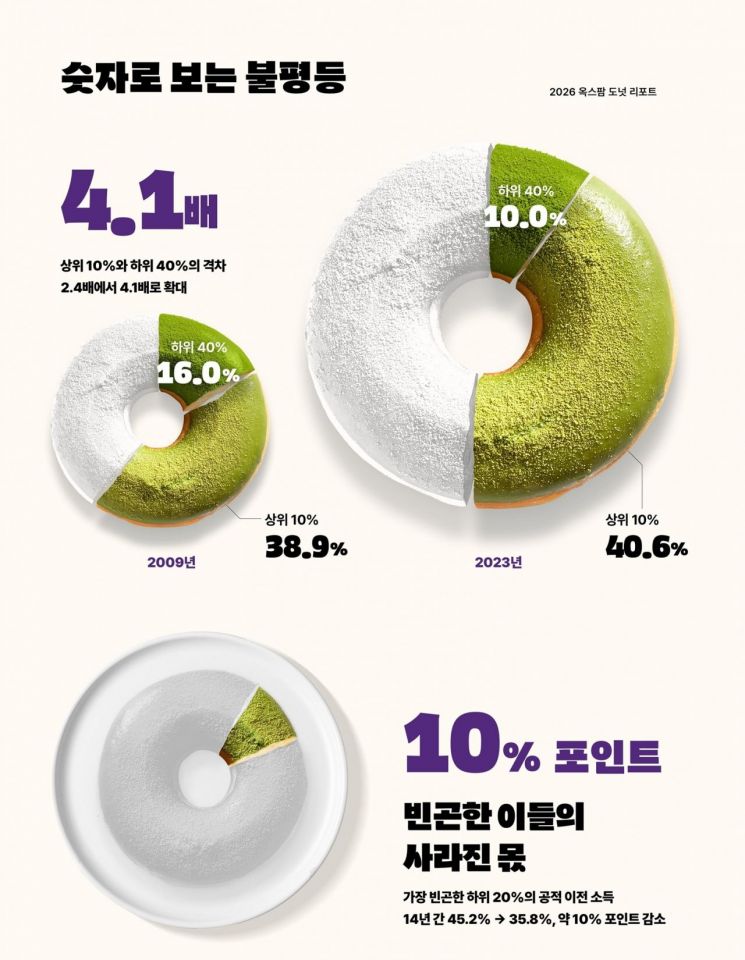
According to the report, the major inequality indicators in Korean society have worsened compared to the past. The Palma ratio, a representative income inequality index, rose from 2.4 in 2009 to 4.1 in 2023. In other words, the top 10% earned 4.1 times more income than the bottom 40%.
In addition, the annual average income of the bottom 50% of individuals by income level is 8.58 million won, meaning they would have to work for 165 years to earn what the top 0.1% make in one year. It was also found that the top 20% of multi-homeowners own 78% of all residential property assets in Korea.
The wage gap is also continuing to widen. The relative wage of non-regular workers compared to regular workers fell from 62% in 2003 to 53.9% in 2024, a decline of 8 percentage points over 21 years. The relative wage of workers in small and medium-sized enterprises compared to large corporations fell from 70% in 2005 to 58.7% in 2023, a decline of 11.3 percentage points over 18 years.
While economic inequality has been intensifying, Korea's public social spending stood at 15.3% of GDP, which is only 72% of the Organisation for Economic Co-operation and Development (OECD) average of 21.2%.
Oxfam Korea pointed out that, despite Korea's unprecedented economic growth, gaps in income, assets, and other aspects of society are widening. It called for an expansion of public social spending to the OECD average level and a shift in social security policies to prepare for the era of artificial intelligence (AI).
In particular, it viewed youth policy as the most effective strategy for reducing inequality. Given that advances in AI technology will have a major impact on youth employment and quality of life, it recommended strengthening housing and education support for young people, while also building a social security system that can include groups currently in blind spots.
Ji Kyungyoung, Executive Director of Oxfam Korea, said, "Inequality is no longer someone else's problem, but a survival challenge for all of us," expressing hope that this report will encourage more citizens to join the journey toward a fairer society.
Meanwhile, the report's title was derived from "doughnut economics," a concept first proposed by British economist Kate Raworth, a former Oxfam researcher.
In this framework, the doughnut is explained as a structure of two concentric circles: the social foundation that safeguards human dignity, and the ecological ceiling that must not be exceeded. The doughnut-shaped space between these two circles represents a just space in which everyone can live safely and with dignity.
© The Asia Business Daily(www.asiae.co.kr). All rights reserved.
![Clutching a Stolen Dior Bag, Saying "I Hate Being Poor but Real"... The Grotesque Con of a "Human Knockoff" [Slate]](https://cwcontent.asiae.co.kr/asiaresize/183/2026021902243444107_1771435474.jpg)
















