Kitagawa and Yaghi (2025 Nobel Prize in Chemistry), Kobilka (2012 Nobel Prize in Chemistry) Join the Network
Three Nobel laureates have joined the official advisory network of the Korean scientific community. This is expected to serve as an opportunity to simultaneously strengthen international academic exchange, nurture the next generation of talent, and enhance science diplomacy capabilities.
The Korean Academy of Science and Technology (KAST) announced that at the "2026 First Regular Board Meeting" held on the 23rd, it elected three scholars as foreign members for 2026: Susumu Kitagawa of Kyoto University in Japan and Omar Yaghi of the University of California, Berkeley in the United States, both winners of the 2025 Nobel Prize in Chemistry, and Brian Kobilka of Stanford University in the United States, winner of the 2012 Nobel Prize in Chemistry.
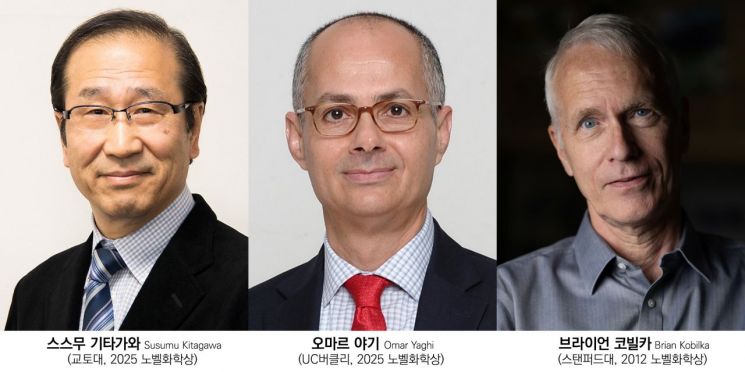
KAST selects world-renowned scholars who have contributed to the advancement of science and technology as foreign members and promotes international academic exchange and research collaboration. It currently has a total of 59 foreign members, including 33 Nobel and Fields Medal laureates.
Professor Kitagawa is a pioneer in research on porous coordination polymers and metal-organic frameworks (MOFs), and received the 2025 Nobel Prize in Chemistry for laying the foundations for applications in gas storage and separation, as well as in the energy and environmental fields. He said, "I am honored to be elected as a foreign member" and added, "I will contribute to society through science."
Professor Yaghi is likewise a leading scholar in research on MOFs and covalent organic frameworks (COFs), and has been recognized for his achievements in climate crisis response fields such as water and carbon capture, energy storage, and technologies for harvesting moisture from air. He said, "I am grateful for the opportunity to collaborate with my Korean colleagues," and added, "I look forward to visiting Korea in the near future and engaging in exchange."
Professor Kobilka elucidated the structure and mechanism of action of G protein-coupled receptors (GPCRs), which are membrane proteins, thereby opening the way for structure-based drug discovery, and was awarded the Nobel Prize in Chemistry in 2012. He said, "My past experience of conducting research together with young Korean scientists was very meaningful," and added, "I look forward to continuing our collaborative activities in the future."
KAST plans to use its foreign members to support international exchange activities and network building for next-generation scientists, and to expand youth talent development programs and public lectures. Starting with Professor Yaghi, who is scheduled to visit Korea in April, it is coordinating the visit schedules of this year’s newly elected foreign members, the presentation of membership plaques, and their participation in KAST programs.
Jin Ho Jung, President of KAST, said, "The election of Nobel laureates as foreign members not only enhances KAST’s international standing and science diplomacy capabilities, but also serves as a catalyst for expanding the global influence of Korean science and technology," adding, "We will actively leverage the experience and networks of our foreign members for policy advice, international cooperation, and the fostering of next-generation scientists."
© The Asia Business Daily(www.asiae.co.kr). All rights reserved.
![Clutching a Stolen Dior Bag, Saying "I Hate Being Poor but Real"... The Grotesque Con of a "Human Knockoff" [Slate]](https://cwcontent.asiae.co.kr/asiaresize/183/2026021902243444107_1771435474.jpg)















