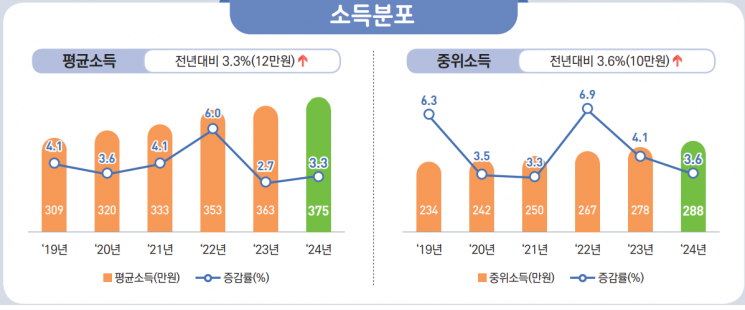
The average income of domestic wage workers in 2024 was tallied at 3.75 million won, up 120,000 won (3.3%) from the previous year’s 3.63 million won. Although the growth rate expanded compared with 2.7% in 2023, many assess that the perceived improvement remains limited when compared with price increases.
On the 23rd, the National Data Office released its report titled “2024 Wage Worker Job Income,” containing these findings. As of December 2024, the average income of wage workers was 3.75 million won, an increase of 3.3% from a year earlier, while the median income was 2.88 million won, up 100,000 won (3.6%). The growth rate of median income, which is the value located exactly in the middle when incomes are arranged in order, slightly exceeded the average income growth rate of 3.3%.
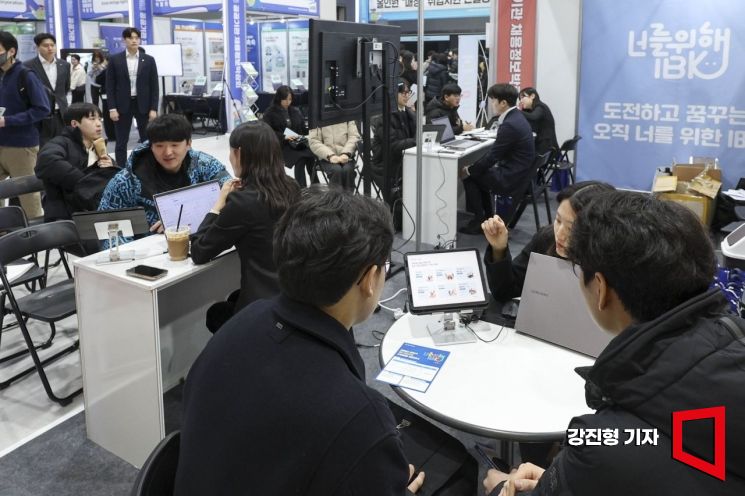 Job seekers taking part in the "2026 Public Institutions Recruitment Fair" held at the aT Center in Seocho-gu, Seoul, visit the Industrial Bank of Korea to gather employment information. 2026.1.27 Photo by Kang Jinhyung
During the same period, the annual consumer price index stood at 114.2, up 2.3% year-on-year, indicating that the wage growth rate slightly outpaced the inflation rate.
By company size, the wage gap between large corporations and small and medium-sized enterprises remained at around double. The average pre-tax income at large corporations was 6.13 million won, up 200,000 won (3.3%) from 5.93 million won a year earlier. For small and medium-sized enterprises, the figure was 3.07 million won, an increase of 90,000 won (3.0%), while for nonprofit organizations it was 3.57 million won, up 80,000 won (2.4%).
By number of employees, workers at establishments with 300 or more employees earned the highest average income at 4.91 million won, followed by 3.76 million won at establishments with 50 to fewer than 300 employees, and 2.80 million won at those with fewer than 50 employees. All categories recorded a year-on-year growth rate of around 3%.
By industry, financial and insurance activities recorded the highest average income at 7.77 million won, followed by electricity, gas, steam and air conditioning supply at 6.99 million won, and international and foreign organizations at 5.38 million won.
In contrast, accommodation and food service activities (1.88 million won), membership organizations and other personal services (2.29 million won), and agriculture, forestry and fishing (2.44 million won) showed relatively low levels. Compared with the previous year, average income increased across all industries, including international and foreign organizations (5.5%), mining and quarrying (4.8%), and wholesale and retail trade (4.6%).
By gender, the average income of male workers was 4.42 million won and that of female workers was 2.89 million won, meaning men earned about 1.5 times as much as women. Both men and women saw a 3.6% increase from a year earlier. By age group, workers in their 40s (4.69 million won) had the highest average income, followed by those in their 50s (4.45 million won. In terms of growth rate alone, those aged 70 and older recorded the highest increase at 5.8%.
© The Asia Business Daily(www.asiae.co.kr). All rights reserved.
![Clutching a Stolen Dior Bag, Saying "I Hate Being Poor but Real"... The Grotesque Con of a "Human Knockoff" [Slate]](https://cwcontent.asiae.co.kr/asiaresize/183/2026021902243444107_1771435474.jpg)
















