Financial authorities are expanding the target of savings banks' financing from the current focus on low-income households and small and medium-sized enterprises (SMEs) to include mid-sized companies. The limit on holdings of unlisted shares will be eased from 10% to 20% of equity capital. However, for large savings banks with assets of 5 trillion won or more, capital and governance regulations will be strengthened to the level applied to banks. The aim is to establish an institutional foundation that allows savings banks to move away from a real estate-centered business model and expand their role in supplying funds to the real economy, while preemptively blocking the risk of insolvency at large institutions.
On the 23rd, Lee Eokwon, Chairman of the Financial Services Commission, discussed these measures, titled the "Plan for Sound Development of Savings Banks," at the "CEO Policy Meeting for the Sound Development of Savings Banks" held at the Korea Federation of Savings Banks in Seoul. The meeting was attended by Oh Hwakyoung, Chairman of the Korea Federation of Savings Banks, the heads of 12 savings banks, as well as officials from the Financial Supervisory Service, the Korea Deposit Insurance Corporation, and the Korea Institute of Finance.
In his opening remarks, Chairman Lee said, "We have prepared a plan for the sound development of savings banks so that they can move away from a business model focused on short-term profits, stably support the real economy and local communities, and firmly establish their role and identity as regional and inclusive finance institutions, from their base regions to the national level."
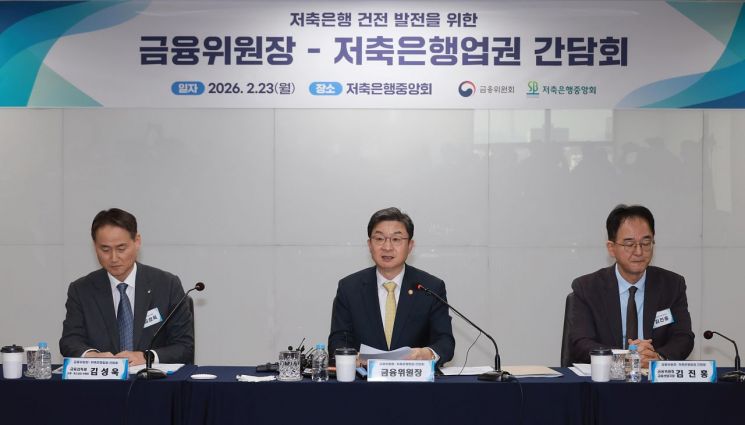 Lee Eokwon, Chairman of the Financial Services Commission, is delivering opening remarks at the "Savings Banks CEO Policy Meeting" held at the Korea Federation of Savings Banks in Mapo-gu, Seoul, on the afternoon of the 23rd.
Moving away from a 'real estate PF-centered' structure... Raising per-borrower credit limits and granting separate limits for non-capital-region borrowers
The Financial Services Commission plans to revise the system so that funds from savings banks are supplied in a more balanced manner across the real economy, including SMEs, mid-sized companies, and small business owners, rather than being concentrated in real estate and collateral-backed lending. To this end, the scope of corporate lending will be expanded from SMEs to mid-sized companies, and the limit on holdings of unlisted shares will be relaxed from 10% to 20% of equity capital.
Support for individual business owners and small merchants will also be strengthened by allowing linked investments with online investment-linked finance (online investment business) and overhauling the "Saitdol" loan products. In addition, the Commission will push to reform the loan-to-deposit ratio calculation system in a way that gives preferential treatment to loans extended outside the Seoul metropolitan area.
Some business conduct regulations have also been adjusted. The Financial Services Commission has decided to allow large savings banks that meet certain requirements, such as a Basel capital adequacy (BIS) ratio of at least 13%, to independently issue and handle debit and prepaid electronic payment instruments such as check cards and mobile coupons, which until now could only be offered jointly with the Korea Federation of Savings Banks. This means that only large savings banks with strong capital buffers and verified soundness will be allowed to expand their business scope so they can diversify their revenue structure.
In addition, for medium and large savings banks with assets of 1 trillion won or more that have sufficient capital strength and risk management capabilities, per-borrower credit limits will be raised. Specifically, the credit limit for corporate borrowers will be increased from 12 billion won to 14 billion won, and for individual business owners from 6 billion won to 7 billion won. To strengthen regional financial functions, an additional separate limit of 500 million to 1 billion won will be granted for borrowers outside the Seoul metropolitan area. This measure is intended to ease concentration in the capital region and improve financial access for local companies and small business owners.
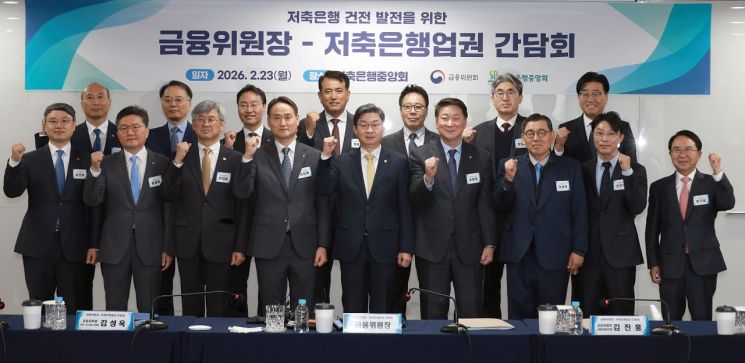 Lee Eokwon, Chairman of the Financial Services Commission (center), is taking a photo with participants at the "Financial Services Commission Chairman?Savings Bank Chief Executive Officers Policy Meeting" held on the 23rd in Mapo, Seoul.
Deregulation, but tighter bank-level oversight for large institutions with assets of 5 trillion won or more
While regulations will be eased, management of soundness and governance will be strengthened. For large savings banks with assets of 5 trillion won or more, capital regulations will be gradually raised to levels similar to those applied to banks, and a forward-looking criteria (FLC) system that reflects a borrower's future repayment capacity will be introduced so that loan risks are assessed more strictly. Accordingly, loan loss provisions will also be built up in a way that better reflects actual conditions.
Even before a crisis materializes, the system will be improved so that authorities can preemptively require capital increases or restrict dividend payments. In addition, monitoring of deposits will be strengthened, and the method of calculating the liquidity ratio will be revised to better reflect reality.
In terms of governance, the cap on major shareholders' ownership stakes will be applied in stages according to asset size, and the fit-and-proper assessment of major shareholders will be reinforced. If problems arise, sanctions will be diversified beyond simple orders to dispose of shares to include measures such as disclosure requirements and restrictions on voting rights.
For small savings banks with assets of 1 trillion won or less, if their financial condition is sound, some regulatory burdens will be reduced, such as by relaxing the frequency of external audits. However, key prudential indicators such as the BIS capital adequacy ratio and delinquency rates will continue to be managed under the existing standards.
To speed up the resolution of non-performing loans across the sector, the authorities also plan to establish a legal basis for setting up an asset management company that will allow savings banks to jointly dispose of bad assets. In addition, criteria for managing and disposing of real estate acquired during the loan recovery process will be clarified so that such properties are not held for long periods.
Oh Hwakyoung, Chairman of the Korea Federation of Savings Banks, said, "A timely institutional stepping stone has been put in place for a new leap forward for savings banks," adding, "We will work with the financial authorities and support our member institutions so that these measures can be smoothly implemented and firmly established."
Regarding the new plan, Chairman Lee said, "This is not a short-term response, but the starting point of a structural transition to help savings banks secure medium- to long-term soundness and competitiveness," and requested, "On this basis, I ask savings banks to further strengthen their responsibility and flexibility in supplying funds, establish themselves as a trusted financial sector for consumers, and redouble their efforts to provide finance for local communities and low-income households."
© The Asia Business Daily(www.asiae.co.kr). All rights reserved.
![Clutching a Stolen Dior Bag, Saying "I Hate Being Poor but Real"... The Grotesque Con of a "Human Knockoff" [Slate]](https://cwcontent.asiae.co.kr/asiaresize/183/2026021902243444107_1771435474.jpg)
















