Democratic Party Pushes Legal Distortion Crime, Constitutional Complaint System for Court Rulings, and Increase in Supreme Court Justices
Proposes Talks with Jang Donghyuk on Administrative Integration of Daejeon and South Chungcheong
People Power Party: "We Will Use Every Means to Oppose Judicial Reform"
On February 23, the Democratic Party of Korea reaffirmed its intention to push ahead with the so-called three judicial reform bills, including the crime of legal distortion, without compromise. The party also proposed a meeting between the ruling and opposition party leaders to handle the integration bills for Daegu-North Gyeongsang, Gwangju-South Jeolla, and Daejeon-South Chungcheong.
Democratic Party leader Chung Cheongrae stated at a Supreme Council meeting held at the National Assembly that day, "We will process the three judicial reform bills, including the creation of the crime of legal distortion, the introduction of a constitutional complaint system for court rulings, and the increase in the number of Supreme Court justices, according to our own timetable during this extraordinary session of the National Assembly, without setbacks and without compromise." Given that the February extraordinary session runs until March 4, this indicates his intention to complete judicial reform in early March despite opposition from other parties.
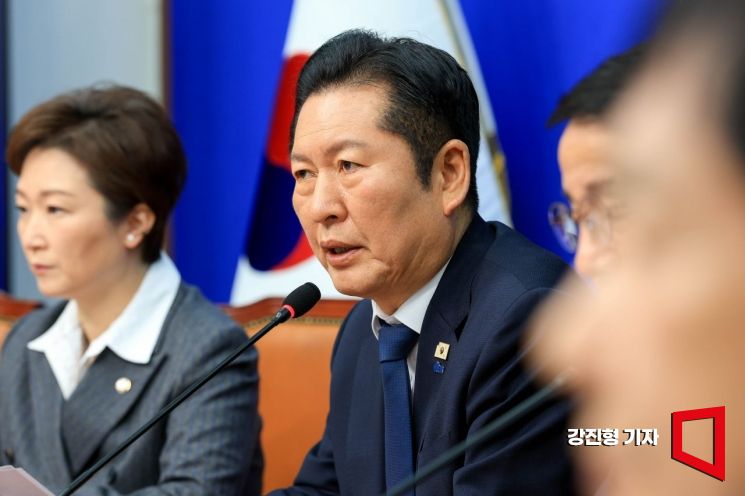 Jeong Cheongrae, leader of the Democratic Party of Korea, is attending the Supreme Council meeting held at the National Assembly in Yeouido, Seoul on Feb. 20, 2026, and delivering opening remarks. Photo by Kang Jinhyung
Chung also reaffirmed his will to push for prosecution reform. He said, "Through yesterday's policy general meeting of lawmakers, we completed the adoption of the party line on the government's advance notice of re-legislation for prosecution reform," and explained, "Under the grand principle of a complete separation of investigation and indictment, the organization of the Serious Crimes Investigation Agency will be unified, and the Criminal Procedure Act will be revised so that the Public Prosecution Service is not granted supplementary investigative powers but is instead given the authority to request supplementary investigations." He added that the revision of the Criminal Procedure Act would be carried out separately from the Corruption Investigation Office for High-ranking Officials Act and the Serious Crimes Investigation Agency Act. He went on to stress, "We will handle the prosecution reform plan adopted as the party line yesterday calmly and boldly, like the horn of an ox moving forward alone."
Democratic Party floor leader Han Byungdo said, "We must open a plenary session tomorrow to deal with urgent livelihood reform bills," adding, "If the handling of livelihood reform bills is delayed, the damage will be passed on intact to the people." He pointed out, "Because the handling of the Child Allowance Act has been delayed, 420,000 children aged 8 are not receiving their allowance, and because the handling of the special administrative integration acts for Daegu-North Gyeongsang, South Jeolla-Gwangju, and South Chungcheong-Daejeon has been delayed, unnecessary confusion is being exacerbated."
After the Supreme Council meeting, Democratic Party chief spokesperson Park Sohyun met with reporters and said, "The handling of reform legislation that has been postponed because of livelihood issues is itself livelihood legislation that can no longer be delayed," adding, "We will definitely pass the prosecution reform bills adopted as the party line, the three judicial reform bills, and the special administrative integration act, which is South Korea's new future strategy." Chief spokesperson Park added, "We will also deal with urgent livelihood issues such as the Commercial Act, the National Referendum Act, the Child Allowance Act, the Real Estate Transaction Reporting Act, and the Urban Renewal Act."
Regarding the handling of the Daejeon-South Chungcheong integration bill, Chung proposed talks with People Power Party leader Jang Donghyuk. He said, "The administrative integration of Daejeon-South Chungcheong and South Chungcheong-Daejeon, which risks drifting due to the People Power Party's obstinacy, is not something to oppose based on whether it is electorally advantageous or disadvantageous," and proposed, "I suggest to leader Jang an official meeting between the two party leaders for substantive progress on administrative integration." He said he would follow Jang's wishes regarding the specific schedule and location of the talks.
Meanwhile, the People Power Party requested that the plenary session be held on the 26th instead of the 24th. Labeling the judicial reform bills being pushed by the Democratic Party as "judicial destruction bills," it expressed its opposition and demanded that non-controversial bills be handled first. After meeting with National Assembly Speaker Woo Wonshik, People Power Party floor leader Song Eonseok said, "There is no sufficient reason at this point to forcibly push through the three evil judicial destruction bills," and warned, "If the Democratic Party tries to railroad them, the People Power Party will have no choice but to mobilize all possible means to oppose them."
© The Asia Business Daily(www.asiae.co.kr). All rights reserved.
![Clutching a Stolen Dior Bag, Saying "I Hate Being Poor but Real"... The Grotesque Con of a "Human Knockoff" [Slate]](https://cwcontent.asiae.co.kr/asiaresize/183/2026021902243444107_1771435474.jpg)















