Considering strike to overthrow Iran's leadership if it refuses to abandon nukes
Iran could target U.S. facilities in the Middle East and Europe through proxy forces
There is speculation that the United States is considering a large-scale attack within a few months to overthrow Iran's leadership. The United States and Iran are set to resume nuclear negotiations in Geneva, Switzerland, on February 26 (local time). This indicates that Washington is prepared to consider even its last resort if the talks run into trouble, or if Iran refuses to abandon its nuclear program despite an initial, limited-scale strike.
On February 22, the New York Times (NYT), citing sources, reported that U.S. President Donald Trump told his aides this was under consideration.
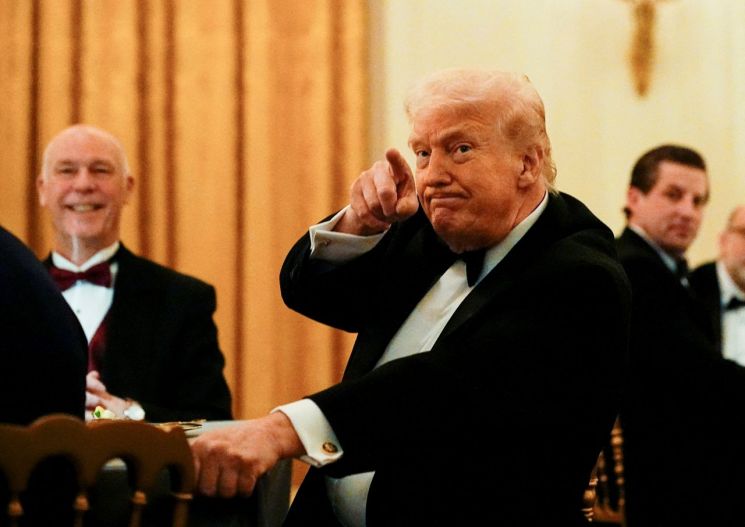
According to his aides, President Trump is leaning toward carrying out an initial strike within a few days. The stated purpose is to make it unmistakably clear that Iran's leadership must agree to abandon its capability to produce nuclear weapons. Targets under review reportedly include the headquarters of the Islamic Revolutionary Guard Corps, Iran's nuclear facilities, and sites related to its ballistic missile program.
Trump also told his aides that if these measures fail to persuade Iran to accept U.S. demands, he will keep open the possibility of a military attack toward the end of the year aimed at ousting Iran's Supreme Leader, Ayatollah Seyyed Ali Khamenei. On February 18, President Trump discussed these attack plans in the White House Situation Room with Vice President J.D. Vance, Secretary of State Marco Rubio, Chairman of the Joint Chiefs of Staff Dan Kane, Central Intelligence Agency (CIA) Director John Ratcliffe, and White House Chief of Staff Susie Wiles.
The United States is currently deploying major military assets, including nuclear-powered aircraft carriers, to the Middle East in large numbers and is ratcheting up pressure on Iran.
However, if President Trump orders a large-scale attack on Iran, Tehran could carry out attacks on U.S.-related facilities in Europe and the Middle East through proxy forces, the NYT reported, citing Western security officials. Concerns have been raised that the Houthis in Yemen could be mobilized to attack Western vessels in the Red Sea, or that organizations under Hezbollah or al-Qaeda could strike U.S. military bases or embassies. No concrete attack plans have yet been detected.
Colin P. Clarke, executive director of the Soufan Center, said, "Iran can carry out terrorist attacks through proxy forces, and that would impose enormous costs on every U.S. military operation."
Even within the Trump administration, doubts are being raised over whether airstrikes could actually force Iran to abandon its nuclear program. On the other hand, some are examining an option to limit Iran to using nuclear technology solely for medical research and treatment, in order to avoid a military clash between the two sides.
The United States had previously reviewed airstrike operations to destroy Iran's nuclear or missile facilities. However, it shelved those plans after concluding they would be more dangerous than the operation to capture Venezuelan President Nicolas Maduro. Officials from the Army, Navy, and Air Force expressed concern about maintaining a posture geared toward a prolonged conflict with Iran.
Steve Witkoff, President Trump's special envoy for the Middle East, said in a Fox News interview that the clear guideline set by Trump for any agreement is that Iran must reduce its enrichment of nuclear material to "zero." However, Iranian Foreign Minister Abbas Araghchi said in a CBS interview that Iran is not prepared to relinquish its right, under the Nuclear Non-Proliferation Treaty (NPT), to produce nuclear fuel.
The NYT analyzed that whether the United States strikes Iran will depend on whether both sides can reach an agreement in these talks that allows each to save face. According to officials, the Trump administration and Iran's leadership are discussing a plan under which Iran would be allowed to produce only a very small amount of nuclear fuel for medical purposes. In that case, Iran could still claim that it is enriching uranium, while the United States could say that Iran is shutting down all facilities for manufacturing nuclear weapons. The NYT added that it remains unclear whether Iran can scale back a nuclear program into which it has invested billions of dollars to such a limited level.
It is uncertain whether the talks scheduled for February 26 will yield smooth and tangible results. A senior Iranian official told Reuters that even after two prior rounds of meetings, the two sides still have wide differences over issues including the scope and sequencing of sanctions relief. The official said that recent discussions have highlighted the gap between the two sides, but added that as long as negotiations continue, there remains a possibility of reaching a provisional agreement.
© The Asia Business Daily(www.asiae.co.kr). All rights reserved.
![Clutching a Stolen Dior Bag, Saying "I Hate Being Poor but Real"... The Grotesque Con of a "Human Knockoff" [Slate]](https://cwcontent.asiae.co.kr/asiaresize/183/2026021902243444107_1771435474.jpg)















