No Supreme Court guidelines on refunds
Industry pushes for clear refund procedures
Korean companies also face protracted legal battles
As the U.S. Supreme Court has ruled that President Donald Trump's country-specific "reciprocal tariffs" are illegal, a wave of lawsuits from companies is expected to follow. With the total amount of tariffs imposed by the U.S. administration on various countries and companies estimated at up to 175 billion dollars (about 254 trillion won), companies' calculations over whether they can actually get their tariffs refunded have become even more complicated.
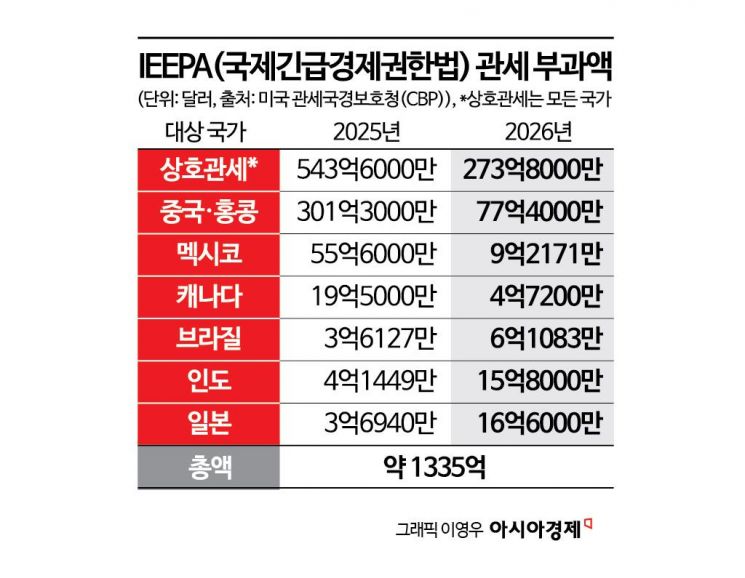
According to the website of U.S. Customs and Border Protection on the 23rd, the total amount of tariffs imposed under the International Emergency Economic Powers Act (IEEPA) from last year through this year (on a fiscal year basis) is about 133.5 billion dollars (about 193 trillion won. Of this, the reciprocal tariffs applied to all countries amount to 81.7 billion dollars. The New York Times (NYT) and others, citing the University of Pennsylvania's Penn-Wharton Budget Model (PWBW), previously projected that refund claims following the ruling that the reciprocal tariffs are illegal could reach 175 billion dollars.
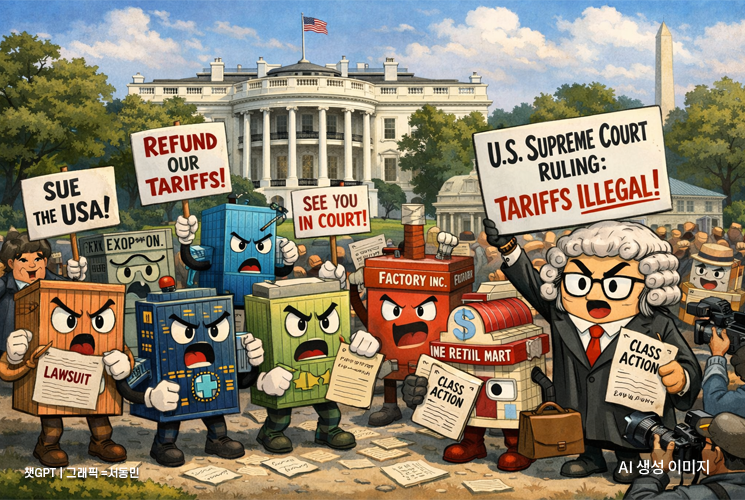
In principle, the Supreme Court's ruling of illegality has deprived the reciprocal tariff revenues imposed by President Trump of their legal basis. Anticipating the Supreme Court's decision, numerous companies have already filed lawsuits seeking the return of tariffs. The Wall Street Journal (WSJ) estimated the number of such companies at several hundred, while Bloomberg News put the figure at more than 1,000.
After the ruling, Walmart, the largest big-box retailer in the United States, and the National Retail Federation (NRF), which represents retailers nationwide, urged the court to "establish procedures to ensure the smooth refund of tariffs to U.S. importers." Neil Bradley, chief policy officer at the U.S. Chamber of Commerce, also stressed that "swift tariff refunds would be a major help to more than 200,000 importing companies."
The problem is that in issuing its ruling, the Supreme Court did not provide any guidelines regarding the procedures for refunding tariffs already paid. Justice Brett Kavanaugh, who wrote a dissenting opinion arguing that the reciprocal tariffs were lawful, warned in the opinion that "there may come a time when the government has to issue refunds" and that "the refund process will probably be a mess." U.S. Treasury Secretary Scott Bessent also commented, "The Supreme Court did not address the refund issue and left the decision to the lower courts," adding, "We will follow the court's decision (on the refund issue), but it could take several weeks or even several months before a decision is reached."
The Trump administration has in fact signaled a prolonged legal battle. At a press conference on the 20th, immediately after the ruling of illegality was handed down, President Trump criticized the decision by pointing out that the court had not mentioned refunds, calling it a "terrible and flawed opinion." He also emphasized that "we could be in court for at least two years and up to five years." Matt Priest, chief executive officer (CEO) of the Footwear Distributors and Retailers of America (FDRA), whose members include Nike and Crocs, likewise advised member companies during an emergency video conference not to rely on tariff refunds, noting that "there is a long way to go."
Patrick Childress, a partner at Holland & Knight and former legal counsel at the Office of the United States Trade Representative (USTR), told the U.S. political outlet Axios that there were two potential avenues for refunds: the government could proactively refund tariffs to all companies, or companies could apply for refunds through Customs and Border Protection (CBP). However, he said the Trump administration has instead signaled that it will pursue legal action.
Experts are concerned that the lawsuits will require enormous time and expense. They explain that rather than rushing into litigation unconditionally, it would be more reasonable to first examine any administrative relief procedures or follow-up guidelines that U.S. Customs may issue and then decide on a response after weighing the practical benefits. Jang Sangshik, head of the International Trade and Commerce Research Institute at the Korea International Trade Association, said, "Given the intent of the Supreme Court ruling, there appears to be a high likelihood that a decision will be made ordering the return of tariffs," but added, "However, if the administration appeals an unfavorable ruling in the first instance to a higher court, it could take considerable time and cost before refunds are ultimately paid."
Some companies, however, may be able to request tax refunds without going through litigation by using the tariff settlement period. Because tariffs are only finalized about 314 days after an import declaration is filed, if the tariff has not yet been finalized, companies can request a tax refund by submitting a post-entry amendment. An industry official said, "Considering when the reciprocal tariffs began to be imposed in earnest, a significant number of import transactions are likely to fall within this window," and added, "In this process, the key will be whether Customs establishes forward-looking administrative procedures."
Jisun Kim, CEO of law firm Dayang specializing in immigration, said, "From a company's perspective, any lawsuit should be brought only in a situation where it can proceed without suffering disadvantages and can still respond appropriately in the future," and advised, "For now, it is important to watch the situation while weighing factors such as time and cost."
© The Asia Business Daily(www.asiae.co.kr). All rights reserved.
![Clutching a Stolen Dior Bag, Saying "I Hate Being Poor but Real"... The Grotesque Con of a "Human Knockoff" [Slate]](https://cwcontent.asiae.co.kr/asiaresize/183/2026021902243444107_1771435474.jpg)
















