Testing Whether the 5% Growth Target Will Be Maintained
Focus on the Next Steps for Zhang Youxia and Liu Zhenli
Barometer for Beijing's External Posture on Taiwan, Tariff Disputes, and More
China's largest annual political event, the "Two Sessions," will kick off on March 4 next month with the opening of the Chinese People's Political Consultative Conference (CPPCC).
This year's Two Sessions are expected to serve as a watershed moment, as China finalizes the 15th Five-Year Plan, which lays out the country's economic blueprint for the next five years, and seeks to overhaul the growth engines of an economy whose slowdown has become increasingly evident.
Particular attention is being paid to whether the government will maintain its 5% growth target, which will be announced in the government work report to be delivered by Premier Li Qiang, to personnel reshuffles in the top military leadership, and to the tone of Beijing's messages toward the United States ahead of U.S. President Donald Trump's planned visit to China.
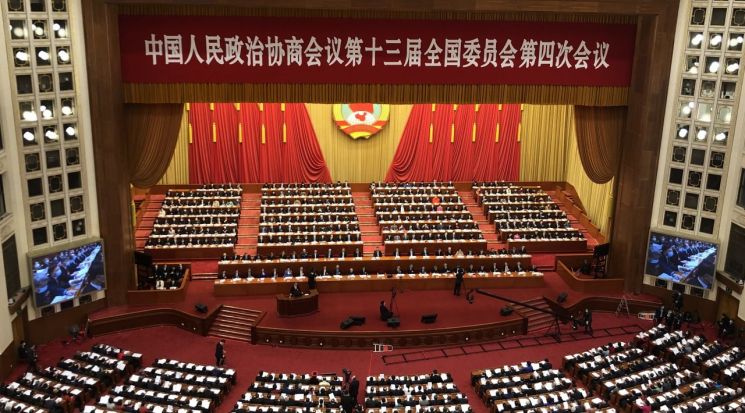 Opening ceremony of the plenary session of the Chinese People's Political Consultative Conference (CPPCC) at the Great Hall of the People in Beijing, China. The plenary sessions of the country's top legislative body, the National People's Congress (NPC), and the policy advisory body, the CPPCC, are held almost simultaneously every year and are collectively known as the Two Sessions. Yonhap News
Against the backdrop of mounting structural challenges such as an economic slowdown, sluggish domestic demand, a slumping property market, and youth unemployment, it is widely expected that this year's Two Sessions will highlight core tasks including achieving self-reliance in science and technology, fostering advanced manufacturing, stabilizing supply chains, and strengthening the social safety net for people's livelihoods.
The most closely watched item on the Two Sessions agenda will be Premier Li Qiang's government work report, to be delivered at the opening session of the National People's Congress (NPC) on the 5th. The report will set out China's target for economic growth, the fiscal deficit ratio, measures to boost consumption and support the property sector, and the scale of defense spending.
Over the past three years, China has consistently set its growth target at "around 5%" and has posted actual growth rates of 5.2%, 5.0%, and 5.0%, respectively.
However, the slowdown has become more pronounced since the third quarter of last year, and with U.S.-driven tariff pressure and technology controls, the property downturn, and youth unemployment all weighing on the economy, many assess that conditions this year will be even more challenging. In fact, more than 20 of the country's 31 provincial-level governments have lowered their growth targets for this year or reduced the lower bound of their target ranges.
Nevertheless, given the long-term goal of doubling gross domestic product (GDP) by 2035 compared with 2019 and the symbolic significance of this year as the starting point of the 15th Five-Year Plan, the "5%" level is seen as more than just a number; it is regarded as a political and psychological red line.
Experts suggest that Beijing may signal a commitment to growth at a level similar to last year while opting for a more flexible wording such as "around 5%." This is interpreted as a way of preserving policy room rather than clinging to a rigid target.
China's defense budget is another key area to watch. After raising military spending by 7.1% in 2022, China has maintained an annual increase of 7.2% for three consecutive years since 2023. Given the ongoing push for military modernization and the external security environment, the prevailing view is that this year's increase will be in a similar range.
The follow-up handling of Vice Chairman Zhang Youxia of the Communist Party's Central Military Commission and Central Military Commission member Liu Zhenli, Chief of Staff of the Joint Staff Department, is also drawing attention. Since China's military announced last month that the two are under investigation for serious disciplinary and legal violations, many observers believe the remaining steps amount largely to formal administrative procedures.
The NPC Standing Committee has placed on the agenda the review of motions concerning the appointment and removal of individual deputies at its meeting scheduled for the 25th and 26th, just before the Two Sessions. This has fueled speculation that the body may discuss the status of Zhang Youxia and Liu Zhenli as deputies.
Because NPC deputies enjoy constitutional immunity from criminal prosecution, stripping them of their deputy status is effectively seen as the final step paving the way for criminal punishment. Judicial action against top military leaders goes beyond rooting out corruption; it also serves to reaffirm control over the armed forces and to reassert the integrity of the command structure. Against the backdrop of a series of recent purges of senior military figures, some expect that the "one-man system" centered on President Xi Jinping and the principle of absolute obedience will be further underscored.
As the U.S.-China global strategic rivalry continues, there is also intense interest in what diplomatic line Beijing will articulate at the Two Sessions. With President Trump's visit to China expected in late March or early April, China is anticipated to spell out its basic principles for responding to tariffs, technology controls, and supply chain restructuring.
China has so far criticized what it calls U.S. "unilateralism" and "interference in internal affairs," while at the same time stressing the need to manage bilateral relations in a stable manner. This year's Two Sessions are likewise expected to produce a calibrated message that emphasizes "mutual respect" and "avoidance of conflict," while making clear that Beijing will firmly defend its core interests. In particular, since the recent ruling by the U.S. Supreme Court declaring reciprocal tariffs unlawful has dealt a blow to President Trump's signature weapon of tariff policy, there is even greater focus on the messages toward Washington that will emerge from this year's Two Sessions.
On the Taiwan issue, Beijing is expected to present a more explicit stance. There is also interest in whether China will send a warning message to Japan, with which ties have recently deteriorated sharply amid the security configuration surrounding the Taiwan Strait, and whether the Korean Peninsula issue, which was not separately mentioned last year, will be brought up.
© The Asia Business Daily(www.asiae.co.kr). All rights reserved.
![Clutching a Stolen Dior Bag, Saying "I Hate Being Poor but Real"... The Grotesque Con of a "Human Knockoff" [Slate]](https://cwcontent.asiae.co.kr/asiaresize/183/2026021902243444107_1771435474.jpg)















