U.S. Supreme Court Rules Reciprocal Tariffs Illegal
Trump Pushes Flat 15% Global Tariff Plan
K-Beauty Firms with High U.S. Exposure Say "Policy Uncertainty Persists"
Focus on U.S. Tariff Refunds... Potential Cash Inflow for APR
As U.S. President Donald Trump once again embarks on a global tariff war, tensions are rising in the K-beauty industry. Although the U.S. Supreme Court ruled that the Trump administration's reciprocal tariffs were illegal, President Trump announced that he would raise the "global tariff" from the existing 10% to 15%. While the country-specific, differentiated reciprocal tariffs have been blocked, a new variable has emerged. With tariff risks coming back into focus, K-beauty’s U.S. growth strategy is facing a major test.
According to the cosmetics and investment industries on the 23rd, the impact of the Trump administration’s global tariff imposition on the profits of Korean cosmetics companies is expected to be limited. However, there is an assessment that risk management has become more difficult because the uncertainty of tariff policy has increased. The 15% global tariff is numerically at the same level as the previous reciprocal tariff, but it has become harder to predict due to the possibility of an additional extension of the tariff application period and the potential for further measures.
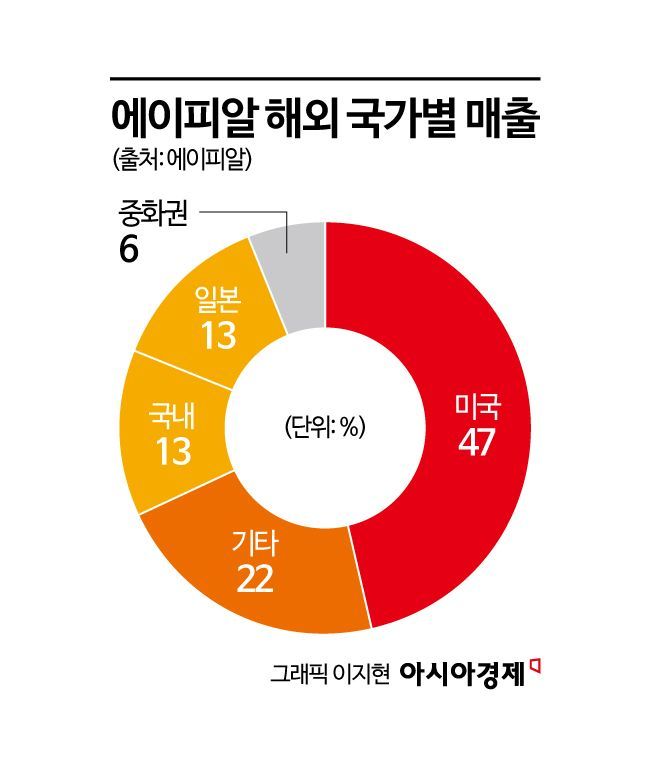
Among domestic beauty companies, APR currently has the highest proportion of exports to the United States. As of the fourth quarter of last year, overseas sales accounted for 87% of APR’s total revenue, of which the United States represented 47%. During the same period, APR’s sales to the United States amounted to 255.1 billion won. An APR official said, "In terms of the tariff rate alone, it is at the same level as before, so the impact will not be significant," but added, "Since the United States is our main export destination, we are always closely monitoring tariff issues." In fact, since the 15% reciprocal tariff began to be imposed in earnest last August, APR’s operating margin is understood to have been affected by a decline of about 1 percentage point.
Amorepacific is also one of the companies with a high share of U.S.-bound sales within its overseas revenue. As of the fourth quarter of last year, overseas sales accounted for 48.7% of Amorepacific’s total revenue, with the United States having the highest share at 15.7%. During the same period, Amorepacific’s sales to the United States amounted to 182.6 billion won. An Amorepacific official said, "Because we operate through a local subsidiary structure and negotiate prices with distributors, we have buffers that can absorb the tariff shock, so the impact will not be large," adding, "In particular, in the case of Laneige, a brand that is popular in North America, it was not positioned as a low-priced cosmetics line, so price resistance is relatively limited." The official continued, "However, we are always closely monitoring tariff developments."
In addition, manufacturers such as Cosmax and Korea Kolmar, as well as distributors such as Silicontwo, are also within the impact range. For manufacturers, the direct impact from tariffs is minimal, but they face volatility in orders from client companies. For distributors, there is an ongoing possibility of margin pressure.
Some observers warn that a flat global 15% tariff could weaken the competitiveness of Korean cosmetics companies. This is because many U.S. brands that have a similar market positioning to K-beauty brands source their products from Chinese original design manufacturers (ODMs), which would ease their cost burden.
Previously, Chinese products were subject to a total tariff of 20%, consisting of a "10% reciprocal tariff" and a "10% fentanyl tariff." If a flat 15% tariff is imposed this time, it would generate a cost-saving effect of about 5 percentage points compared with the previous level. Minyoung Son, an analyst at KB Securities, said, "If a flat global 15% tariff is imposed instead of country-specific differentiated tariffs, the reduction in China-related tariff burdens and associated risks for overseas brands could improve their profitability and reduce the demand for onshore production, thereby weakening the relative competitiveness of Korean cosmetics companies."
The illegal ruling on reciprocal tariffs has also raised the possibility of refunds for tariffs already paid. Since the 15% reciprocal tariff has been applied since the second half of last year, if refunds are made for the volumes exported to the United States during that period, companies could see a significant inflow of cash. However, because the refund process is not automatic, there is a possibility that separate administrative procedures or legal disputes may follow. Within the industry, there is also a view that even if refunds materialize, they will remain a one-off factor and are unlikely to be a decisive variable for the medium- to long-term earnings trajectory.
A beauty industry official said, "It is still too early to comment on any legal action related to the illegality of the existing reciprocal tariffs, but if refunds are realized in the future, it will be positive for short-term earnings," while adding, "However, it is difficult to say that policy uncertainty has been resolved."
Analyst Son said, "In the case of reciprocal tariff refunds, it will take a considerable amount of time before anything is finalized because the specific criteria, such as whether a given case is eligible for a refund, the refund amount, and the timing of application, all differ," but added, "If refunds are made, they will serve as a one-off earnings boost for companies with large export volumes to the United States, such as APR, Amorepacific, and Silicontwo."
© The Asia Business Daily(www.asiae.co.kr). All rights reserved.
![Clutching a Stolen Dior Bag, Saying "I Hate Being Poor but Real"... The Grotesque Con of a "Human Knockoff" [Slate]](https://cwcontent.asiae.co.kr/asiaresize/183/2026021902243444107_1771435474.jpg)















