Controversy Over the Composition of the Expert Committee for the 12th Basic Plan
"Skewed to One Side, Making It Difficult to Reflect Balanced Opinions"
Ministry: "We Will Disclose Each Stage and Collect Opinions"
Swings With Every Change of Administration... Supplementary Measures Needed
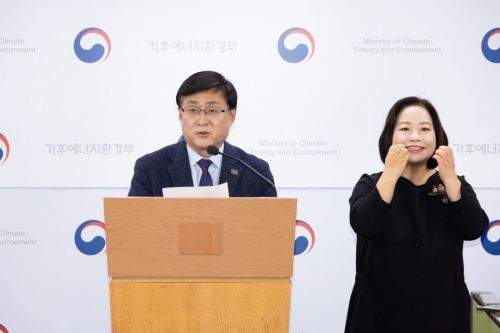 Kim Seonghwan, Minister of Climate, Energy and Environment, is briefing on the direction for implementing the 12th Basic Plan for Electricity Supply and Demand at the Government Complex Sejong in Sejong City on January 26, 2026. Photo by Ministry of Climate, Energy and Environment
As the government is drawing up the 12th Basic Plan for Electricity Supply and Demand (hereinafter the 12th Basic Plan), criticism has emerged that the composition of experts participating in the process is skewed to one side and needs to be supplemented.
According to the power industry on the 23rd, among the 79 private-sector experts participating in the 12th Basic Plan, only 6 are from civic organizations. In addition to the inclusion of an activist from Plan 1.5 in the General Committee, 1 to 2 members from civic groups are also present in each of the subcommittees on Demand Planning (Energy Transition Forum), Facility Planning (Plan 1.5, Ocean Energy Pathways), Grid Innovation (Green Energy Strategy Institute), and Market Innovation (Climate Solutions).
All of these civic organizations have argued that South Korea must greatly expand renewable energy such as solar and wind power. They act individually but also form coalitions depending on the issue. Plan 1.5, the Energy Transition Forum, and the Green Energy Strategy Institute have voiced opposition to expanding nuclear power plants.
Given that the wind power sector (GS Wind) and solar power sector (Hanwha Solutions) are each represented by one person from industry, this means that 8 people are participating from the renewable energy field alone.
In contrast, the nuclear sector is represented by only one person from the Korea Atomic Energy Research Institute. In addition, only one person each has been included for liquefied natural gas (LNG), hydrogen, coal, and thermal power, by generation source. This has led to analysis that the government may have formed the expert committee for the 12th Basic Plan with the policy goal of expanding renewable energy in mind.
The group that is raising the strongest objections to this is the nuclear sector.
The government has already decided, under the 11th Basic Plan, to proceed as planned with the construction of two large nuclear power plants and small modular reactors (SMRs). It has set a policy direction to achieve carbon neutrality through an energy mix of renewable energy and nuclear power, which is a zero-carbon power source.
The Basic Plan, which is formulated every two years, forecasts national power demand for the next 15 years and sets out corresponding plans for power supply and power generation facilities. The 11th Basic Plan covers up to 2038, while the 12th Basic Plan spans from 2026 to 2040. Since major power facility construction is carried out in line with the Basic Plan, the energy industry is paying close attention.
The nuclear sector argues that the 12th Basic Plan should also include additional construction plans for large nuclear power plants and SMRs. Nevertheless, with only one person from the nuclear field participating in the committee, there are concerns that the sector may not be able to properly voice its position in future decision-making processes.
Choi Sungmin, President of the Korean Nuclear Society, said, "Nuclear power can compensate for the intermittency of highly variable renewable energy through flexible operation," adding, "In order to reflect this role of nuclear power in the 12th Basic Plan, additional nuclear experts need to be included."
The Ministry of Climate, Energy and Environment has stated that it is difficult to add or change experts for the Basic Plan. Instead, it stressed that it will ensure full collection of external opinions by transparently releasing the process of formulating the Basic Plan in real time.
An official from the ministry said, "As there is room for controversy, the principle is not to disclose the list of experts for the Basic Plan to the outside," and added, "At each stage, we will make the contents of the Basic Plan public and use formats such as public debates to make up for any shortcomings."
The composition of the expert committee for the Basic Plan was also an issue for the 11th Basic Plan. At that time, 5 members from the nuclear sector participated, whereas no civic organizations were included. With the change of administration, the environment has swung from one extreme to the other.
Kim Sohee, a lawmaker from the People Power Party, pointed out, "The composition of the expert committee is skewed to one side, like a tilted playing field," and added, "Supplementary measures are needed to ensure a balanced formulation of the Basic Plan."
© The Asia Business Daily(www.asiae.co.kr). All rights reserved.
![Clutching a Stolen Dior Bag, Saying "I Hate Being Poor but Real"... The Grotesque Con of a "Human Knockoff" [Slate]](https://cwcontent.asiae.co.kr/asiaresize/183/2026021902243444107_1771435474.jpg)















