Network Usage Fees, Onple Act, and Map Exports
Cited as Non-Tariff Barriers in the Digital Sector
Concerns Mount Over Stronger U.S. Trade Pressure on Korea
Calls Grow to Slow the Pace of Regulatory Legislation
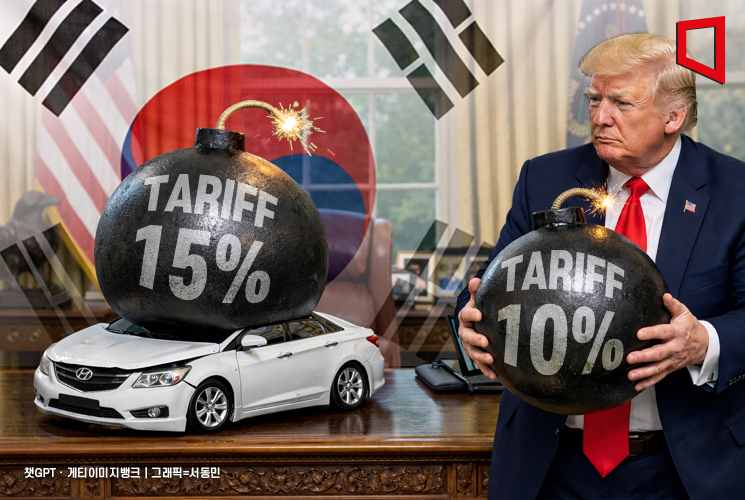
As U.S. President Donald Trump has pulled out the Section 301 card of the Trade Act, known as the "Super 301," in response to the Supreme Court’s brake on reciprocal tariffs, concerns are growing that Washington will use South Korea’s digital regulations as a pretext to ramp up trade pressure.
Section 301 of the Trade Act authorizes the U.S. administration to respond, including by imposing tariffs, to unfair, unreasonable, or discriminatory acts, policies, or practices by foreign governments that restrict or burden U.S. trade. Although it is nominally aimed at unfair trade practices, it is regarded as a tool for exerting pressure and triggering tariff measures against other countries based on the administration’s discretionary judgment. Because it enables wide-ranging investigations and sanctions against other countries, it is also called the "Super 301."
The Office of the United States Trade Representative (USTR), in its annual National Trade Estimate Report on Foreign Trade Barriers (NTE), has consistently cited South Korea’s network usage fee issue, restrictions on exporting high-precision maps overseas, the Cloud Security Assurance Program (CSAP), and the Online Platform Fairness Act (Onple Act) as representative non-tariff barriers in the digital sector.
The United States views as "anti-competitive" the bill under discussion in the National Assembly that would require global content providers to shoulder part of the network usage fees. It also regards as a disadvantage for U.S. companies the requirement that government approval be obtained to export South Korea’s high-precision maps to overseas servers. Google, Apple, and others have submitted applications to the Korean government to transfer 1:5000 scale high-precision map data to overseas servers, but the government is delaying its decision in consideration of concerns about reverse discrimination against domestic companies and the potential impact on trade negotiations. The CSAP certification system, which is required for entering South Korea’s public cloud market, is likewise one of the digital regulatory barriers pointed out by the United States.
The United States is also wary of the fact that the Korean government has restricted the overseas transfer of domestic users’ personal data through the Personal Information Protection Act and is expanding the scale of administrative fines through legal amendments. Washington further believes that the Online Platform Fairness Act (Onple Act), which the government and ruling party are pursuing, will function as a form of ex-ante regulation that works to the disadvantage of U.S. companies, and it views the Korean government’s pressure on Coupang over its large-scale personal data breach as excessive regulation.
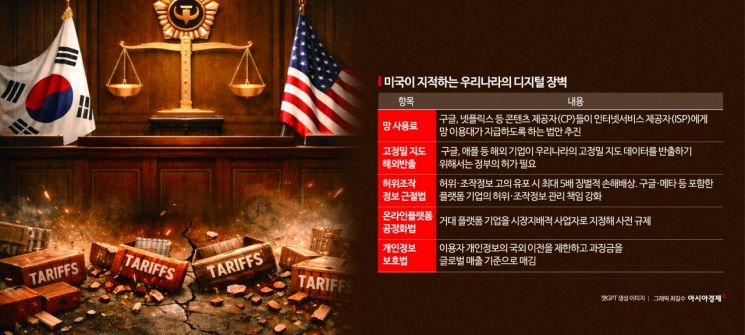
Some observers are concerned that the U.S. administration could also raise issues with the Fake News Eradication Act (the amended Information and Communications Network Act), which passed the National Assembly plenary session in December last year. This bill strengthens the responsibility of platform companies, including Google and Meta, for managing fake and manipulated information. It stipulates that, if fake or manipulated information is intentionally disseminated, punitive damages of up to five times the amount of actual loss may be claimed. The U.S. State Department stated in an official position last month, "We express serious concern over the Korean government’s decision to approve the amendment to the Information and Communications Network Act," adding, "This will negatively affect U.S.-based online platform businesses and undermine freedom of expression." James Heller, Charge d’Affaires ad interim at the U.S. Embassy in Seoul, also sent a letter last month to Baek Hoon, Deputy Prime Minister and Minister of Science and ICT, urging the Korean government to "honor its commitment not to discriminate against the operation of U.S. big tech companies’ businesses in Korea."
As trade uncertainty has grown with the United States invoking Section 301 of the Trade Act, some experts advise that the pace of ongoing digital regulatory legislation should be adjusted. Choi Kyungjin, a professor at the College of Law at Gachon University, said, "The Trump administration will likely seek to ratchet up trade pressure by citing South Korea’s digital regulations in order to induce greater investment into the United States," adding, "It is necessary to both moderate the speed of new legislation related to platform regulation and make efforts to explain that our government’s digital regulations are not targeted solely at U.S. companies."
© The Asia Business Daily(www.asiae.co.kr). All rights reserved.
![Clutching a Stolen Dior Bag, Saying "I Hate Being Poor but Real"... The Grotesque Con of a "Human Knockoff" [Slate]](https://cwcontent.asiae.co.kr/asiaresize/183/2026021902243444107_1771435474.jpg)
















