U.S. Supreme Court Rules Reciprocal Tariffs Illegal
Room to Offset Nullified Reciprocal Tariffs with Item-Specific Tariffs
Korean Pharma and Biotech Firms Reduce Risk via Local U.S. Bases
But Short- to Mid-Term Uncertainty Persists
Uncertainty facing the domestic pharmaceutical and biotech industry is expected to persist following the U.S. Supreme Court ruling that reciprocal tariffs are illegal. Immediately after the ruling, the Donald Trump administration moved to activate a "Plan B" that imposes a 15% "global tariff" on all imports and signaled the introduction of item-specific tariffs, meaning that risks surrounding tariffs on pharmaceuticals are likely to continue.
On the 23rd, Lee Seungkyu, Vice Chairman of the Korea Biotechnology Industry Organization, commented on the impact of the latest neutralization of reciprocal tariffs, stating, "In the short term, most of our companies have escaped tariff risk by securing local production bases in the United States." However, he also pointed out, "The U.S. administration has announced plans to compensate for the invalidated reciprocal tariffs with individual, item-specific tariffs, which means that the burden on companies will persist and intensify over the mid to long term."
Jung Yuntaek, Head of the Korea Pharma Economic Research Institute, said, "The introduction of the 15% global tariff is a symbolic expression of the Trump administration's determination not to back down from its external pressure stance even after the Supreme Court's ruling of unconstitutionality." He added, "Rather than immediately taking a sudden hard-line measure specifically on pharmaceuticals, the administration is expected to maintain a stance of approaching individual product categories such as biosimilars in a sophisticated, item-by-item manner, linking this to the results of the supply chain investigations it has already been conducting from the perspective of health security."
The main source of risk regarding pharmaceutical tariffs lies in the diversification of legal grounds. The latest Supreme Court ruling is limited to the International Emergency Economic Powers Act (IEEPA), which grants the president broad emergency economic powers. In contrast, the primary legal basis the Trump administration uses to impose tariffs on specific items such as pharmaceuticals is Section 232 of the Trade Expansion Act. Because this provision invokes national security as its justification, it is relatively free from judicial scrutiny. With the broad tool of reciprocal tariffs blocked by the judiciary, some analysts warn that if the administration concentrates its firepower on specific strategic items such as pharmaceuticals by leveraging Section 232, the pressure felt by the industry could become even stronger than before.
Political volatility is another risk that cannot be ignored. During the Korea-U.S. summit in November last year, the U.S. side suggested a 15% cap on tariffs for Korean pharmaceuticals, signaling stability. However, President Trump, just last month, did not hesitate to overturn the previous understanding by declaring that he would raise this cap to 25%. This is interpreted as an intention to use tariffs not merely as a trade barrier, but as a powerful bargaining chip to gain the upper hand in other trade issues. In particular, the 15% global tariff introduced on the basis of Section 122 of the Trade Act can remain in force for up to 150 days. After securing this five-month grace period, the administration is highly likely to design a more sophisticated and powerful package of item-specific tariffs by simultaneously pursuing "unfair trade investigations" under Section 301 of the Trade Act.
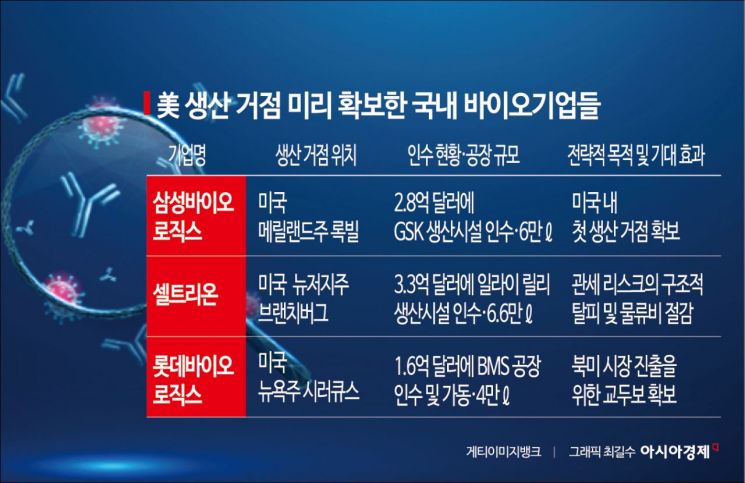
Amid these waves, domestic pharmaceutical and biotech companies are focusing on blocking the practical transfer of risk by securing local production bases in the United States. Samsung Biologics has established a production base in Rockville, Maryland, and Celltrion has built a large-scale contract manufacturing system by acquiring a production facility in New Jersey. Lotte Biologics has also set up a production base in New York, adopting a strategy of fundamentally bypassing tariff barriers. SK Biopharmaceuticals, for its part, has secured a local contract manufacturing organization (CMO) facility approved by the U.S. Food and Drug Administration (FDA), and is thus seen as having minimized the risk of supply chain disruption stemming from policy changes.
© The Asia Business Daily(www.asiae.co.kr). All rights reserved.
![Clutching a Stolen Dior Bag, Saying "I Hate Being Poor but Real"... The Grotesque Con of a "Human Knockoff" [Slate]](https://cwcontent.asiae.co.kr/asiaresize/183/2026021902243444107_1771435474.jpg)















