Ministry of National Defense: "Final announcement on South Korea-U.S. combined exercises to be made this week after coordination"
Uncertain prospects for cooperation on joint DMZ management and restoration of the military agreement
Discord between South Korea and the United States is expected to reach a critical point this week. Differences continue over the schedule of the South Korea-U.S. combined exercises, access to the Demilitarized Zone (DMZ), and the standoff during U.S.-China fighter training. There is a forecast that, if the rift deepens, it could also affect the restoration of the September 19 Military Agreement.
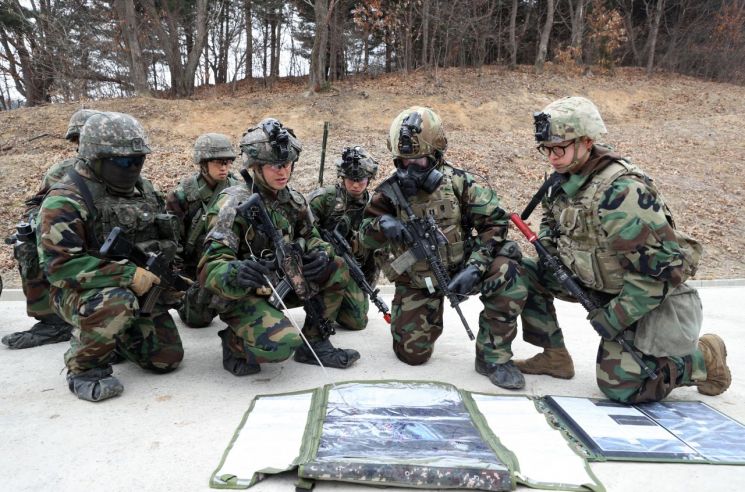 Soldiers from the Republic of Korea Army's 25th Division and U.S. Forces Korea's 2nd Infantry Division are shown discussing operations during last year's South Korea-U.S. joint exercise. Photo by the Joint Press Corps.
On the 23rd, a government official said, "We plan to make a final announcement on the coordinated plan for the South Korea-U.S. combined exercises within this week," adding, "As for the South Korea-U.S.-Japan combined air drills, we will further adjust the schedule because it overlaps with the Lunar New Year holidays and Japan's so-called Takeshima Day (designated every year on February 22)."
The South Korean and U.S. military authorities had initially planned to jointly announce the exercise plan for "Freedom Shield" (FS) on the 25th. South Korea’s position is to minimize field training exercises involving actual troops and equipment during the FS period. The U.S. military, on the other hand, is reluctant. It argues that scaling down is impossible because some additional U.S. troops and equipment have already arrived in South Korea to participate in the field training exercises.
Even if the South Korea-U.S. combined exercises are finally coordinated immediately, the U.S. side’s resentment is unlikely to be easily resolved. Our government plans to focus first on restoring the no-fly zones under the September 19 Military Agreement. If our military is unable to conduct reconnaissance and surveillance, it has no other choice but to rely on U.S. intelligence, surveillance, and reconnaissance assets. U.S. assistance is desperately needed, but cooperation remains uncertain.
The clash between South Korea and the United States began over the issue of authority to approve access to the Demilitarized Zone (DMZ). The United Nations Command protested, saying, "Allowing the Republic of Korea to have authority to approve access to the DMZ directly conflicts with the Armistice Agreement and would so undermine the United Nations Commander’s authority."
The Ministry of National Defense recently proposed joint management of the DMZ to the U.S. side, but both inside and outside the military, the assessment is that it will not be easy for the United Nations Command to accept this.
Subsequently, the standoff between U.S. and Chinese fighter jets further complicated matters. It is known that Minister of National Defense Ahn Kyu-baek and Chairman of the Joint Chiefs of Staff Jin Young-seung lodged a protest with U.S. Forces Korea on the 18th, saying that "no specific air training plans were shared."
© The Asia Business Daily(www.asiae.co.kr). All rights reserved.
![Clutching a Stolen Dior Bag, Saying "I Hate Being Poor but Real"... The Grotesque Con of a "Human Knockoff" [Slate]](https://cwcontent.asiae.co.kr/asiaresize/183/2026021902243444107_1771435474.jpg)















