People in Their 20s Account for Just 5.6% of New Car Registrations
Meanwhile, the Share of New Cars Owned by Older Drivers Rises Every Year
60s at 18.5%, 70s at 4.6%

Last year, the share of newly registered cars accounted for by people in their 20s and 30s fell to its lowest level in the past 10 years. In contrast, the registration share for those in their 60s and 70s rose sharply. Analysts say that people in their 20s and 30s, who feel burdened by high car prices, are opting for car-sharing services instead of purchasing, while people in their 60s and 70s are increasingly inclined to buy cars for economic activity.
According to Kaizuyu Data Research Institute on the 23rd, the number of newly registered passenger cars by people in their 20s last year (based on privately owned passenger vehicles) was 61,962, accounting for only 5.6% of the total 1,102,051 newly registered passenger cars.
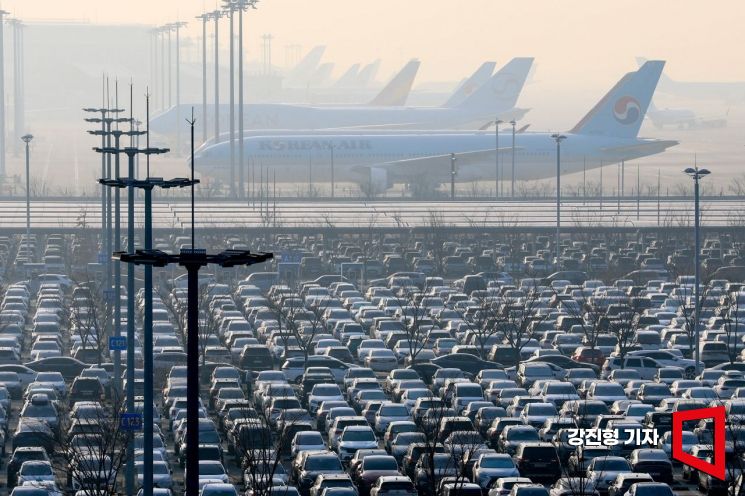 The long-term parking lot at Incheon International Airport Terminal 2 is filled with travelers' cars. The photo is not related to the specific content of the article. Photo by Kang Jinhyung
The new car registration share for people in their 20s was 8.8% in 2016, but over the past five years it has declined, recording 8.0% in 2021, 7.8% in 2022, 7.2% in 2023, and 6.7% in 2024. Last year it fell further to 5.6%, the lowest level in the 10 years since Kaizuyu Data Research Institute began compiling the data in 2016.
The number of newly registered passenger cars by people in their 30s last year was also 209,749. Their share of registrations was only 19.0%. The new car registration share for people in their 30s has likewise been declining every year. Their share, which was 25.9% in 2016, fell to 19.0% last year, a drop of 6.9 percentage points over 10 years. This is also the lowest level in the past decade.
In contrast, both the number and share of newly registered passenger cars for older age groups in their 60s and 70s have been increasing every year. Last year, the number of new car registrations for people in their 60s and 70s was 204,294 and 50,861 respectively, accounting for 18.5% and 4.6% of total sales.
The share of new car registrations by people in their 60s was only 9.6% in 2016, but it has steadily risen, reaching 18.5% last year, roughly doubling. The new car registration share for people in their 70s, which was 2.8% in 2016, has also increased every year, reaching the mid-4% range last year. The combined new car registration share for people in their 60s and 70s also hit a 10-year high.
The main reasons cited for the decline in new car purchases among people in their 20s and 30s are the sharp rise in car prices and the spread of the sharing economy. There is an interpretation that young people in their 20s, who do not regard cars as essential goods, are feeling increasingly burdened by continuously rising new car prices and are instead turning to car-sharing applications (apps) rather than buying.
Although voluntary surrender of driver’s licenses is being encouraged to prevent accidents involving elderly drivers, demand for cars among people in their 60s and 70s is not decreasing. As population aging leads to more people in these age groups remaining economically active, demand for vehicles for mobility purposes appears to be holding steady.
© The Asia Business Daily(www.asiae.co.kr). All rights reserved.
![Clutching a Stolen Dior Bag, Saying "I Hate Being Poor but Real"... The Grotesque Con of a "Human Knockoff" [Slate]](https://cwcontent.asiae.co.kr/asiaresize/183/2026021902243444107_1771435474.jpg)

















