After 599 Trillion Won Last Year, Further Rebound Expected
Global healthcare venture capital (VC) investment has now completed its correction phase and is expected to rebound in earnest this year, leveraging new drug development technologies that use artificial intelligence (AI).
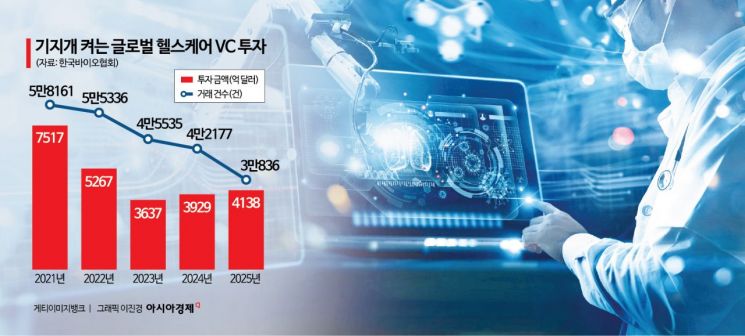
According to the report titled "Global Healthcare Industry Investment Status and Outlook" published on the 23rd by the Korea Biotechnology Industry Organization, global healthcare VC investment hit an all-time high of 751.7 billion dollars (about 1,088 trillion won, 58,161 deals) in 2021 before declining, but it appears to have bottomed out as it recovered to 413.8 billion dollars (about 599 trillion won, 30,836 deals) last year. Market participants analyze that AI technology will drive investment again this year, expanding capital inflows centered on initial public offerings (IPOs) and mergers and acquisitions (M&A). This is because the adoption of AI improves the success rate from the discovery of new drug candidates through to clinical trials, while significantly reducing massive development costs.
By major segment, biopharmaceutical investment peaked at 55.6 billion dollars (about 80 trillion won) in 2021 during the COVID-19 pandemic, then declined to 27.1 billion dollars (about 39 trillion won) last year as clinical development risks following large-scale capital inflows and the contraction of capital markets interacted in a complex way. However, as additional interest rate cuts gradually increase risk appetite across capital markets, investment in this area is expected to improve gradually going forward. Meanwhile, the healthcare technology segment, which had been on a downward trend from 29.9 billion dollars (about 43 trillion won) in 2021, showed a modest rebound to 12.6 billion dollars (about 18 trillion won) last year, moving past the contraction phase and entering a stabilization stage. Even amid market adjustments across platform and digital health, AI healthcare companies are successively securing funding. Large-scale deals continue to drive substantial capital inflows, including more than 500 million dollars (about 724.0 billion won) raised by Abridge, 481 million dollars (about 696.4 billion won) by Transcarent, and 275 million dollars (about 398.2 billion won) by Innovacer.
The medical technology segment, centered on medical devices and diagnostics, has maintained relatively stable demand and functioned as a defensive investment area, recording an investment volume of 11.6 billion dollars (about 16 trillion won) last year. In contrast, the healthcare services and pharmaceutical services segments showed a clear decline, as capital flows shifted away from VC investment toward private equity (PE) and strategic investment. Structural changes in the exit market are also noteworthy. In the past, exits in the biopharmaceutical sector were mainly driven by increases in IPO proceeds and the number of listings, but since 2022, as capital markets have frozen, the exit market has recently been reorganized around mergers and acquisitions. Going forward, accelerated healthcare policy reform, changes in reimbursement systems, and the convergence of healthcare IT and healthtech are expected to become key drivers that will positively shape the global investment environment.
The report stated, "After the large inflows of capital during the pandemic, clinical development risks and the contraction of capital markets have jointly led to an adjustment in both the scale and frequency of investments," and forecast that "as additional interest rate cuts expand risk appetite across capital markets, investment activity will show a gradual improvement trend going forward."
© The Asia Business Daily(www.asiae.co.kr). All rights reserved.
![Clutching a Stolen Dior Bag, Saying "I Hate Being Poor but Real"... The Grotesque Con of a "Human Knockoff" [Slate]](https://cwcontent.asiae.co.kr/asiaresize/183/2026021902243444107_1771435474.jpg)















