Core Project of the Wonderful Nam River Initiative
Expected to Boost Tourism as an Integrated Space for Rest, History, and Culture
Jinju City in South Gyeongsang Province is accelerating the development of Mangyeong Park, a differentiated tourism resource that expands rest areas in the old downtown and combines the natural scenery of the Nam River with the city’s unique history.
This project is a core initiative of the “Wonderful Nam River Project,” which Jinju City is promoting as a priority. It is expected to reinvigorate the old downtown area, where park infrastructure has been relatively lacking, and serve as a springboard for Jinju to grow into a city of historical and cultural tourism. The city is developing Mangyeong Park as a “Bigeo (Flying Vehicle) Theme Park” where visitors can experience Jinju’s history and culture.
◆ “Bigeo Overpass” connecting Somang Jinsan and Mangyeong Park
The “Bigeo Overpass,” promoted through a design competition, is highly significant in that it connects Somang Jinsan Lantern Park and Mangyeong Park, which had been cut off from each other by roads, into a single pedestrian axis. This overpass, built as a steel structure 5 meters wide and 40 meters long, features a sophisticated aluminum panel exterior and a warm wooden deck floor, providing citizens with a safe and pleasant walking environment.
In terms of design, it maximizes sculptural beauty by embodying the dynamic moment when Bigeo, a historical asset of Jinju, spreads its wings toward the sky and soars. With the overpass now linking the two parks, movement between them has become more convenient, and the secured, organic circulation is creating a flow that connects tourism resources across the old downtown.
In particular, at night, the light leaking through the perforated panels on the outer wall of the overpass visually recreates the image of lanterns floating on the Nam River. It creates a subtle scene as if countless lanterns are slowly drifting along the water, transforming the structure from a simple walkway into a new nighttime scenic attraction that embodies Jinju’s identity and artistic character.
◆ “Bigeo Forest Trail” connecting the Bigeo Overpass and the old beacon mound
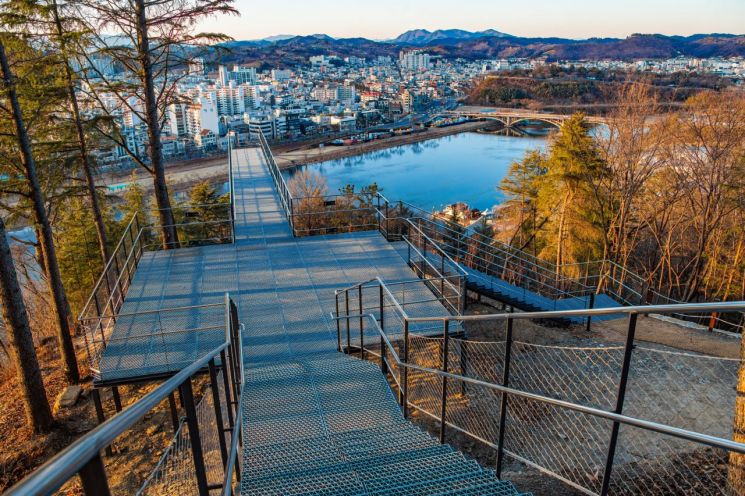
The “Bigeo Forest Trail,” promoted alongside the Bigeo Overpass as part of the design competition and completed last year, has refurbished the aging existing walking path into a rest area where visitors can closely enjoy the beautiful natural scenery of the Nam River.
This forest trail, which connects the Bigeo Overpass with the Mangjinsan Beacon Mound, includes two viewing decks that offer sweeping views of the Nam River, Jinju Fortress, and the cityscape of Jinju. On some sections of the 560-meter-long trail, a steel grating structure has been applied to enhance openness and durability. In addition, nighttime lighting has been installed to improve the walking environment so that citizens can enjoy safe strolls regardless of the time.
With the creation of the Bigeo Forest Trail, a tourism circulation route has been established from Somang Jinsan Lantern Park to the old beacon mound. Accessibility between parks has also been improved, allowing citizens to enjoy nature in the city center more conveniently.
◆ Expansion of observatory, traditional garden, and convenience facilities
The “Mangyeong Park Observatory Development Project” began construction last year and is scheduled for completion this year. The upper level will be configured as an open-air external space with a pavilion-like structure that allows wind to pass through, forming a new landscape of the Nam River that harmonizes with Chokseoknu Pavilion and providing an open space for citizens.
The “Traditional Culture Garden Development Project” was selected in 2024 as a tourism resource development project, securing conversion project funding, and construction began in December last year. Comprising three zones-an entrance garden, a water purification and pumping station area, and a forest garden-the project will plant traditional tree species and reinterpret traditional garden elements in a modern way to realize a Korean traditional garden that harmonizes with nature.
In addition, within the Mangyeong Park area, the city is promoting the construction of a parking lot to maximize convenience for park users, and plans to complete by 2026 the widening and expansion of the park access road, which has long caused inconvenience due to its narrow width. The goal is to create an easily accessible urban rest and tourism attraction that any citizen can use conveniently.
◆ Step-by-step completion through 2027, revitalizing the old downtown
Jinju City plans to carry out the Mangyeong Park development project in phases through 2027 and open each section sequentially. By completing the project in stages, the city aims to minimize inconvenience to citizens during construction, while gradually opening finished sections to enhance the public’s sense of benefit.
Mangyeong Park is an area that had long been neglected and used as farmland in the past, and the project is highly meaningful in that it returns this space to citizens. By organically linking it with nearby major tourism resources such as the Nam River, Chokseoknu Pavilion, and Jinju Fortress, the city plans to expand pedestrian routes and transform the area into a stay-type destination where visitors can enjoy nature, history, and culture together.
The city intends to establish a “Nam River Tourism Belt” centered on Mangyeong Park and foster it as a key hub of “Wonderful Nam River.” Through this, Jinju aims to inject new vitality into the old downtown and turn the area into a place that visitors will want to return to again and again.
© The Asia Business Daily(www.asiae.co.kr). All rights reserved.
![Clutching a Stolen Dior Bag, Saying "I Hate Being Poor but Real"... The Grotesque Con of a "Human Knockoff" [Slate]](https://cwcontent.asiae.co.kr/asiaresize/183/2026021902243444107_1771435474.jpg)















