First Meeting of the High-Level Radioactive Waste Management Committee on the 23rd
Adoption of Rules for Committee Operations
Discussion of Site Suitability Investigation Plan
Start of URL Construction in Taebaek City This Year
Four National Assembly-Recommended Seats Vacant...Criticism of a Half-Complete Launch
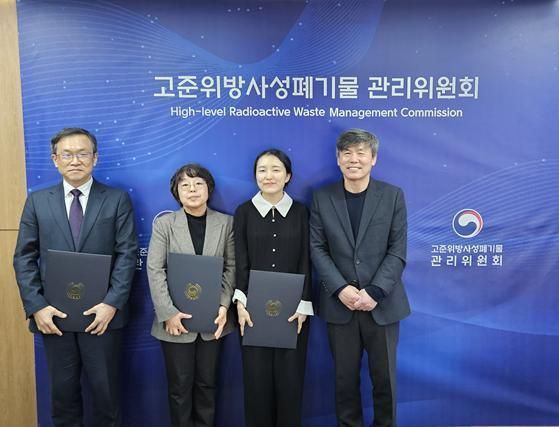 Jung Jaehak (Professor, Kyung Hee University), Park Jinhee (Professor, Dongguk University), and Ha Jeongrim (Attorney, Taerim Law Firm), non-standing members of the High-Level Radioactive Waste Management Committee, together with Chairman Kim Hyunkwon, are taking a commemorative photo after the presentation of appointment letters. Jan. 5, 2026. High-Level Radioactive Waste Management Committee
The High-Level Radioactive Waste Management Committee is holding its first meeting since its launch and is formally beginning its work to construct high-level radioactive waste management facilities, including an underground research laboratory, an interim storage facility, and a disposal facility.
On the 23rd, the High-Level Radioactive Waste Management Committee will hold its first meeting at the Post Tower in Jung-gu, Seoul, where it will adopt the detailed operating regulations of the Committee and receive reports from the Secretariat on this year’s work plan and on the site suitability investigation plan.
This meeting is the first official activity since the Committee was established on September 26 last year in accordance with the Special Act on the Management of High-Level Radioactive Waste. The Committee was set up under the Prime Minister’s Office to carry out work such as managing high-level radioactive waste and conducting site investigations and selection for management facilities. It will exist for five years and, within that five-year period, will review whether to change the responsible central administrative authority.
The operating regulations to be adopted by the Committee on this day set out the matters delegated by the Special Act on the Management of High-Level Radioactive Waste and its Enforcement Decree. They include detailed provisions for operating meetings, such as convening meetings, submitting and placing items on the agenda, and decision-making procedures, as well as rules on the formation and operation of expert committees and advisory panels to enhance the Committee’s expertise on individual issues.
The Secretariat will report on its work plan, including: establishing the Third Basic Plan for High-Level Radioactive Waste Management; selecting sites for high-level radioactive waste management facilities; preparing support measures for regions that host management facilities; and promoting the acquisition of Korean-type high-level radioactive waste disposal technology. Since the Second Basic Plan was established on December 2, 2021, the Third Basic Plan must be prepared by the end of this year, when the five-year statutory deadline expires.
The Committee stated, “Because this year is an important year that marks the first year of high-level radioactive waste management, we plan to strengthen implementation by clarifying the medium- to long-term implementation plan (roadmap) and guiding principles of the high-level radioactive waste management policy through the establishment of the Third Basic Plan.”
The Committee also received a report on the draft site suitability investigation plan for high-level radioactive waste management facilities, which presents a blueprint for the entire process of selecting sites for such facilities.
In detail, within this year the Committee will first exclude areas unsuitable for installing management facilities, such as volcanic and fault zones, and will conduct preliminary surveys of areas with favorable site conditions, with the results to be made public in a transparent manner.
Next year, it plans to carry out a site solicitation process targeting local governments in areas where unsuitable regions have been excluded. Local governments wishing to host management facilities may apply to the solicitation after completing procedures such as confirming residents’ opinions and obtaining consent from their local councils.
For sites submitted by local governments, the Committee will evaluate factors such as geological safety and compliance with legal procedures, select “candidate sites for preliminary investigation,” and then finalize the site for the management facilities through a sequence of steps: preliminary investigation, in-depth investigation, and a local referendum.
High-level radioactive waste is stored in wet storage and temporary (dry) storage facilities within nuclear power plants, then transferred to an interim storage facility, and finally moved to a deep geological disposal facility. The site suitability investigation plan will be finalized after this meeting, following the collection of opinions from relevant ministries and agencies, including the Nuclear Safety and Security Commission, and after additional revisions and deliberation.
In Korea, the spent nuclear fuel wet storage facilities at the Hanbit, Hanul, and Kori nuclear power plants are expected to reach capacity starting in 2030, creating an urgent need to expand on-site temporary storage facilities. The Committee also plans to construct an interim storage facility by 2050 and a disposal facility by 2060.
Before constructing the disposal facility, the Committee plans to launch, within this year, the project to build an underground research laboratory (URL) in Taebaek City. The underground research laboratory, with a total project cost of 647.5 billion won (635.6 billion won from the central government budget and 11.9 billion won from local government funds), is scheduled for completion in 2032 and will later be opened to the public to help raise awareness of high-level radioactive waste management policy.
Meanwhile, the High-Level Radioactive Waste Management Committee consists of nine members including the Chairperson. At present, only five positions have been filled: the Chairperson; one standing member appointed by the President upon the Chairperson’s recommendation; and three non-standing members. The remaining four members to be recommended by the National Assembly are vacant, leading some to criticize the launch as being only half-complete.
© The Asia Business Daily(www.asiae.co.kr). All rights reserved.
![Clutching a Stolen Dior Bag, Saying "I Hate Being Poor but Real"... The Grotesque Con of a "Human Knockoff" [Slate]](https://cwcontent.asiae.co.kr/asiaresize/183/2026021902243444107_1771435474.jpg)















