UN: "Governments Must Confront Corruption and Prosecute Criminal Networks"
The United Nations (UN) human rights body has urged governments around the world to crack down on scam (fraud) syndicates, warning that such organizations are rapidly increasing in number, particularly in Southeast Asia.
According to AFP and other outlets on the 19th (local time), the Office of the UN High Commissioner for Human Rights (OHCHR) released a report documenting cases of damage caused by scam syndicates that occurred between 2021 and 2025 in Cambodia, Laos, Myanmar, the Philippines, and other locations. The report estimates that more than 300,000 people across Southeast Asia have been involved in scam-related crimes.
Based on satellite imagery, field reports, and other sources, 74% of the identified scam syndicates were found to be concentrated in the Mekong River basin. The criminal proceeds that these organizations generate worldwide are estimated at 64 billion dollars (about 92.7 trillion won) per year.
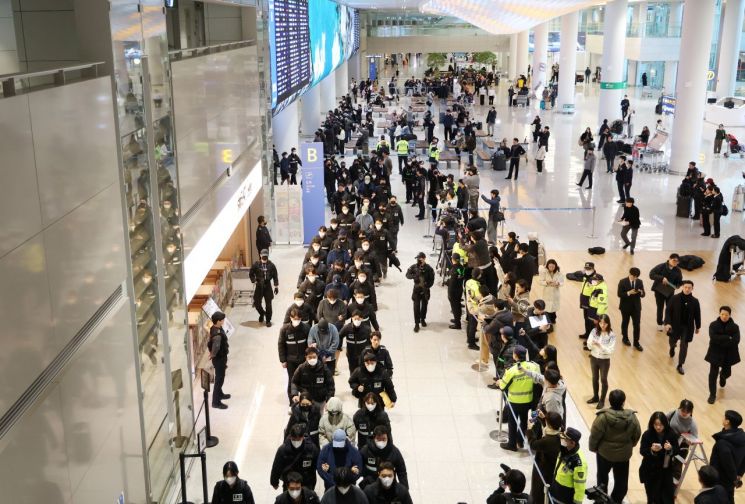 Members of a Korean criminal organization who committed crimes in Cambodia, including scams (fraud) and hostage-taking and robbery, were repatriated to Korea via Incheon International Airport on January 23 and are being escorted to investigative agencies. Yonhap News
The victims came from at least 66 countries, including nations in Asia and Africa, and were highly diverse. Among them, 75% said they became involved with the scam syndicates through friends, family, or acquaintances. It was also revealed that 79% of survivors did not even know that scam compounds existed before they became victims of the syndicates through human trafficking and other means.
Some 68% of the victims accepted the jobs offered by the scam syndicates because of the promised salary, and 47% were either unemployed at the time or in precarious employment situations.
The report provides detailed descriptions of the horrific conditions at the time, based on survivors' testimonies. Victims were confined in large facilities surrounded by barbed wire and were forced to work for up to 19 hours a day. One victim from Sri Lanka testified that if they failed to meet their monthly fraud targets, they were punished by being locked for several hours in a water container known as a "water prison."
Another victim from Bangladesh said the perpetrators forced them to watch others being abused or compelled them to participate directly in acts of violence as a way to enforce obedience.
A victim from Ghana testified that he was forced to watch his friend being beaten right in front of him, while a female victim from Vietnam said she was starved for a week after her escape attempt was discovered. There were also allegations that government bodies such as the police and border guards colluded with the scam syndicates.
Volker Turk, the UN High Commissioner for Human Rights, condemned the situation as "shocking and heartbreaking," and urged governments to "prosecute the criminal organizations behind these abuses and combat corruption." He added that "safe, timely, and effective rescue operations for victims are needed, along with guarantees of rehabilitation for torture and trauma, and appropriate support systems to help them avoid the risk of reprisals."
© The Asia Business Daily(www.asiae.co.kr). All rights reserved.
![Clutching a Stolen Dior Bag, Saying "I Hate Being Poor but Real"... The Grotesque Con of a "Human Knockoff" [Slate]](https://cwcontent.asiae.co.kr/asiaresize/183/2026021902243444107_1771435474.jpg)















