Auto insurance posts 150 billion won loss... insurance profit down 4.4%
CSM at 14.1677 trillion won... K-ICS ratio at 262.9%
Samsung Fire & Marine Insurance announced on the 20th that it posted a net profit of 2.0183 trillion won attributable to controlling shareholders last year.
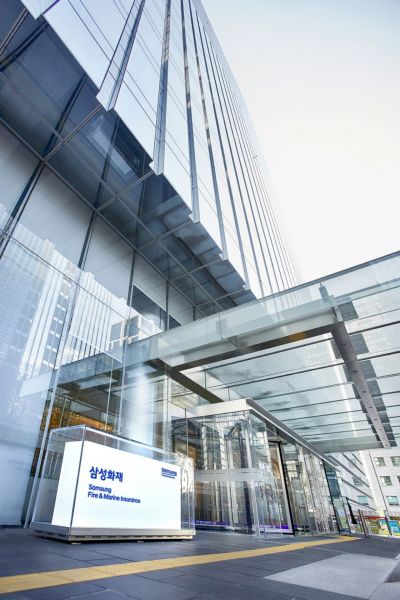 Exterior view of the Samsung Fire & Marine Insurance Seocho Building, Seocho-gu, Seoul. Samsung Fire & Marine Insurance
Although net profit remained in the 2 trillion won range for the second consecutive year, it decreased by 2.7% compared with the previous year.
Insurance profit fell 4.4% year-on-year to 1.5077 trillion won, affected by a reduction in the accumulated gap between expected and actual insurance claims, despite stable insurance contract service margin (CSM) amortization income and disciplined expense management.
In long-term insurance, the company generated a stable level of new business CSM as the conversion of the new business portfolio toward profitability in the second half improved the conversion multiple by 1.7 times compared with the first half. The total amount of CSM in force at the end of last year was 14.1677 trillion won, up from the end of the previous year.
In automobile insurance, based on its competitive edge in online channels, the company recorded insurance revenue of 5.5651 trillion won, maintaining a similar level to the previous year.
Insurance profit posted a loss of 159 billion won due to the accumulated impact of past rate cuts and higher claims costs.
In general insurance, insurance revenue increased 6.1% year-on-year, driven by concurrent growth at home and abroad through the expansion of specialty insurance and portfolio solutions. However, due to an increase in small and mid-sized claims, the loss ratio rose by 0.9 percentage points, and insurance profit decreased 2.8% to 170.8 billion won.
In the asset management segment, the investment yield came in at 3.44%, as valuation gains expanded on the back of enhanced asset yields and investments focused on high-return assets. This represented an improvement of 0.22 percentage points from the previous year. Investment profit based on assets under management was 2.9813 trillion won, up 13.8% year-on-year.
As of the end of December last year, the Korea Insurance Capital Standard (K-ICS) ratio stood at 262.9%, remaining at a stable level, although it was down 1.6 percentage points from a year earlier. The basic capital ratio was 170.7%, up 14.7 percentage points.
Samsung Fire & Marine Insurance pledged to cancel treasury shares and increase dividends to enhance shareholder value. Last year, the dividend per share (DPS) was 19,500 won, with a shareholder return ratio of 41.1%. Based on profit growth and other factors, the company plans to raise the shareholder return ratio to 50% by 2028.
Following the reduction of its treasury share ratio to 13.4% through the cancellation of common shares and treasury shares in April last year, the company also presented a plan to lower this ratio to around 5% by 2028.
Samsung Fire & Marine Insurance also unveiled its key management strategies for this year.
First, it plans to strengthen its core insurance business competitiveness by moving beyond the existing competitive landscape and pursuing profitability-focused management and business structure innovation.
In addition, as a leading insurer, the company plans to continue identifying differentiated new growth engines through swift and bold changes in a rapidly changing environment.
Ku Youngmin, Chief Financial Officer (CFO) and head of the Management Support Office at Samsung Fire & Marine Insurance, said, "All business divisions will carry out bold changes to solidify the fundamentals of our core business," adding, "We will strive to remain a company trusted by shareholders, customers, and society by building a new growth foundation through challenges that can reshape the market landscape."
At the earnings conference call held the same day, Samsung Fire & Marine Insurance faced criticism that "its value-up policy is weaker than that of other Samsung Group affiliates" and that "shareholder returns are insufficient."
Cho Beonhyeong, head of the Management Support Team, said, "Our goal of raising the shareholder return ratio to 50% by 2028 under the 'corporate value enhancement value-up strategy' announced in January last year remains unchanged," explaining, "We are precisely measuring the return on equity (ROE) for each business unit and preparing capital allocation measures to achieve this goal."
There was also a comment that "the long-term insurance loss ratio is somewhat high at 97.2%."
Jinman Cho, head of the Long-term Insurance Strategy Team, said, "Last year's 97.2% loss ratio is a figure that rose 9.5 percentage points from the previous year, but this is due to a base effect stemming from changes in the incurred but not reported (IBNR) loss recognition system in the previous year," adding, "We began implementing measures to control excessive (insurance claim) billing last year, and as we will simultaneously expand high-quality coverage and adjust rates from this year onward, the annual loss ratio is expected to gradually decline."
© The Asia Business Daily(www.asiae.co.kr). All rights reserved.
![Clutching a Stolen Dior Bag, Saying "I Hate Being Poor but Real"... The Grotesque Con of a "Human Knockoff" [Slate]](https://cwcontent.asiae.co.kr/asiaresize/183/2026021902243444107_1771435474.jpg)















