Elderly diners fill the restaurant, signaling a new social trend
Older adults going out in search of 'socializing' rather than just a meal
Rising 'senior consumption'... concerns over polarization among the elderly
"There are so many kinds of seasoned vegetables. It is really nice. Think how much work it would take to prepare all of this at home..."
A little before noon on the 19th, at a three-star hotel buffet in Myeong-dong, Jung-gu, Seoul. As lunchtime began, instead of tourists, women in their 70s and 80s wearing bright scarves started lining up to enter. Jung Haengmi (74), linking arms with a friend who had just arrived, walked into the buffet laughing like a schoolgirl. Most of the seats were occupied by seniors with graying hair. Hotel restaurants in downtown Seoul had become a modern version of a village gathering place for "active seniors." While serving herself abalone porridge, Jung said, "My friends and I each put in 100,000 won a month into a rotating savings club and come out to eat at a hotel," adding, "I have finished raising my children, so now I want to spend money on my own body and happiness."
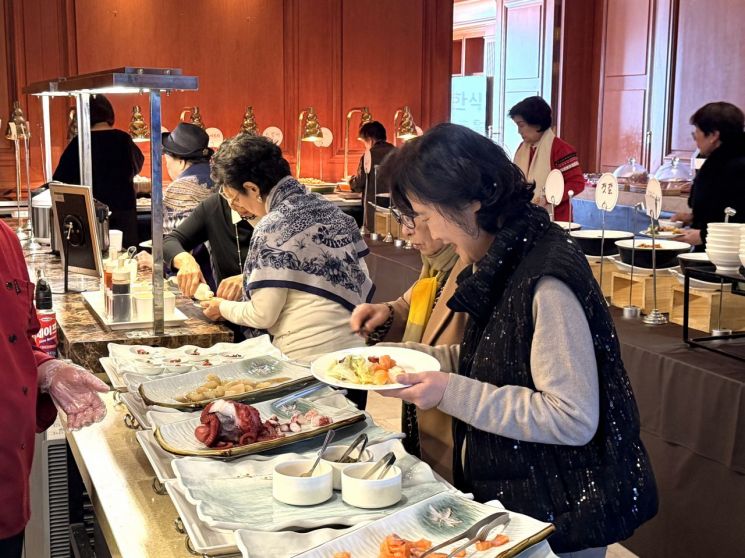 On the afternoon of the 19th, senior citizens are choosing food for their lunch at a three-star hotel buffet in Myeong-dong, Jung-gu, Seoul. Recently, downtown hotel restaurants have become a 'social space' for the elderly who gather for outings and social interaction. Photo by Park Hosu
'Hotel lunch' is just an excuse... the real purpose is 'social interaction'
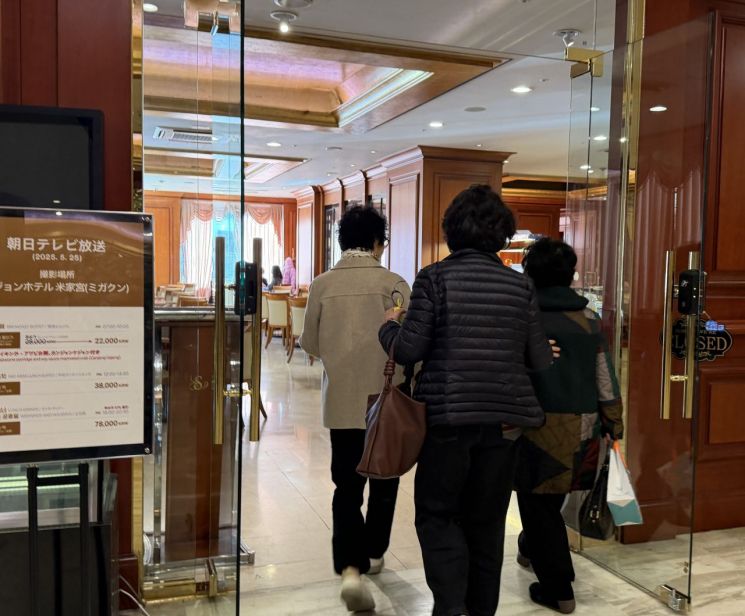 Women in their 70s who arrived early at a hotel restaurant in Myeong-dong, Jung-gu, Seoul, ahead of its opening are entering for lunch. Photo by Park Hosu
The consumption landscape of the elderly is changing rapidly as more "active seniors" (older adults who continue to enjoy leisure, consumption, and social activities after retirement and live proactively) choose outings and social interaction through reasonably priced hotel meals and similar options.
The so-called "haljummas' lunch" (a portmanteau of the Korean words for grandmother and middle-aged married woman) is far removed from the luxury of a single meal costing well over 100,000 won at a five-star hotel restaurant. Most are weekday buffets priced in the 20,000-30,000 won range, but for seniors, these meals provide not only a way to take care of a meal but also a justification to go out of the house. Lee (73), who lives in Gwangjin-gu, Seoul, said, "If I stay at home, the day ends with nothing but watching TV, but when I come out like this, I choose what to wear, put on makeup, and see people," adding, "The fact that we spend time together is more important than the food." A hotel representative said, "After switching to year-round operation, more than 90% of our guests have become people in their 60s to 80s, and quite a few come alone," adding, "Naengmyeon, which stimulates seniors' appetites, is the most popular menu item."
Experts see this phenomenon as an alternative form of a "dismantled community." Park Seunghee, a professor in the Department of Social Welfare at Sungkyunkwan University, said, "Commercial spaces are replacing the traditional sarangbang and neighborhood gatherings that have disappeared," and analyzed, "The act of going out and communicating with others, even by paying money, is a kind of choice for survival." From a medical perspective as well, such outings by the elderly are recommended. Choi Seonghye, a professor of neurology at Inha University Hospital and president of the Korean Dementia Association, explained, "Social isolation is one of the major risk factors for dementia," adding, "The very process of seniors having conversations and maintaining relationships is brain activity."
Seniors lining up at free meal centers as well... "We must address polarization"
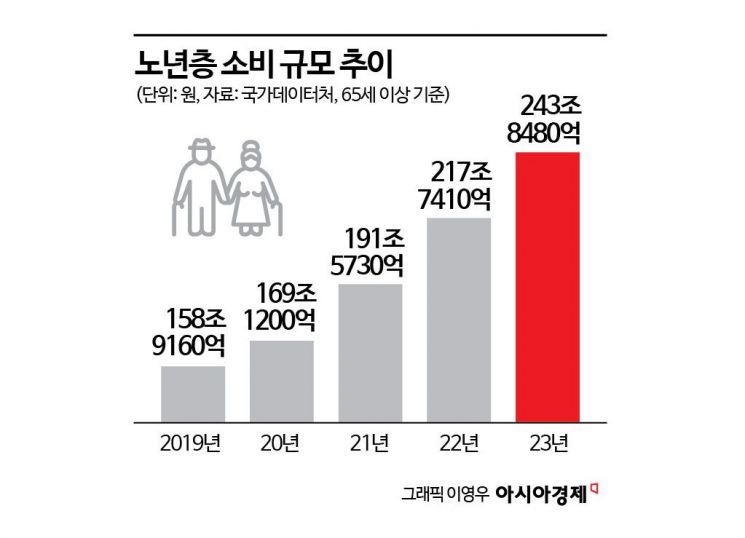
Some observers warn that this new pattern of "senior consumption" could lead to polarization among the elderly. According to the Ministry of the Interior and Safety on the 20th, South Korea entered a super-aged society in December 2024, when the proportion of the population aged 65 and older exceeded 20%. Senior consumption is also increasing rapidly. An analysis released by the National Data Agency late last year showed that total consumption by those aged 65 and older in 2023 was 243.8 trillion won, up 12% from the previous year. In particular, spending on leisure and dining out has increased significantly, creating a trend in which the elderly are gaining control of the market.
Professor Park pointed out, "There are seniors who maintain their relationships with 30,000 won, while long lines still form at free meal centers in Seoul," adding, "Consumption polarization can lead to gaps in social relationships." She continued, "We need policy alternatives to bridge the gap between older adults who drive private consumption and those who depend on the welfare system."
© The Asia Business Daily(www.asiae.co.kr). All rights reserved.
![Clutching a Stolen Dior Bag, Saying "I Hate Being Poor but Real"... The Grotesque Con of a "Human Knockoff" [Slate]](https://cwcontent.asiae.co.kr/asiaresize/183/2026021902243444107_1771435474.jpg)

















