Interview with National Data Office Commissioner Ahn Hyeongjun
"As the government's Chief Data Officer (CDO), overseeing data utilization across all ministries, I will establish national data governance."
The Cabinet meeting on the 3rd was the first occasion to showcase the new status of the National Data Office, which has been reborn from a "statistics-producing agency" into a "pan-government data control tower." At the meeting, President Lee Jaemyung officially designated Ahn Hyeongjun, head of the National Data Office, as the "CDO of the Republic of Korea," asking him to fully perform his role as the head of the agency responsible for overseeing all of the nation's data. In October last year, the government upgraded Statistics Korea, previously an affiliated agency under the Ministry of Economy and Finance, to a central administrative agency directly under the Prime Minister. The main goal of this change is to comprehensively oversee data scattered across various ministries in the age of artificial intelligence (AI) and to lead data-driven innovation in both public policy and the private sector. At the center of this is Commissioner Ahn. With the upgrade to an office (cheo), he has become a standing member who attends Cabinet meetings. On the 20th, we met Commissioner Ahn at the Government Daejeon Complex to hear about his determination and aspirations as CDO.
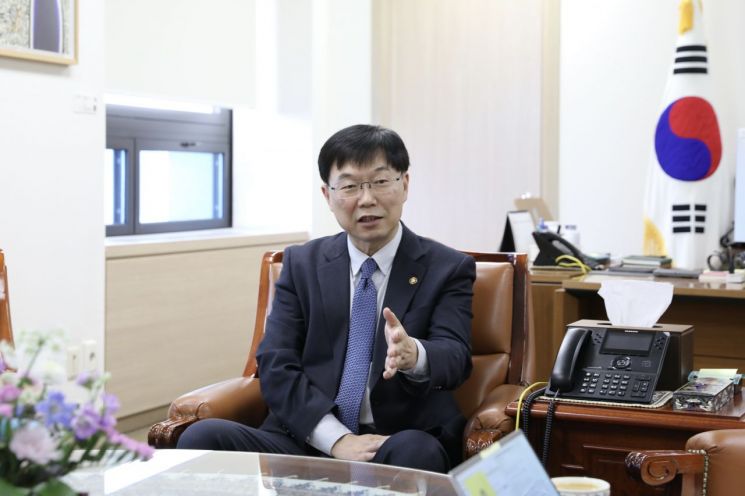 An Hyungjun, Director of the National Data Office, said in an interview with The Asia Business Daily at his office in the Government Complex Daejeon on the 20th, "As the country's Chief Data Officer (CDO), I will faithfully carry out the role of establishing national data governance." National Data Office
Q. What has changed the most since the agency was elevated to an office?
Even after the upgrade, actual data policy management remains dispersed across several ministries: public data at the Ministry of the Interior and Safety, private-sector data at the Ministry of Science and ICT, and personal data at the Personal Information Protection Commission, among others. The challenge going forward is whether the National Data Office can, as a control tower, actually establish an effective governance framework. To this end, we are pushing for the enactment of the National Data Framework Act and the establishment of a National Data Committee. A draft bill has been completed. It includes coordination of policies in each data domain, designation and management of nationally important data, and strengthening of data standardization and quality control. We are currently refining the draft through a research project and plan to submit it to the National Assembly around April this year, with the goal of implementing it within the year. Along with putting in place the relevant laws and systems, we will also expand the organization and personnel needed to carry out the work. Within the headquarters, we have newly established the "National Data Management Headquarters" and, at the bureau level, the "National Data Planning and Cooperation Bureau," under which we have placed the "National Data Planning and Cooperation Division" and the "AI Statistics Innovation Division." The current increase in staff is 16 people, but we plan to further expand personnel after the legal and institutional framework is in place.
Q. What will change when important data are designated and managed as "national data"?
Important data directly linked to people's lives or national security will be designated and managed separately, like a "national treasure." We are considering designating the demographic registry as the first "nationally important data." Demographic data, essentially the roster of all 50 million people living in our country, are the key data that enable linkage and integration. By attaching various statistics to this, we are providing new statistical services. The recently released comprehensive pension statistics were also created by adding pension data such as home pension, civil servant pension, and basic pension held by each ministry to existing data. We can also consider designating data held by private companies in areas such as credit cards and telecommunications as nationally important data. We plan to impose strong obligations to prevent the loss or destruction of nationally important data. To support this, we are also reviewing the introduction of various incentives.
Q. As CDO, what are your priority projects?
There are currently about 1,300 types of official statistics produced in Korea. Today's generative AI, based on large language models (LLMs), is good at reading text, but its ability to interpret statistical figures and tables is weak. It generates answers using secondary sources such as news articles and blogs instead of official statistics, which can lead to inaccurate results. Such hallucinations are a major risk factor that undermines trust in statistics. This is also a common challenge facing statistical authorities around the world in the AI era. To overcome this limitation, the National Data Office is building a metadata system. By 2028, we expect AI to be able to directly query official statistical databases and provide accurate answers.
Q. Are there any new statistics to be introduced this year?
We plan to further advance the measurement of the value of unpaid household work that is not included in gross domestic product (GDP). Since 2018, we have been measuring the value of unpaid household work, including house management and caregiving, and this time we will add the "National Time Transfer Account," which shows the intergenerational transfer of this unpaid household work. We plan to have it approved as national statistics in June. We are also working to measure new forms of employment in digital platform work (such as food delivery or Kakao Taxi), whose share and social relevance have recently increased significantly.
Q. You are launching the world's first survey on "AI utilization" targeting companies.
For the Economic Census to be conducted in June this year on business establishments, we have newly added survey items on AI utilization, smart factory operations, and robot activities. This is to capture recent changes in the industrial ecosystem, such as the AI transformation (AX), and to use the findings to support policy. It will be the first survey that can objectively determine how much companies are using AI in their work. Korea is the first country to conduct a national-level survey on AI utilization. In addition, to improve the accuracy of the statistics, we plan to introduce AI technologies throughout the survey process, including industry classification, call center operations, and public outreach.
© The Asia Business Daily(www.asiae.co.kr). All rights reserved.
![Clutching a Stolen Dior Bag, Saying "I Hate Being Poor but Real"... The Grotesque Con of a "Human Knockoff" [Slate]](https://cwcontent.asiae.co.kr/asiaresize/183/2026021902243444107_1771435474.jpg)















