Transition to Residence, Care, Jobs, and Diversity
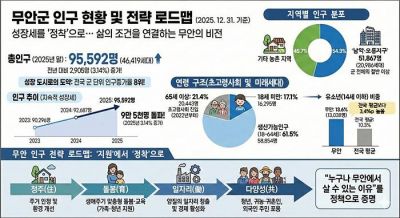 Muan-gun, promoting stable population growth through its 100,000-population strategy. Provided by Muan-gun.
Despite the nationwide trend of population decline, Muan-gun in South Jeolla Province is moving to fully implement a residential innovation roadmap in order to turn the population growth that pushed its population past 95,000 by the end of 2025 into a firmly established trend.
The county announced that it will integrate housing, care, jobs, and diversity into a single strategy to transform itself into a "population growth city" and pursue mid- to long-term policies aimed at ushering in the era of a 100,000 population.
According to the county, as of the end of December 2025, the population stood at 95,592 people (46,419 households), an increase of 2,905 people (3.14%) compared with 2024. The Namak and Oryong districts had a combined population of 51,867 people (20,986 households), accounting for more than half of the county's total and establishing themselves as the central axis of growth.
The age structure was 16,295 people (17.1%) under 18, 13,038 youths (13.6%) aged 14 or younger, and 20,443 seniors (21.4%) aged 65 or older. Although the proportion of elderly residents exceeded 20%, placing Muan-gun in South Jeolla Province in a super-aged society since 2022, the share of youths is 3.4 percentage points higher than the national average of 10.3%, which is seen as confirmation of a solid foundation for families and children.
To shift this trend from being centered on "in-migration" to being centered on "settlement," the county presented "residence-care-jobs-diversity" as the core keywords of its population strategy. The plan is to organically link life conditions such as childbirth, childrearing, education, housing, transportation, and culture to create a structure in which people "come, stay, and settle down."
The county will expand its 2026 policies based on the achievements of 2025. Birth basic income was applied for and paid to 566 children in 2025, and 168 households benefited from housing support for newlyweds and families with multiple children. In-migration incentives were paid to 6,530 new residents (including 23 military service members and 319 university students), and, through address-change support and promotional activities, relocation grants and welcome packages were provided to a total of 6,875 people.
In 2026, the policy scope will be broadened from "Muan, a good place to raise children" to "Muan, where families stay." Birth basic income will provide 200,000 won per month (100,000 won in cash and 100,000 won in local currency) to children aged 1 to 18, and about 2.2 billion won has been budgeted for 2026 for approximately 583 children born in 2024 and about 580 children born in 2025. In the housing sector, the county will continue support for housing stability for newlyweds and families with multiple children, as well as interest support for jeonse (lump-sum deposit lease) loans, with plans to implement a total program of 699 million won for 268 households in 2026.
The county will also work in parallel to expand urban infrastructure as another pillar of its population policy. It will strengthen its job base by creating an RE100-based distributed energy specialized industrial complex and seeking its designation as a national industrial complex, as well as by establishing a K-food convergence industrial complex and attracting anchor companies. As part of residential infrastructure, it will promote the construction of the Juksan IC, the groundbreaking of the Oryong Complex Cultural Center, and the establishment of the Youth Vision Center for western South Jeolla Province. In terms of educational infrastructure, it plans to build the Muan Public Library and open Muan Sarang Kindergarten, Muan Sarang Elementary School, and Muan Hope Middle School in March 2026, followed by the opening of Muan Hope Elementary School in September 2026.
Youth policy will shift from "support" to "growth linkage." Muan-gun in South Jeolla Province will strengthen its youth challenge support program to provide counseling, life management, and customized programs, and has designed it to lead to employment and entrepreneurship by linking with local companies and institutions. It will also expand the base for startups by operating eight youth commercial spaces, providing startup activity support for 15 young entrepreneurs, and running general and specialized labs in a makerspace.
Return-to-farming and return-to-rural policies will focus on "settlement after trial stays." In 2025, the Return-to-Farming and Return-to-Rural Support Center conducted 227 counseling sessions and participated in four fairs, achieving 242 counseling cases in total. In 2026, the county plans to strengthen a settlement package that bundles housing, work, relationships, education, and follow-up management by operating stay-type return-to-farming houses, expanding the "Experience Life in Jeonnam" program, creating Harmony Villages, and supporting the activation of outstanding startups.
Policies for foreign residents will place emphasis on helping them settle not just as a labor force but as members of the local community. The concept is to expand adaptation to daily life, protection of rights and interests, and participation in the local community through operating a county administration monitoring group, providing settlement support, offering Korean language and Korean culture education, and running mobile counseling services and safe escort services.
Looking beyond one-year projects, the county will establish the "Second Basic Population Policy Plan of Muan-gun (2026-2030)" to comprehensively diagnose its population structure, daytime and nighttime population, and residential conditions, and to develop it into an actionable plan that includes performance indicators (KPIs), a monitoring system, funding and investment priorities, and public-private governance.
Muan County Governor Kim San said, "Population policy is not limited to support for childbirth and childrearing; it only becomes effective when housing, jobs, education, care, transportation, residential environment, and everyday administration are organically connected." He added, "We will open the era of 'Muan with a population of 100,000' by simultaneously achieving the growth of the new town and the revitalization of towns and townships, expanding diverse settlement models in which young people and returnees to farming and rural areas put down roots and foreign residents become our neighbors."
© The Asia Business Daily(www.asiae.co.kr). All rights reserved.
![Clutching a Stolen Dior Bag, Saying "I Hate Being Poor but Real"... The Grotesque Con of a "Human Knockoff" [Slate]](https://cwcontent.asiae.co.kr/asiaresize/183/2026021902243444107_1771435474.jpg)















