Tourism revenue down 1.2 billion dollars (1.7 trillion won)
Protests spread amid surge in ICE deportations and arrests
Government rebuts: "No link between economic slowdown and immigration crackdown"
There are growing claims that the Donald Trump administration's hard-line immigration crackdown is hurting the U.S. service industry. Labor groups point out that labor shortages and a decline in tourism revenue are already becoming a reality, while the government is pushing back, denying any link between enforcement actions and the broader economic situation.
The British daily The Guardian reported on the 18th (local time), citing a report by the U.S.-Canada service workers' union UNITE HERE, that from December 2024 to December 2025 the number of workers in service sectors such as food service and tourism fell by about 98,000. In particular, the union estimated that from September 2024 to September 2025 U.S. tourism revenue decreased by about 1.2 billion dollars (approximately 1.7 trillion won).
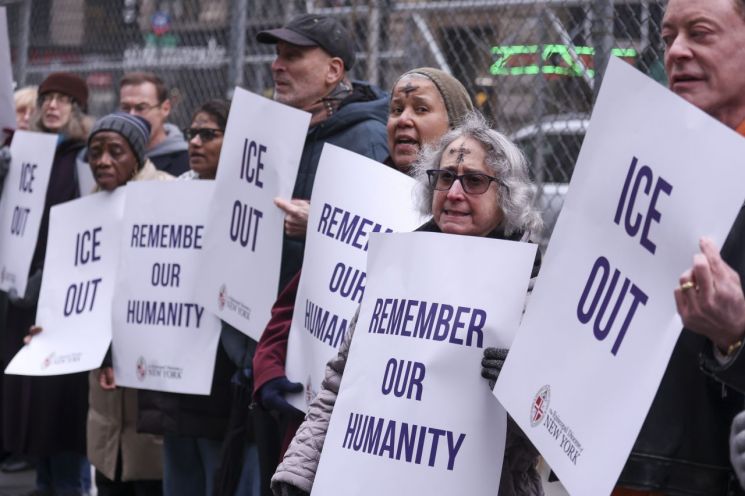 The expansion of activities by ICE (U.S. Immigration and Customs Enforcement), which is responsible for immigration enforcement, is also at the center of controversy. Over the past year, arrests and deportations have increased, and critics say even immigrants without criminal records have been targeted. EPA Yonhap News
The service industry is a sector with a high dependence on immigrant labor. Industry estimates suggest that about one-third of workers are immigrants. On the ground, there are growing reports of workers avoiding coming to work since enforcement has been stepped up, and this is said to be worsening labor shortages. Some hotels and restaurants also testify that the number of job applicants has fallen, making it difficult to operate.
Amid this, signs of a downturn in the tourism industry are also emerging. The number of tourists visiting the United States last year was tallied as having decreased by about 2.5 million from the previous year. In Washington, D.C., restaurant closures in 2025 reportedly hit an all-time high, while new openings fell by around 30%. Minnesota has likewise seen international air passengers drop by about 15% due to a decline in Canadian tourists, and analysts say local small businesses have suffered revenue losses amounting to tens of millions of dollars.
The expansion of activities by Immigration and Customs Enforcement (ICE), which is responsible for immigration enforcement, is also at the center of controversy. According to The Guardian and other outlets, over the past year the number of arrests and deportations has increased, and critics say immigrants with no criminal record have been included among those targeted. In some areas, there has also been an outcry over what is seen as excessive enforcement tactics and pressure to meet performance targets. The administration, however, maintains that the top priority is public safety through deporting criminals and strengthening law enforcement.
The Department of Homeland Security (DHS) countered that "if there were a correlation between illegal immigration and economic boom, the economy would have been stronger under the previous administration," rejecting the idea of a direct link between enforcement actions and economic slowdown. DHS further stressed that "cracking down on criminals makes communities safer and has a positive impact on the economy." While labor groups argue that hard-line immigration policies and an anti-immigrant climate are leading to a decline in both domestic and international tourists, the government is drawing a clear line against analyses that say tougher law enforcement is hurting the economy, suggesting the debate will continue for some time.
© The Asia Business Daily(www.asiae.co.kr). All rights reserved.
![Clutching a Stolen Dior Bag, Saying "I Hate Being Poor but Real"... The Grotesque Con of a "Human Knockoff" [Slate]](https://cwcontent.asiae.co.kr/asiaresize/183/2026021902243444107_1771435474.jpg)















