Korea Institute for Health and Social Affairs Report
16% for High School or Below, 47% for University Graduates
The higher a mother's level of education, the higher her likelihood of using parental leave and the longer she tends to take it.
On February 17, the Korea Institute for Health and Social Affairs released a report titled "Recent Trends in Marriage and Childbirth and Their Determinants," which analyzed data from the "2024 Family and Fertility Survey." The survey examined the use of work-family balance policies among 3,292 women who had given birth (9,479 cases), and the analysis produced these findings.
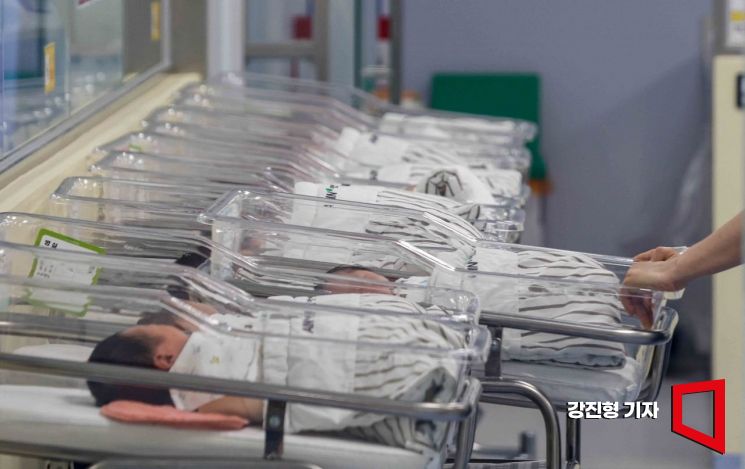
According to the report, among 3,216 cases where the women were eligible to use the parental leave system at the time of childbirth, 40.7% actually took parental leave. Their average leave duration was 12.5 months. When parental leave utilization was broken down by the mother's education level, 16.0% of those with a high school diploma or less, 46.9% of university graduates, and 57.6% of those with a graduate degree or higher used parental leave, indicating that parental leave utilization increases as the level of education rises.
Leave duration also increased with education level: women with a high school diploma or less used 10.4 months of leave on average, university graduates used 12.6 months, and those with a graduate degree or higher used 13.8 months.
Regarding intentions to have additional children, the analysis focused on 669 married women whose first child was under 10 years old (women whose first child was born in 2015 or later. Among women aged 19 to 34, about half said they intended to have another child, whereas only about 27% of those aged 35 to 39 and about 10% of those aged 40 or older expressed an intention to have more children. By current employment status, 32.2% of non-employed women and 24.6% of employed women intended to have another child. By the sex of the child, 27.9% of women whose first child was a boy and 29.3% of those whose first child was a girl intended to have another child, indicating no meaningful relationship between the first child’s sex and intentions for additional childbirth.
When the analysis was limited to 321 women who were currently employed, 24.6% said they intended to have another child. By employment type, 27.7% of regular employees and 18.2% of daily workers expressed such intentions, showing a large gap depending on employment status.
With respect to income, intentions for additional childbirth were highest in the third income quintile, which corresponds to the middle-income group, at 37.0%. This was followed by the fourth quintile (25.3%), the second quintile (22.4%), the fifth quintile (21.6%), and the first quintile (20.6%), forming an "inverse U-shape" pattern. However, the differences among groups were not statistically significant.
Examining the relationship between the use of work-family balance policies after childbirth and intentions for additional childbirth, 26.9% of women who used parental leave said they intended to have another child, compared with 27.6% of those who did not use parental leave. However, regression analysis (a statistical method used to estimate relationships between variables) indicated that using parental leave had a more positive impact on intentions for additional childbirth than not using it.
The research team stated, "There is a need to establish systems that provide concrete support for household income and caregiving during the period when parental leave is being used," adding, "It is also necessary to improve labor market flexibility so that job security upon returning to work and work-life balance can be ensured."
© The Asia Business Daily(www.asiae.co.kr). All rights reserved.
![Clutching a Stolen Dior Bag, Saying "I Hate Being Poor but Real"... The Grotesque Con of a "Human Knockoff" [Slate]](https://cwcontent.asiae.co.kr/asiaresize/183/2026021902243444107_1771435474.jpg)















