Pushing to Exclude Not Only Policy Finance but Also Private Mid-Interest-Rate Loans from Banks' Performance Management
Preventing a Contraction in Lending to Mid- and Low-Credit Borrowers... Strengthening the Inclusive Finance Stance
While tightening the reins on household loan management in the banking sector this year, the financial authorities are pushing a plan to exclude loans to mid- and low-credit borrowers from the overall volume regulations. The intention is to maintain the policy stance of managing the total volume of household loans for real estate market stability, while strengthening "inclusive finance" policies so that vulnerable borrowers' access to funds does not shrink abruptly.
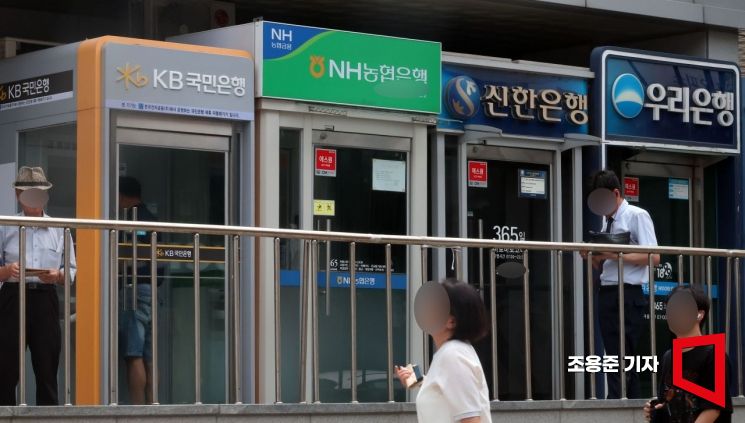 Citizens are passing in front of a commercial bank ATM installed on a street in central Seoul. Photo by Jo Yongjun
According to the financial authorities on the 17th, the Financial Services Commission (FSC) is reviewing a plan, ahead of next week's announcement of household debt management measures, to manage the growth rate of household loans at banks this year at a level even lower than last year's 1.8%, while excluding private mid-interest-rate loan products from the performance management targets for household lending.
An official from the financial authorities said, "There are mid-interest-rate loan products among private financial products that are not policy finance products," adding, "We are discussing ways to grant incentives even for products that are not directly linked to policy finance." The official went on to explain, "We are fine-tuning the details, such as whether to exclude these products entirely from the calculation of each bank's household loan management performance, or to exclude only a certain percentage."
Since introducing the total volume regulation on household loans, the government has set an annual household loan growth ceiling for each individual bank every year. This year, it is considering a plan to exclude private mid-interest-rate loan products from the targets used to calculate this ceiling. From the standpoint of financial institutions, even if they increase the volume of such products, it will not be reflected in the total volume limit, creating an incentive to handle them more actively.
Last year, the financial authorities excluded policy finance products for low-income households, such as Sae-Hope Stepping Stone Loans, Saitdol Loans, and Didimdol and Bogeumjari-type loans, from banks' household loan performance management targets. This year, the authorities plan to expand the scope of exceptions beyond policy finance to include private mid-interest-rate loans as well. This is a measure to prevent access to credit for mid- and low-credit borrowers from deteriorating excessively under the policy stance of curbing household loan growth.
Previously, on January 28, Financial Services Commission Vice Chairman Lee Eokwon stated, "We will ensure that the supply of funds to mid- and low-credit borrowers is not curtailed by excluding products such as Sae-Hope Stepping Stone Loans and mid-interest-rate loans to a certain extent from the management targets."
This move by the government is intertwined with the situation in which the lending threshold at commercial banks is rising due to the tightening of household loan regulations. According to the Korea Federation of Banks, the average credit score of household loan borrowers newly handled in December last year by the five major banks - KB Kookmin Bank, Shinhan Bank, Hana Bank, Woori Bank, and NH Nonghyup Bank - was between 940 and 950 points. This is a steady increase compared with 927 to 939 points in December 2024 and 923 to 933 points in December 2023.
On a 1,000-point scale, borrowers with scores of 950 points or higher are classified as ultra-high-credit, and those with 900 points or higher as high-credit. This effectively means that bank lending is centered on ultra-high-credit borrowers. Concerns are being raised that if high-credit borrowers in the 900-point range find it difficult to obtain loans from first-tier banks and move to second-tier financial institutions, access to funds for mid- and low-credit borrowers with scores in the 800-point range or below could worsen even further.
Another official from the financial authorities said, "This year's household debt management plan will further strengthen the safeguards to ensure that loans to mid- and low-credit borrowers are not squeezed," adding, "The specific details will be finalized in the measures to be announced at the end of this month."
© The Asia Business Daily(www.asiae.co.kr). All rights reserved.
![Clutching a Stolen Dior Bag, Saying "I Hate Being Poor but Real"... The Grotesque Con of a "Human Knockoff" [Slate]](https://cwcontent.asiae.co.kr/asiaresize/183/2026021902243444107_1771435474.jpg)















