Triple safeguards: 5,000-won cap and weekday-only purchases
Some retailers urge halt to mobile sales, citing "threat to livelihood"
Plan to prepare countermeasures after studying purchasing behavior of 3,000 users
It has been one week since mobile sales of Lotto tickets began. Twenty-four years after its launch in 2002, Lotto has finally entered smartphones, improving consumer convenience while also having to solve the difficult tasks of protecting the sales rights of vulnerable groups and achieving coexistence with offline retailers. The government plans to conduct a detailed analysis of any sales impact on existing retailers caused by the introduction of mobile sales and to announce support measures in the second half of this year.
"Enhancing convenience while coexisting with retailers"... Cautious approach to expanding mobile sales
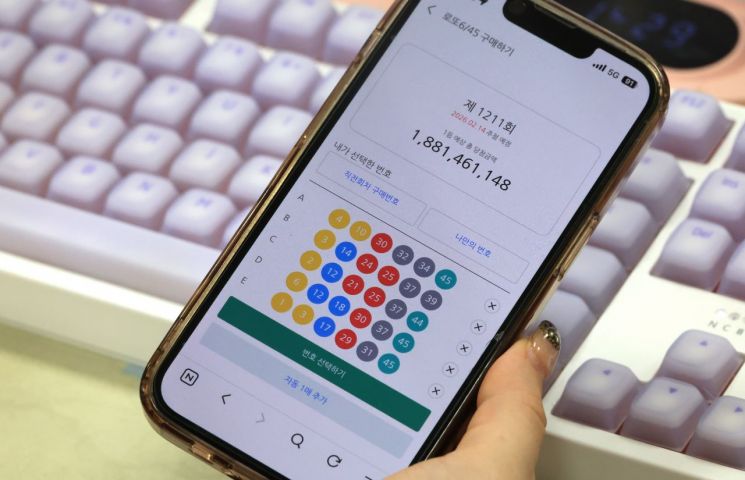
Lee Yonguk, Secretary General of the Lottery Commission at the Ministry of Strategy and Budget, who recently announced the plan to sell Lotto via mobile, made it clear that the core of this reform is not simply improving convenience but achieving "coexistence." When the Lottery Act was enacted, Lotto sales rights were preferentially granted to socially disadvantaged groups such as people with disabilities and low-income earners. This has provided the legal foundation for the lottery business to go beyond being a simple gambling industry and to realize the value of sharing.
This is also why the government, while allowing mobile sales, has imposed strict restrictions such as limiting purchases to weekdays, capping purchases at 5,000 won per draw, and restricting online sales (including PC) to 5% of the previous year's sales. The rule has changed from "up to 5,000 won per person per draw via PC" to "up to 5,000 won per person per draw via PC and mobile combined," meaning that the total amount that can be purchased online has not actually increased.
However, some offline retailers are protesting the very introduction of mobile sales. They have sent a formal request to the Lottery Commission calling for a halt to mobile sales and have also posted petitions on online petition sites asking for a reconsideration. They argue that, in the long run, this could undermine the right of retailers to make a living.
Lee stated, "The biggest obstacle is that expanding mobile sales may reduce offline sales," adding, "Improving convenience for buyers is important, but because it is essential to take into account the retailers who have supported the lottery industry for 20 years, we will proceed gradually."
In-depth empirical analysis of 3,000 users... "Immediate support measures if retailer sales decline"
The government will treat the pilot operation period in the first half of the year as a period for securing empirical data. It plans to closely track changes in online and offline purchasing patterns among about 3,000 users to analyze whether mobile sales create new demand or instead take away sales from existing retailers.
In particular, retailers who have been in business for less than five years, whose profit base is relatively weak due to their early stage of operation, and low-sales outlets whose revenue falls below the average will be key subjects of the study. If the empirical analysis confirms a decline in sales, the government plans to finalize support measures for retailers in time for the full-scale launch of "mobile Lotto" in the second half of the year. Lee added, "We will rigorously verify whether offline purchase demand shifts to online," and said, "Only when countermeasures are prepared to address any decline in retailer sales will full-scale expansion be possible."
However, the government is taking a cautious stance on the issue of raising commission rates, which is the most sensitive matter for retailers. This is because the mere mention of commissions immediately sparks controversy. Currently, the Lotto sales commission rate is 5.5% of the sales amount (including 0.5% value-added tax). When a retailer sells one Lotto game priced at 1,000 won, it earns 55 won in commission income before tax.
© The Asia Business Daily(www.asiae.co.kr). All rights reserved.
![Clutching a Stolen Dior Bag, Saying "I Hate Being Poor but Real"... The Grotesque Con of a "Human Knockoff" [Slate]](https://cwcontent.asiae.co.kr/asiaresize/183/2026021902243444107_1771435474.jpg)
















