"Enrollment increases without scientific verification will destroy the educational field"
"Once students on leave return, education will already be impossible...capacity must be verified"
"It is like putting 400 people on a boat with a capacity of 100."
Medical school professors across the country have warned that the government's decision to increase medical school enrollment is "a one-sided policy push that will seriously undermine the quality of medical education."
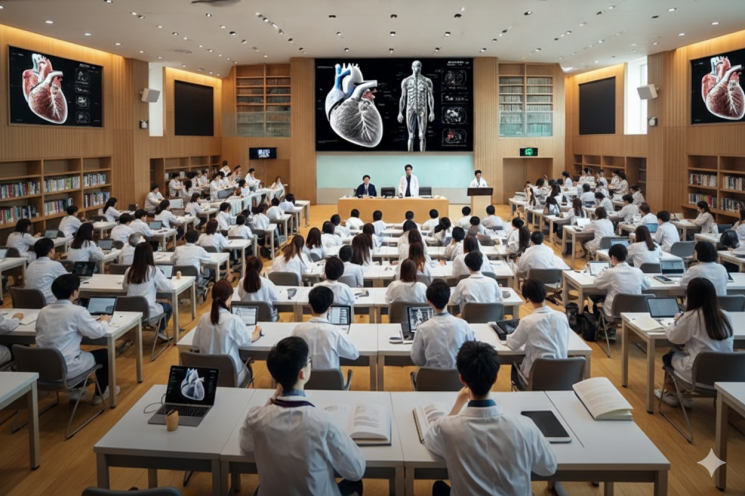
The National Association of Medical School Professors held a press conference on the 13th at Korea University Law School in Seongbuk-gu, Seoul, to assess the crisis facing medical education on the ground and to present essential preconditions for training high-quality physicians.
The first thing they demanded was rigorous verification before discussing any increase in enrollment. Jo Yoonjung, chair of the National Association of Medical School Professors and a professor in the Department of Laboratory Medicine at Korea University Anam Hospital, argued, "Data verifying the capacity for education and training based on year-by-year scenarios for 2027, 2031, and so on must be released first." The government relied on projections by the Medical Workforce Projection Committee and convened the Health and Medical Policy Deliberation Committee several times to decide on the scale of the increase. However, she said the government should have first scientifically verified whether actual universities and hospitals can educate additional students, not just focused on a particular number, and then made its decision.
Jo went on to compare the current steep enrollment hike to an "overloaded ship" operating beyond its loading capacity. She noted that medical education is not something that can be done with just a blackboard and chalk; it requires a wide variety of patient groups and an affiliated hospital with at least 500 beds. Taking this into account, she estimated that the current capacity of teaching hospitals in Korea is about 3,200 residents per year. At this rate, by 2031, when the expanded cohort graduates next year, roughly 6,000 graduates will flood the system, and there will be virtually no hospital infrastructure to accommodate them, making poor-quality training inevitable.
Jo said, "If we take into account about 749 students currently on leave who are expected to return next year, the educational environment is already overcrowded even without any additional increase in enrollment," adding, "Meanwhile, at some national universities, there are medical schools where only one or two professors remain in essential medical departments, making normal education impossible."
She continued, "If the boat called medical school sinks under excessive load, patient safety will be affected immediately," and added, "If ensuring the quality of education is the guiding principle for deliberation, then systematic verification is necessary to uphold that principle." She criticized the government by saying, "There is a saying that a little knowledge is a dangerous thing, and now there are so many people trying to steer the boat that it has ended up on the top of the Himalayas," and "The government officials who designed this policy are truly bold."
Regarding the view in some quarters that "we only need to be ready before the increased number of medical students move up to the clinical years," Jo dismissed it as "an absurd idea that ignores reality on the ground." She explained that medical education is a continuous learning process linked to hospitals starting from the first year of the premedical course, and that it requires enormous resources and time, with as many as 20 professors sometimes involved in a single teaching session.
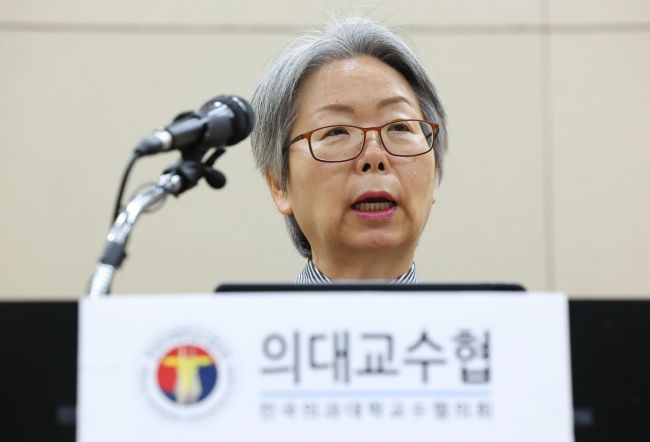 Cho Yoonjung, chair of the National Association of Medical School Professors, is speaking at a press conference held at Korea University School of Law in Seongbuk-gu, Seoul, on the 13th. Yonhap News
Enrollment hikes at regional medical schools could lead to 'polarization in physician training'
They also pointed out that the current increase in medical school enrollment is a measure whose effects will only be seen 10 years from now. Lee Deokhwan, emeritus professor of chemistry and science communication at Sogang University and an advisor to the association, said, "To citizens mired in the muddy waters of collapsing regional and essential medical services, the government is effectively saying, 'If you can just stay alive for 10 years, the students now entering medical school will fix things for you,'" and criticized, "Medical schools in the Seoul area, where educational conditions are good, were excluded from the enrollment increase, while the 'enrollment bomb' was dropped on regional medical schools whose facilities and personnel are inadequate." He further warned, "Ten years from now, we could see the tragedy of patients desperately seeking out only doctors from certain universities whose quality of education is guaranteed."
He said, "If you look at the average annual increase of 668 students, we would need to build six more tertiary hospitals the size of Seoul National University Hospital just to train the additional doctors," and added, "It costs about 700 billion won to build one hospital, and that is a scale our society cannot absorb." He argued, "To revive the currently collapsed essential medical services, we must first implement immediately actionable measures such as normalizing medical fees, easing legal burdens, and improving the medical delivery system."
Jo emphasized, "Ensuring the quality of education depends on who the actual trainees are and on the teaching competence of those who will educate them, and we must also examine whether there are concrete plans for lectures and practical training, and whether the capacity for patient-contact education and clinical training is secured," adding, "If these four conditions are not verified, it is difficult to use 'ensuring educational quality' as the basis for policy."
© The Asia Business Daily(www.asiae.co.kr). All rights reserved.
![Clutching a Stolen Dior Bag, Saying "I Hate Being Poor but Real"... The Grotesque Con of a "Human Knockoff" [Slate]](https://cwcontent.asiae.co.kr/asiaresize/183/2026021902243444107_1771435474.jpg)
















