Admissions industry forecasts dualized medical school cutoffs
Potential benefits also seen for high schools outside the capital region
Jeju: 2.5 medical school admits per high school
With the government deciding to increase medical school enrollment quotas, attention is focusing on how this will reshape the college admissions landscape. As in 2025, when medical school quotas were previously expanded, it is expected that the number of so-called "N-time test takers" (students retaking the college entrance exam multiple times) will increase, and that in non-capital regions eligible for the newly established "regional doctor system," a dual-track strategy may emerge.
◆ "This year, N-time test takers likely to exceed 160,000"
According to the Ministry of Health and Welfare and the Ministry of Education, from the 2027 to the 2031 academic year, medical school quotas will increase by an annual average of 668 students. In the first year, the 2027 academic year, the medical school quota will be 3,548 students, an increase of 490 from the existing 3,058. In the 2028 and 2029 academic years, the additional quota will rise to 613, bringing the annual intake to 3,671 students. In the 2030 and 2031 academic years, when a public medical school (100 students) and a regional medical school (100 students) are established, the quota will be expanded by 813 students each year, and the total medical school quota is expected to reach 3,871.
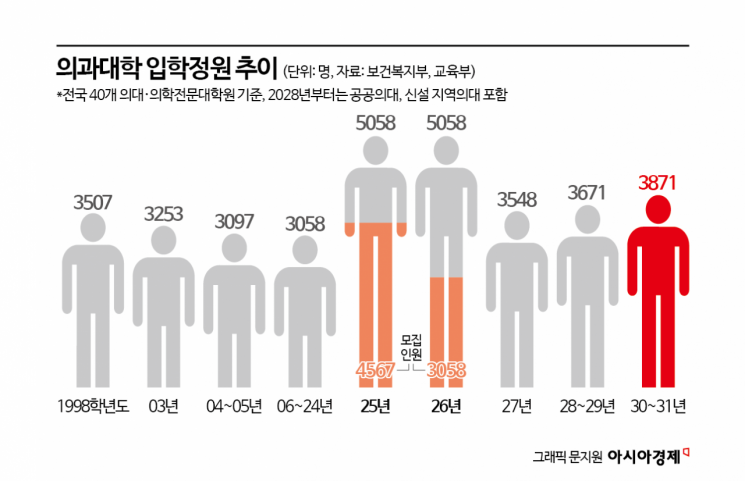
The admissions industry expects the number of N-time test takers this year to reach more than 160,000.
First, starting with the 2028 academic year college admissions cycle, school records will be evaluated on a 5-grade scale and the College Scholastic Ability Test (CSAT) will be integrated, so students regard this year's CSAT as "the last exam to be administered under the current CSAT system." Because of this, there is no other choice but for N-time test takers to flock to this year's exam. In addition, this year's repeat test takers were born in 2007, a year with an exceptionally high birth rate (the so-called Year of the Golden Pig), which structurally drives up the number of N-time test takers. Due to the previous CSAT being considered unusually difficult, the number of students who failed to gain admission through regular admissions increased by 6.9% compared with the previous year.
On top of this, with the increase in medical school quotas, the number of N-time test takers who are retaking the exam for a second year or more is expected to easily surpass last year's 159,922. As top-tier students shift toward applying to medical schools, students in general natural science tracks may also attempt to "switch universities."
There are also projections that the admission cutoff for medical schools will fall. Since the scale of the 2027 academic year medical school quota increase exceeds 27% of Seoul National University's natural sciences intake, it is believed that the impact on admissions will be significant. Some regional universities are expected to see applicants with a school record average as low as 4.7 still fall within the acceptance range. In the 2025 academic year, when medical school quotas were previously expanded, the admission cutoff for successful applicants to medical schools fell by 0.3 of a grade, and in the Gangwon region, the cutoff for regional talent admissions dropped into the 4th-grade range on school records.
As a result, it is expected that medical school cutoffs will become dualized, and that demand will grow for niche strategies that leverage structures favoring regional talent. Lee Manki, head of the Uway Education Evaluation Research Institute, said, "In the general admissions track, competition among the very top-tier students will continue, while in the regional doctor system, there is a possibility that a relatively different cutoff line will form," adding, "We may see a dual structure in admission cutoffs." He also analyzed, "Considering the number of test takers, it appears advantageous to apply through the regional doctor selection track in almost all regions, including the Gangwon area."
◆ With the introduction of the "regional doctor system," Jeju > Gangwon > Chungcheong among key beneficiaries... In Jeju, medical school admissions per high school to rise from 1.0 to 2.5
There is also analysis that in high schools located in regions where the regional doctor system is applied, the average number of successful medical school applicants per school could increase by up to about twofold.
Jongno Hagwon analyzed 1,112 high schools nationwide that fall under the regional doctor system and concluded that the system would make it most advantageous to gain admission to medical schools in Jeju.
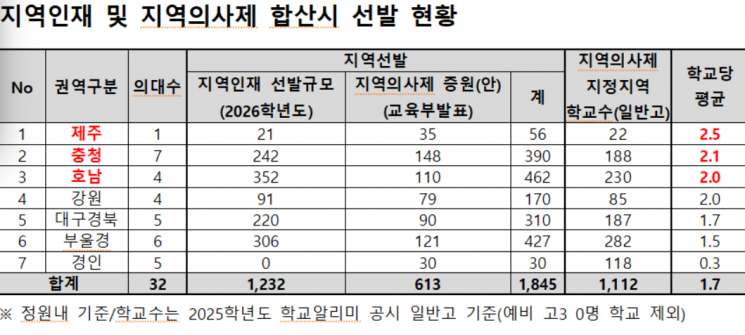
At the medical school located in Jeju (Jeju National University), based on the 2026 academic year, a total of 21 students were selected through the "regional talent admissions track" from 22 high schools. Going forward, if 35 additional students are selected each year through the "regional doctor admissions track," the total will rise to 56 students. This means the number of successful medical school applicants per high school in Jeju will increase from the current 1.0 to 2.5.
In Gangwon (which has four medical schools), the average number of medical students selected per high school will increase by 0.9, from 1.1 to 2.0, making it the second-largest beneficiary after Jeju. It is followed by Chungcheong (from 1.3 to 2.1), Daegu and North Gyeongsang (from 1.2 to 1.7), Honam (from 1.5 to 2.0), Busan, Ulsan, and South Gyeongsang (from 1.1 to 1.5), and the Gyeongin area (from 0 to 0.3).
Im Seongho, head of Jongno Hagwon, said, "With the introduction of the regional doctor system, regional advantages and disadvantages have become greater than before," adding, "Depending on the extent of that gap, the range of fluctuations in admission cutoffs at each university could also widen."
© The Asia Business Daily(www.asiae.co.kr). All rights reserved.
![Clutching a Stolen Dior Bag, Saying "I Hate Being Poor but Real"... The Grotesque Con of a "Human Knockoff" [Slate]](https://cwcontent.asiae.co.kr/asiaresize/183/2026021902243444107_1771435474.jpg)
















