42-Page Roadmap for Rebuilding Unveiled
150 Billion Dollars in Dedicated Shipbuilding Investment Secured
Ongoing Commitment to Cooperation with South Korea and Japan...Hints at "Bridge Strategy"
The administration of U.S. President Donald Trump has announced a comprehensive action plan to rebuild the country’s shipbuilding industry and has formalized its intention to cooperate with South Korea and Japan.
On the 13th (local time), the White House released a 42-page document titled the "U.S. Maritime Action Plan" under the names of Secretary of State and National Security Advisor Marco Rubio and Office of Management and Budget (OMB) Director Russell Vought. The plan states that it will continue cooperation with South Korea and Japan to revitalize shipbuilding, saying it will "reduce dependence on unreliable suppliers" through cooperation with allies and partners.
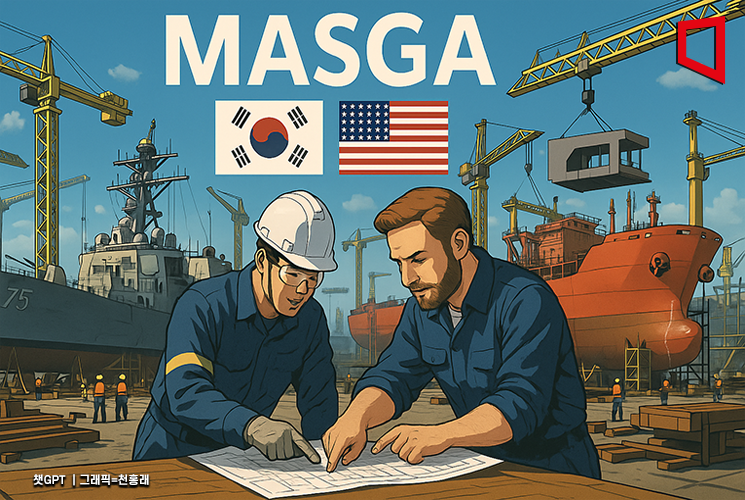
The White House stated that it has so far secured at least 150 billion dollars (about 217 trillion won) in dedicated investment for the U.S. shipbuilding industry. This is interpreted as referring to the 150 billion-dollar shipbuilding package, the so-called "MASGA (Make American Shipbuilding Great Again) Project," which is part of the 350 billion dollars in investment in the United States that South Korea pledged under last year’s Korea-U.S. trade agreement. The Department of Commerce said it would use this fund to push ahead with "the largest investment in the history of U.S. shipbuilding."
The plan also contains concepts for cooperation with foreign shipbuilders. It proposes a "Bridge Strategy" under which overseas shipbuilders that have signed ship sales contracts with the United States will invest capital and build a production base in the United States by acquiring U.S. shipyards or forming partnerships with local companies, and until such a U.S. production base is established, will build part of the contracted volume in their home countries. However, under the Jones Act, enacted in 1920, vessels engaged in port-to-port transportation within the United States must meet the requirements of "U.S.-built, U.S.-flagged, and U.S.-owned," so how these institutional barriers will be adjusted is seen as a key variable.
The action plan also recommends imposing a universal port entry fee on foreign-built commercial vessels. It estimates that imposing 1 cent per kilogram of cargo weight would raise about 66 billion dollars over 10 years, and imposing 25 cents would raise about 1.5 trillion dollars. The idea is to use this as a funding source for a "Maritime Security Trust Fund."
In addition, the plan includes measures for an overall restructuring of the industry, such as: the establishment of "Maritime Prosperity Zones" specialized in shipbuilding and marine industries; an overhaul of education and training systems for shipbuilding personnel; and the expansion of the U.S.-built and U.S.-flagged merchant fleet.
As the United States emphasizes cooperation with allies while at the same time clearly pursuing a strategy of expanding its domestic production and employment base, the South Korean shipbuilding industry is expected to face both increased investment opportunities and rising regulatory and institutional risks.
© The Asia Business Daily(www.asiae.co.kr). All rights reserved.
![Clutching a Stolen Dior Bag, Saying "I Hate Being Poor but Real"... The Grotesque Con of a "Human Knockoff" [Slate]](https://cwcontent.asiae.co.kr/asiaresize/183/2026021902243444107_1771435474.jpg)
















