490 Candidates Elected Uncontested in 2022
In Seoul, 21.4% Chosen Without a Vote
Criticism Mounts Over Seat-Sharing by the Two Major Parties
"The problem of uncontested elections is a kind of collusion among political parties. It takes away residents' right to vote."
The political community is watching closely to see whether the "uncontested election fiasco" will be repeated in this year's June 3 local elections. An uncontested election refers to a situation in which, if the number of candidates does not exceed the number of seats to be filled, or if there is only one candidate, no voting is held and that candidate is declared elected on election day. In other words, if only as many candidates run as there are seats to be filled, they are elected without going through an election.
In the 2022 local elections (the 8th), 490 candidates were elected without a vote. In the 7th local elections, there were only 89 uncontested winners, but the number surged. In some precincts, the number of ballot papers differed from other areas, and this was due to uncontested elections. In ordinary local elections, voters usually cast seven ballots, but in the case of uncontested elections, there are no ballot papers. In fact, voters in the 1st constituency of Jung-gu, Daegu, received only four ballot papers.
What is the problem with uncontested elections?
Uncontested elections are regarded not merely as a shortcut in the process of choosing local representatives, but as a "crisis of democracy or of the local self-government system." In a related report in 2022, the National Assembly Research Service pointed out that "if candidates are elected without voting and voters lose their opportunity to choose, this may, in the long term, lead to a loss of the voters' ability to hold their representatives accountable and deepen apathy toward elections," adding that "uncontested elections restrict both the ex ante evaluation of pledges and the ex post evaluation of policy performance through voting, and furthermore may lead to questions about the qualifications of those elected and, after their election, to a decline in the accountability of representatives."
In practice, in uncontested elections, even though there is a candidate, ballot papers, campaign posters, and campaign materials are all omitted. For local residents, even though local elections are held only once every four years, they do not know "who the candidate is" or "what pledges they are making." Even if the candidate has a criminal record or unpaid taxes, there is no way for them to find out. When there is an uncontested election, electioneering itself is prohibited during the official campaign period, so there is no need to produce campaign materials, and they cannot be produced. While this is partly a way to save on election expenses, it effectively excludes not only voters' right to vote but also their right to know who the candidates are.
Result of collusion between dominant parties in Yeongnam and Honam and the two major parties in the Seoul metropolitan area
Heo Cheolhun, Secretary General of the National Election Commission, stated at the National Assembly Special Committee on Political Reform that "I believe the frequent occurrence of uncontested elections does not conform to the basic principles of elections."
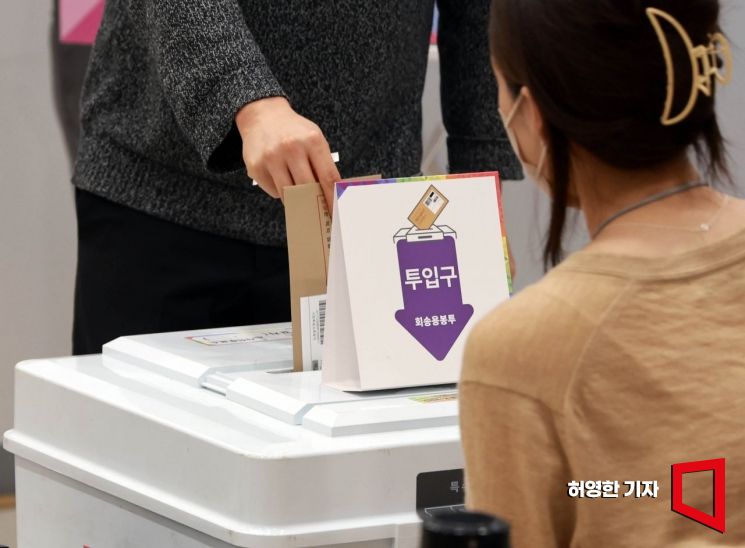 At an early voting station in Jung-gu, Seoul, a voter is placing a ballot envelope into a ballot box. Photo by Heo Younghan
Is the problem of uncontested elections simply due to a lack of people willing to step up as local representatives? The reality is different. Local councils are quite popular positions, to the extent that controversies over alleged nomination bribes have recently emerged. Nevertheless, the reason there are no challengers is the combination of a system in which a particular party monopolizes a particular region and the way the nomination and electoral systems are structured.
Although uncontested elections have usually been regarded as a problem in regions with strong regional political identities, such as Honam and Yeongnam, the situation is more complex. In the 8th local elections, Jeollabuk-do had the highest ratio of uncontested winners to total winners at 24.5%, but Seoul followed closely at 21.4%. In Seoul alone, about one-fifth of those elected in the local elections were chosen without going through a vote.
The increase in uncontested elections is the result of multiple factors.
In Yeongnam and Honam, a particular party is overwhelmingly dominant within the region, so potential candidates give up on running in the first place. Moreover, because nomination by a particular party is effectively regarded as equivalent to being elected, even independent candidates are discouraged from running. As a result, there are many cases in which candidates from the Democratic Party of Korea in Honam and candidates from the People Power Party in Yeongnam are elected without a vote.
The pattern in the Seoul metropolitan area is different. In Seoul, there were 121 uncontested winners: 2 members of the city council, 109 members of district councils, and 10 basic proportional representatives. According to an analysis by the National Assembly Research Service, "Of the 154 district council constituencies in Seoul, 98 are two-member constituencies (where two members are elected in each constituency), and 100 uncontested winners emerged in 50 of those constituencies." Uncontested elections also occurred in 3 out of 50 three-member constituencies. The Research Service explained, "In local elections, voters cast only one vote regardless of the size of the constituency, and winners are determined by their ranking in the vote count. In two-member constituencies, if a party nominates more than one candidate, uncertainty increases because votes are split among candidates from the same party. As a result, the two major parties each nominate only one candidate, and this ultimately leads to uncontested elections." In other words, after assessing the political landscape through opinion polls and other means, the two major parties effectively carved up the seats to ensure that not a single candidate from either side would lose.
Within political circles, there are concerns that election outcomes produced in this way are undermining the local self-government system. Local council members inevitably pay more attention to those who control nominations than to the voters. In addition, the composition of local councils itself shifts from being made up of people dedicated to regional development to people seeking to secure personal interests by obtaining party nominations and "taking a seat." Local councils are thus exposed to the risk of being filled with stakeholders, backed by nominators and name recognition, instead of public-minded representatives.
What needs to change?
Im Miae, a Democratic Party lawmaker serving on the National Assembly Special Committee on Political Reform, said, "In the Seoul metropolitan area, there are quite a few regional party chairs who are aware of the problem, but we cannot leave everything up to the will of regional chairs alone," adding, "We need institutional reform." In other words, to break the collusive structure, what is needed is institutional change rather than the personal resolve of a few politicians.
As for reform measures, one proposal is to abolish two-member constituencies in basic-level local elections and increase the number of constituencies that elect three or more members. Whether intended or not, to break the one-on-one race structure that parties construct to avoid losing elections, the system itself must be revised. Attorney Ha Seungsoo, who has long pointed out problems in the local election system, recently argued at a National Assembly forum that "we should consider introducing a mixed-member proportional representation system or a regional proportional representation system for metropolitan council elections." The aim is to enhance the equality of the vote and create a structure in which competition among diverse political forces is possible. This would prevent so-called "wasted votes" that emerge every election and promote competition among parties within each region.
© The Asia Business Daily(www.asiae.co.kr). All rights reserved.
![Clutching a Stolen Dior Bag, Saying "I Hate Being Poor but Real"... The Grotesque Con of a "Human Knockoff" [Slate]](https://cwcontent.asiae.co.kr/asiaresize/183/2026021902243444107_1771435474.jpg)















